
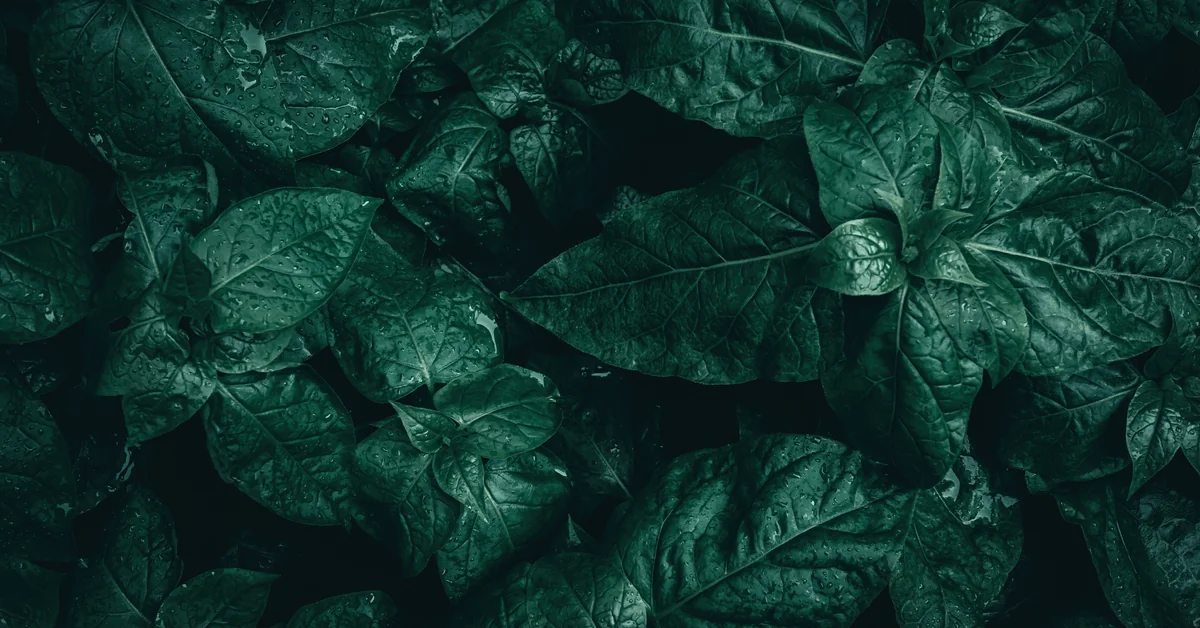
Too much nitrogen no flowers is a real, documented trade-off, not folk wisdom. Nitrogen fuels leaf and stem growth, and a plant that is well supplied with it has every reason to keep making foliage and no signal telling it to stop and build a flower instead. The University of Delaware’s Weekly Crop Update, written by extension specialist Gordon Johnson, states the trade-off directly: “Too much nitrogen will favor the growth of foliage over flowering and fruiting.” A plant that has never looked better and never flowered is not a contradiction. It is the expected outcome of that trade-off.
The plant is not being difficult. It is following its own logic.
A plant has a limited pool of resources and a fixed set of things it can build with them: roots, leaves, stems, or flowers. Nitrogen is the nutrient most directly tied to leaf and stem construction, since it is a core building block of chlorophyll and of the proteins that drive growth. When nitrogen is abundant, growth is cheap in the currency the plant cares about, and the plant’s default response is to keep growing rather than to divert resources into a flower, which costs the plant a great deal and, indoors, delivers nothing back.
The University of California’s Statewide IPM Program describes the same dynamic from the pest-management side: excess nitrogen produces “overly succulent leaves and shoots,” a growth pattern the plant favors precisely because nitrogen makes that growth easy to fund. Extension guidance across ornamental and vegetable crops agrees on the direction of the effect even when the exact numbers differ by crop, which is why this article does not give one.
The old theory, and what is actually still true about it
At the start of the twentieth century, the botanist Georg Klebs proposed that the ratio of carbohydrates to nitrogen inside a plant, not either nutrient alone, was what decided whether a plant grew vegetatively or flowered. A high ratio of carbohydrate to nitrogen favored reproduction, in his framing, and a low ratio favored more leaf and stem growth.
That specific ratio theory has not held up as a complete explanation. Later research found it does not fully account for how flowering is actually triggered inside a plant, since flowering is now understood to be controlled by a network of hormonal and genetic signals, not by a single nutrient balance. But the underlying observation was not wrong, only incomplete: nitrogen supply still measurably shifts a plant toward leaf growth and away from flower initiation, and that shift shows up consistently across studied species even though the mechanism turned out to be more complicated than a simple ratio.
More recent research on nitrogen signaling adds a detail worth knowing: nitrogen’s effect on flowering timing is not simply “more nitrogen, later flowers.” A 2021 study on Arabidopsis published in the Proceedings of the National Academy of Sciences reports that both a shortage and an excess of nitrogen can delay flowering, through different signaling pathways. The relationship is not a straight line you can dial in either direction. What is consistent is that a nitrogen-rich plant defaults to vegetative growth, which is the part of the picture that matters for a fragrant houseplant sitting in a pot indoors.
What this looks like on an actual plant
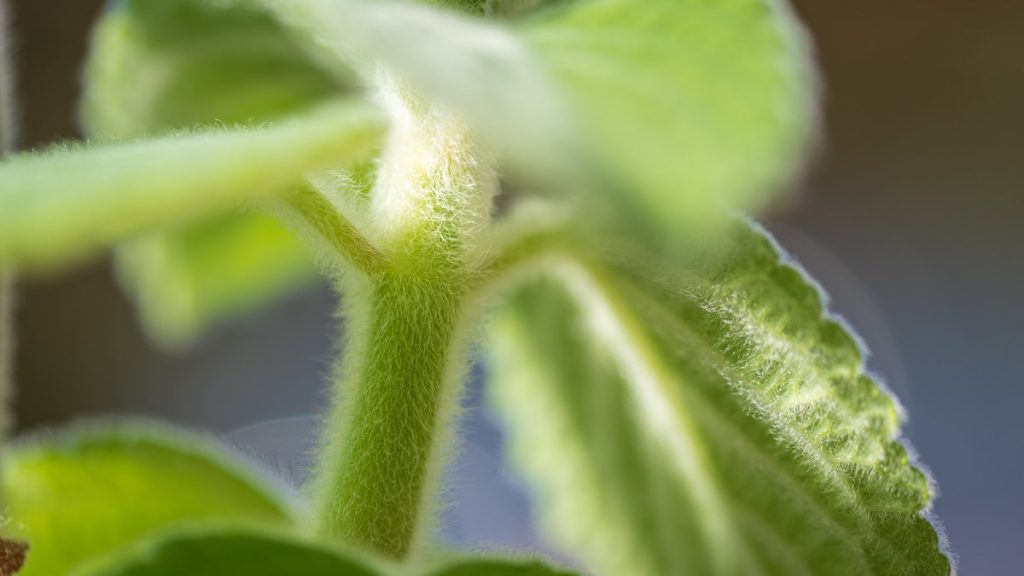
Not every lush, green, flowerless plant is overfed on nitrogen. But a few signs make nitrogen a reasonable first suspect rather than a guess:
- Vigorous, dense new leaf growth, month after month, with no slowdown.
- Deep, almost blue-green leaf color, noticeably darker than the plant’s usual shade.
- Soft, lush stems and leaves rather than firm, compact growth.
- A feeding routine that runs continuously, without a rest period, and without any reduction during the plant’s slower season.
- No flower buds at any point, not even ones that formed and then dropped, which points at a plant that never started building one rather than a plant that lost one partway through.
If your plant instead formed buds and then lost them, nitrogen is a much less likely explanation, and the mechanism belongs to a different article: see flower buds falling off before opening.
What to actually change
This article does not publish a feeding schedule, a dose, or a specific N-P-K ratio, because a responsible number depends on the product you are using and the plant you own, and a wrong number given in the abstract can do more harm than the problem it is meant to fix. What is safe to say in general terms:
Feed less often, not necessarily less strong. A continuous supply of nitrogen is what drives the imbalance. Building in an actual rest period, particularly during the plant’s slower season, removes the constant vegetative signal rather than just diluting it.
Stop feeding once buds appear. If a plant does set buds, continuing a heavy nitrogen feed through bud development competes with the resources the flower needs and can favor new leaf growth over finishing the bloom.
Do not respond to “no flowers” by feeding more. This is the instinct that makes the problem worse. A plant that already has abundant nitrogen and still will not flower is not undernourished. It is imbalanced, and more of the same nutrient it already has plenty of will not correct that.
Check whether light, not feeding, is the actual constraint. Nitrogen excess and light deficiency often travel together, because a plant kept in a dim spot cannot use surplus nitrogen for anything except leaf growth, since it has no light budget to spend on a flower either way. See how much light do plants need to flower.
The myth this is often confused with, and why it is the mirror image
A great deal of retail advice frames the fix for “no flowers” as adding a high-phosphorus “bloom booster” product. That advice gets the direction backward twice over: research does not support extra phosphorus increasing flower count in a plant that already has adequate phosphorus, and the nutrient genuinely implicated in suppressing flowers is the one already abundant in most feeding routines, nitrogen, not the one people rush to add more of. The full correction, with sources, is in does phosphorus make plants bloom.
If nitrogen is not the explanation
A lush, flowerless plant that is not being heavily or continuously fed likely has a different cause. Work through the full sort in why a fragrant houseplant refuses to flower indoors, and check whether your plant has simply not reached flowering maturity yet at how long before a plant flowers.
Frequently asked questions
Should I stop feeding my plant entirely to get it to flower? No. Cutting nitrogen to zero removes a nutrient the plant genuinely needs for healthy growth, including the growth that eventually supports a flower. The goal is a rest period and a reduced, less constant supply, not starvation.
How do I know if my plant is nitrogen-rich rather than just healthy? Healthy growth that includes flower buds at some point in its cycle is a good sign. Continuous, vigorous leaf growth with no buds ever appearing, especially alongside frequent or year-round feeding, points more specifically at a nitrogen-driven vegetative pattern.
Will switching to a “flowering” fertilizer fix this faster than just feeding less? Not reliably, since many flowering formulas still contain meaningful nitrogen, just at a different ratio to phosphorus and potassium. Reducing how often and how continuously you feed addresses the actual imbalance more directly than changing which bottle you use.
Does this apply to all four genera this site covers the same way? The underlying trade-off between vegetative and reproductive growth is general across flowering plants, but how sensitive an individual species is, and how much nitrogen counts as too much, varies and is not well documented at the houseplant scale for gardenia, jasmine, hoya, and citrus individually. Treat the signs described above as more reliable than any single number.
My plant gets no fertilizer at all and still will not flower. Could that be the problem instead? Unlikely in the same direction. An unfed plant is more likely to be limited by whatever nutrients its potting mix started with running out, which is a different problem than nitrogen excess. If light and maturity both check out and the plant has had no feeding in a long time, that is worth investigating separately rather than assuming the nitrogen explanation applies in reverse.