Tag: flower buds

  • Low Humidity Bud Drop: Why Buds Fail Before Leaves Do

    Dry indoor air causes bud drop because an unopened flower bud loses water through its surface faster than a leaf does, and has almost no way to slow that loss down. So when humidity drops, the bud is usually the first visible casualty, sometimes weeks before a leaf shows so much as a brown tip. That single fact explains a pattern a lot of readers report and cannot make sense of: "the leaves are fine, so why are the buds shriveling?" The leaves being fine is not evidence against humidity. It is exactly what low-humidity bud stress looks like before it spreads.

    Why a bud fails before a leaf does

    Leaves have a defense against dry air that buds mostly lack. A leaf's surface carries stomata, tiny pores the plant can partially close to slow water loss when the air turns dry, along with a cuticle built up over the leaf's lifetime to resist evaporation. A developing flower bud has neither advantage to the same degree. Recent floral-transpiration research, reported as a 2024 study posted on bioRxiv, found that flowers have comparatively few stomata and that this limits their ability to regulate how much water they lose to the surrounding air, with total water loss from a flower driven largely by the humidity gradient between the flower's surface and the room, rather than by anything the plant can actively control there. The same body of work reports that petal and bud tissue commonly has a more water-permeable cuticle than leaf tissue.

    Put plainly: a leaf can partially defend itself against dry air. A bud largely cannot. That is the mechanism behind the pattern, not just a coincidence of timing.

    What the pattern actually looks like

    Clemson Cooperative Extension's gardenia factsheet lists low humidity first among the recognized causes of bud drop, alongside overwatering, under-watering, insufficient light and high temperatures, and describes the visible result plainly: buds "turn brown and drop off." The New York Botanical Garden's plant information service is specific about the threshold that matters for gardenia, as reported: the plant "will struggle in humidity below 60%," a level that is genuinely hard to sustain in a heated home through a northern winter. The University of Connecticut's Home & Garden Education Center generalizes the same point across houseplants broadly: "Lack of humidity, especially in the winter, frequently causes leaf and/or bud drop."

    The honest caveat belongs here rather than buried at the end: that 60% figure is reported specifically for gardenia, the most bud-drop-prone plant in this niche and the one with the most published guidance behind it. Jasmine, hoya and citrus do not have an equally well-documented humidity threshold in the sources checked for this article, and printing a number for them without a named source behind it would be a guess dressed up as fact. What transfers across all four genera is the mechanism above, not a specific percentage: buds are more humidity-sensitive tissue than leaves, on every fragrant houseplant this site covers, whether or not a research figure exists for that particular species yet.

    Reading the shape of the drop, not just the fact of it

    Because low humidity is one of several bud-drop triggers rather than the only one, the shape of the drop is a more useful clue than the drop itself. This is not a diagnostic test, and none of the sources above claim it is one, but the underlying mechanisms point in a consistent direction worth using as a starting point.

    • A slow, staggered loss over a week or more, buds going one at a time while the plant otherwise looks normal, fits a chronic, low-grade stress that accumulates, which is the pattern humidity and inconsistent watering both produce. See inconsistent watering as a bud-drop trigger for the watering version of the same shape.
    • Every bud going at once, close together in time, often right after a change in the room, fits an acute shock such as a move or a sudden temperature swing more than a slow environmental drift. That pattern is covered in temperature swings, drafts and heat vents at bud stage.
    • Buds that brown and dry while still firmly attached, rather than falling cleanly, is a distinct failure called bud blast, and it is covered separately in flower buds falling off before opening, which also explains the plant-level mechanism behind why a bud is sacrificed at all.

    Low humidity can contribute to more than one of these shapes, so use this as a starting hypothesis to test against what else changed in the room, not as a standalone verdict.

    The heating-season trap

    Winter is when low humidity and bud drop show up together most often, and it is not a coincidence of season. Forced-air heating lowers indoor relative humidity as a direct physical effect of warming cold outdoor air, which holds far less moisture than warm air even before it is heated further indoors. A plant that set buds successfully in a mild, humid month can lose them weeks later purely because the furnace came on, with nothing else in the room having changed. This is one reason a bud-drop episode that starts in late autumn or winter deserves humidity as an early suspect, independent of watering habits or plant placement.

    What this article does not cover

    Raising humidity is an environmental and equipment question, and comparing humidifiers, pebble trays, misting and grouping plants together is outside what this site covers. What matters here is recognizing humidity as a plausible cause from the pattern, not choosing a fix. For method-level guidance on managing indoor humidity, a university extension service or botanical garden's plant information service, such as the Clemson Home and Garden Information Center, is the right place to ask.

    Where to go next

    Frequently asked questions

    How do I know if bud drop is from low humidity and not something else? No single symptom confirms it on its own. Low humidity is more likely when the loss is gradual, buds going one at a time over a week or more, the leaves still look normal, and the change coincides with heating season starting. A sudden, all-at-once loss right after a move points elsewhere first.

    Is 60% humidity really necessary for a fragrant houseplant to hold its buds? That specific figure is reported for gardenia by the New York Botanical Garden's plant information service and is genuinely difficult to sustain in a heated home. It is not confirmed at the same precision for jasmine, hoya or citrus, so treat it as a gardenia-specific benchmark rather than a universal rule for every plant in this niche.

    Can low humidity cause bud drop even if the plant looks perfectly healthy otherwise? Yes, and this is the pattern that confuses the most readers. Bud tissue is more vulnerable to dry air than leaf tissue, so buds commonly fail well before a leaf shows any visible stress from the same conditions.

    Does low humidity affect all four fragrant genera the same way? The underlying mechanism, buds losing water faster than leaves in dry air, applies across gardenia, jasmine, hoya and citrus. How sensitive each genus is in practice is not equally well documented; gardenia has by far the most published evidence behind it.

    If I fix the humidity, will the buds that already dropped come back? No. Once a bud has separated at its abscission point or dried in place, that individual bud is gone regardless of what changes afterward. Stabilizing humidity protects buds that have not yet failed and improves the odds for the next flowering cycle.
  • How to Tell Flower Buds From New Growth on a Plant

    How to Tell Flower Buds From New Growth on a Plant

    Three checks answer this most of the time. Flower buds are usually plumper and rounder than the buds that make leaves, which are slender and pointed. Leaf buds sit in a leaf axil, where a leaf meets the stem, while flower buds often sit at a shoot tip or on a short stalk of their own. On many plants the flower bud also carries a downy or scaly covering the leaf bud does not have. What no article can promise you is that these hold for your species, and on citrus the bud has genuinely not decided yet when it starts to move.

    The general shape rule, and who says so

    The clearest published description of the difference comes from fruit growing, where getting it wrong costs a crop. The Royal Horticultural Society’s guidance on identifying fruit buds on apples and pears, read 7 September 2026, describes a fruit bud as a “plump, round bud” and notes that “bud scales on fruit buds are typically downy, especially on apples, pears, peaches and nectarines.” Growth buds, by contrast, are “slender, pointed buds borne in a leaf axil,” and “these buds are usually much smaller and more insignificant than fruit buds.”

    That gives you three separable signals rather than one impression.

    SignalFlower budLeaf or growth bud
    ShapePlump and roundedSlender and pointed
    SizeNoticeably larger, hard to miss once you knowSmaller, easy to overlook
    PositionOften terminal, or on a short stalk of its ownIn a leaf axil, tight against the stem
    SurfaceOften downy or scalyUsually smooth and plain

    Apples are not fragrant houseplants, and the rule transfers imperfectly. It is quoted here because it is the version an institution is willing to put its name to, and because the four signals it separates are the ones worth looking for on any plant.

    The test that is right every time

    Photograph the bud, in the same light and from the same angle, and look again a week later.

    A vegetative shoot lengthens. The bud scales part, a stem extends, and small leaves unfold and separate from one another. A flower bud mostly does not lengthen. It swells, stays compact, and the parts that emerge stay wrapped around each other rather than spreading apart. Nothing about this test requires you to know the species, and it beats any rule about shape, because the plant is telling you directly.

    The reason to do the slow version rather than guess is that guessing has a cost in both directions. A gardener who decides a swelling shoot tip is a flower bud spends a month waiting on a leaf. A gardener who decides a flower bud is a shoot tidies it off.

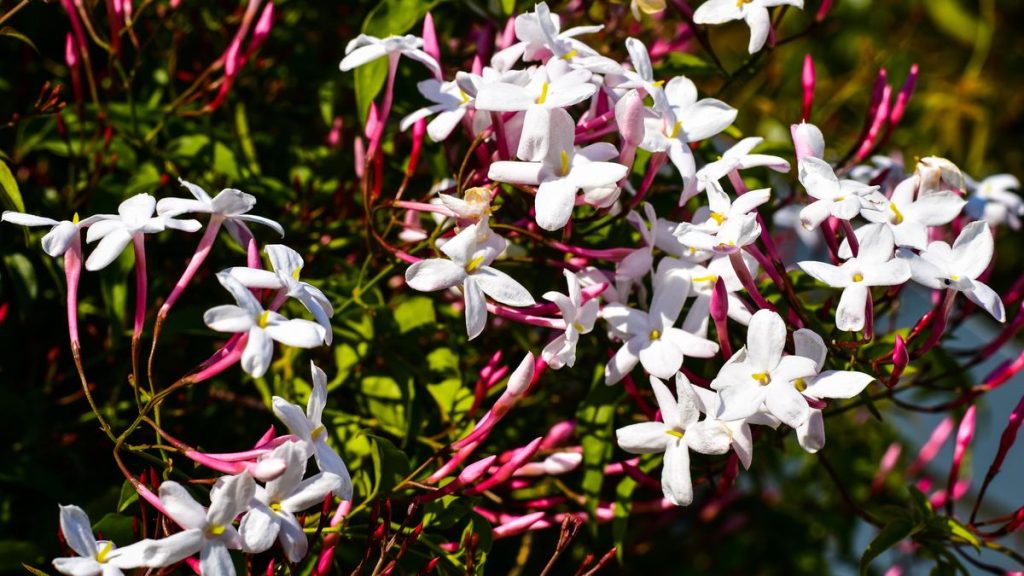
    Pink flower buds of Jasminum polyanthum next to the white flowers they open into
    On pink jasmine, bud color is the tell — pink means flower, not a smaller version of the white bloom.

    The three genera where the answer is specific

    This is the part the general articles skip, and it is where a fragrance-focused reader gets the most value.

    Hoya: the bud is on a structure you must not remove

    Hoyas do not put flowers straight onto new vine growth. Aaron Steil, in Iowa State University Extension and Outreach’s “All About Hoyas,” dated February 2026 and read 7 September 2026, writes that “hoyas bloom from persistent structures called peduncles (spurs)” and that “many species rebloom from the same peduncle repeatedly.”

    The practical consequence in the same source is blunt: “always allow spent flowers to fall off naturally and never cut them off. Cutting them off can delay flowering for a long time, as you remove future flower sites,” and “for this reason, do not deadhead hoya.” A bare hoya peduncle looks like a short dead stub. It is the opposite of dead, and on a plant grown for scent it is the single most valuable thing on the vine. The wider set of questions about growing this genus indoors sits on our hoya coverage.

    Steil adds the sequel that catches people out once the buds do appear: “once buds form, leave it alone. Sudden changes in watering patterns, temperature swings, or moving the plant to a new location with different light can cause bud drop, sometimes called bud blast.”

    Pink jasmine: the bud color is the identification

    On Jasminum polyanthum the bud does not look like a smaller version of the flower, which is why people miss it. The Chicago Botanic Garden’s plant finder entry for the species, read 7 September 2026, records that it “produces an abundance of light pink flower buds in late winter and early spring,” and that these are “followed by masses of fragrant, trumpet-shaped, star-like white flowers,” with bloom time listed across January to April.

    So on this plant the tell is chromatic rather than structural. Pink means flower. A green tip elongating along the wire hoop is vine. Anyone who has waited for a white bud to appear has been looking for the wrong thing. Jasmine-specific growing questions sit on our jasmine coverage.

    Citrus: the bud has not chosen yet

    Citrus is the honest exception, and it is worth stating plainly because it makes a nonsense of any universal bud rule.

    In “Advances in Citrus Flowering: A Review,” by M. Agustí, C. Reig, A. Martínez-Fuentes and C. Mesejo, published in Frontiers in Plant Science in 2022 and read 7 September 2026, the authors state that “floral induction and floral differentiation take place 2 to 3 months before and at the time of bud release, respectively.” Induction happens months earlier, but the bud only differentiates as it opens.

    The same review sets out what a citrus bud can turn into: “(1) leafless inflorescences bearing one or (2) more flowers, (3) leafy inflorescences bearing one flower in a terminal position, and (4) many axillary flowers, and (5) vegetative shoots.” Five outcomes, and three of them mix leaves and flowers on the same shoot. A swelling citrus bud in spring is therefore not identifiable at the moment it swells, not because you lack the skill, but because the plant has not finished deciding. Watching the flush develop is the only method, and the fragrant-citrus questions readers ask most often sit on our citrus coverage.

    Why the identification is worth the week

    Three real consequences ride on it.

    Pruning. Cutting a stem that carries next season’s flower buds removes those flowers, and on plants that flower on old wood there is no second chance that year. Which growth carries the flowers, and when cutting is safe, is the subject of pruning at the wrong time.

    Worry. Readers regularly report bud drop on plants that never had buds. If the structure that vanished was a leaf shoot that stalled, the cause and the fix are different. If it really was a bud and it fell, that is a specific and well-documented failure, covered in buds forming and falling before they open.

    Tidying. As above, deadheading a hoya costs future flowers. The general rule that follows is a good one for any fragrant plant: do not cut a structure you cannot name.

    What this cannot tell you

    Bud shape varies too much between species for a single rule, and the four-signal table above is a starting point rather than a key. Nothing here identifies a bud on a plant nobody has published a description of, and for several popular fragrant houseplants no institutional description of bud morphology appears to exist at all. Where that is the case, the week-apart photograph is the answer.

    It also does not tell you why a plant is making leaves and no buds in the first place. That is a separate question with its own order of causes, set out in why a fragrant houseplant refuses to flower indoors.

    Frequently asked questions

    How do I tell flower buds from new growth? Look at shape, position and surface. The RHS describes fruit and flower buds as plump and round, often with downy scales, and growth buds as slender, pointed and set in a leaf axil. Then confirm by watching: a leaf shoot elongates and unfolds separate leaves, while a flower bud swells without extending.

    My hoya has a bare stalk with nothing on it. Should I cut it off? No. Iowa State University Extension and Outreach states that hoyas bloom from persistent peduncles and that many species rebloom from the same peduncle repeatedly, and it advises never cutting spent flowers off because that removes future flower sites.

    What color are jasmine flower buds? On Jasminum polyanthum they are light pink, according to the Chicago Botanic Garden, and they open to white flowers in late winter and early spring. If you are watching for white buds on this species you will miss them.

    Why can nobody tell me whether my citrus bud is a flower? Because on citrus the bud differentiates as it opens. The 2022 Frontiers in Plant Science review by Agustí and colleagues reports that floral differentiation happens at the time of bud release, and that a sprouting bud can produce a leafless inflorescence, a leafy inflorescence with flowers, or a purely vegetative shoot.

    Is a fat bud always a flower? Not always, and not on every species. It is the strongest single visual signal, which is why fruit growers use it, but shape varies between species and a terminal vegetative bud can be plump too. Time is the only test that does not depend on the species.

    Sources

    • Royal Horticultural Society. “Apples and pears: identifying fruit buds,” RHS Advice. Read 7 September 2026.
    • Steil, A. “All About Hoyas.” Iowa State University Extension and Outreach, Yard and Garden, February 2026. Read 7 September 2026.
    • Chicago Botanic Garden. Plant Finder entry for Jasminum polyanthum, pink jasmine. Read 7 September 2026.
    • Agustí, M., Reig, C., Martínez-Fuentes, A., Mesejo, C. “Advances in Citrus Flowering: A Review.” Frontiers in Plant Science, volume 13, 2022. Read 7 September 2026.
  • Flower Buds Falling Off Before Opening: Why It Happens

    Flower Buds Falling Off Before Opening: Why It Happens

    Flower buds falling off before opening is almost never a disease. It is the plant canceling an expensive project. An unopened bud is the costliest uncommitted thing a plant is carrying, so when conditions change for the worse, the bud is the first thing sacrificed. That is why the trigger is usually recent and small rather than long-standing, and why the plant looks perfectly healthy afterward. Before anything else, work out which of two failures you had: did the buds fall off the plant, or did they dry up and stay attached?

    Your plant did not fail. It disinvested.

    Buds do not simply fall off the way a poorly glued object does. Plants shed organs through abscission, a controlled cell-separation process that happens at a purpose-built structure called the abscission zone. In their review in the journal Plants, Botton and Ruperti describe abscission as “a natural mechanism evolved by plants to respond to different cues” that is “accomplished through a series of highly coordinated sequential events.” The hormone ethylene drives the separation, and auxin flowing from a healthy, developing organ holds it back.

    That is the whole explanation in one sentence: while the plant is committed to the bud, it keeps sending the signal that holds the bud on. When the plant reads its conditions as marginal, that signal weakens, the abscission zone activates, and the bud is released deliberately. The same review notes that abscission “can be significantly affected by environmental conditions, such as light availability, temperature and drought stress.”

    So the question to ask is not “what damaged my buds.” It is “what made the plant decide it could not afford them.”

    Dropped or blasted? Two different failures

    These get treated as one thing almost everywhere, and they point in different directions.

    Dropped (abscission). The bud separates cleanly and falls, often still plump and green or showing color. You find whole buds on the floor or the soil surface, and the stem is left with a small, tidy scar rather than a torn stub. A clean scar means the plant let go on purpose.

    Blasted. The bud browns, shrivels or goes papery while still attached, and may hang on the plant for days or weeks. Nothing was released. The bud died in place.

    The distinction matters because blast tends to follow conditions that dry or scorch the bud faster than the plant can supply it, while a clean drop tends to follow a change the plant reads as a reason to disinvest. The American Orchid Society defines bud blast as buds that “wither and fall from an otherwise healthy plant” and calls buds “the most sensitive part of an orchid.” That last phrase generalizes well: across fragrant genera, the buds fail before the leaves show anything at all.

    Flower Buds Falling Off Before Opening: Why It Happens - illustration

    What changed in the last two weeks?

    This is the practical output of the disinvestment idea. You are not looking for a long-standing fault. You are looking for a recent event.

    • Did you move it? A new position means a different light level and often a different temperature and airflow. The New York Botanical Garden’s plant information service attributes bud loss on a gardenia brought in from outdoors to “the lower light level indoors and lack of the temperature drop at night that the plant needs.”
    • Did the heating come on, or did a vent, radiator or draft start hitting it? Purdue Consumer Horticulture describes the gardenia meeting the home’s “hot, dry air and gloomy winter days,” after which buds “begin dropping from the plant in droves.”
    • Did watering slip, or swing? A plant that briefly reads drought will pull resources back from buds first. The trigger is usually the swing, not the average.
    • Did the air get dry? Buds lose water faster than they can replace it, and Clemson Cooperative Extension lists low humidity first among gardenia bud drop causes. How to raise humidity is equipment territory and not something this site covers.
    • Was it repotted or root-disturbed? Root disturbance during bud development is a common trigger.
    • Is there fruit on the counter nearby? This one is rarely mentioned and worth knowing. Ripening fruit releases ethylene, the same hormone that executes abscission. The American Orchid Society names “ethylene gas given off by ripening fruit; gas leaks” among the causes of bud blast.

    One honest note: the sources do not agree on how much of this is humidity and how much is temperature. Clemson names low humidity first, Purdue emphasizes hot dry air together with low winter light, and NYBG puts the missing night-time temperature drop at the center. The temperature figures themselves differ between institutions, which is covered in more detail under cold period for plants to bloom. Treat “which factor matters most” as unsettled, and treat stability as the point they all agree on.

    Why it is almost never a pest or a disease

    If buds are failing while foliage looks normal, a pathogen is an unlikely explanation. Pests do reach flower buds, and Clemson’s gardenia factsheet notes that “a whitefly infestation is the most commonly occurring problem on gardenias,” with aphids also common on leaf undersides. But a pest heavy enough to strip buds usually leaves other evidence: sticky residue, sooty deposits, distorted new growth or visible insects.

    Identifying and treating a pest is outside what this site covers. If you find one, take it to a university extension service, such as the Clemson Home and Garden Information Center or your own state or provincial extension office, both of which publish identification material and will answer a question directly.

    Can you save the buds you still have?

    Honestly, usually not the ones already committed to falling. Once the abscission zone in a bud has activated, that bud is gone, and buds that were stressed alongside it are often already on the same path. Nothing you do this week reverses that.

    What you can change is the outcome of the next flush. Every source above converges on one instruction, and it is not a technique but a discipline: stop changing things. Choose the position with the best available light, accept whatever temperature pattern that position gives, keep watering consistent rather than optimal, and then leave the plant alone through the entire bud-development period, which for many fragrant plants runs for weeks. NYBG also suggests pinching off young growth emerging beside a developing flower bud, which “forces the energy of the plant into bud formation.”

    If your plant never produced buds in the first place, this article is the wrong branch. Start from why a fragrant houseplant refuses to flower indoors, which sorts the no-bud causes separately.

    Find your plant

    The mechanism above is the same across species. What differs is which trigger each genus is most sensitive to.

    • Gardenia: the most bud-drop-prone plant in this niche, and the one with the most published guidance behind it.
    • Jasmine: several unrelated plants are sold under this name, and they do not all behave alike.
    • Hoya: buds develop slowly on structures the plant reuses, which changes what a lost bud costs you.
    • Citrus: some flower drop is normal, because the plant routinely sets more than it can carry.

    Frequently asked questions

    Why did my plant drop its buds right after I moved it to a better spot?
    Because “better” is judged by you and “different” is judged by the plant. A move changes light, temperature and airflow at once, during the phase when the plant is deciding whether it can afford the buds it is carrying. Movement during bud development is one of the recognized triggers for bud loss, even when the new position is objectively brighter.

    What is the difference between bud drop and bud blast?
    Bud drop means the bud separated at the abscission zone and fell, usually intact, leaving a clean scar. Bud blast means the bud browned or shriveled while still attached and died in place. Drop points toward a change the plant reacted to. Blast points toward buds losing water or being damaged faster than the plant could supply them.

    Will misting the buds help?
    This site does not compare humidity methods, so treat that as a question for a general houseplant care source. What is worth knowing here is that raising humidity is a slow, environmental change, and buds already committed to falling will usually fall regardless. Stability across the whole bud-development period matters more than any single intervention.

    Is bud drop caused by fertilizer?
    Rarely as a direct trigger. Bud drop follows environmental change far more often than nutrition. The related and more common mistake is expecting fertilizer to produce flowers in the first place, and the research does not support that expectation either.

    How long until it tries again?
    That depends on the species and on where it is in its annual cycle, and no honest answer covers all fragrant plants. Some set buds only once per year, in which case the next attempt is a season away. The useful goal is not rescuing this flush but making the plant’s conditions boring enough that the next one survives.