Tag: hoya

  • How to Tell Flower Buds From New Growth on a Plant

    How to Tell Flower Buds From New Growth on a Plant

    Three checks answer this most of the time. Flower buds are usually plumper and rounder than the buds that make leaves, which are slender and pointed. Leaf buds sit in a leaf axil, where a leaf meets the stem, while flower buds often sit at a shoot tip or on a short stalk of their own. On many plants the flower bud also carries a downy or scaly covering the leaf bud does not have. What no article can promise you is that these hold for your species, and on citrus the bud has genuinely not decided yet when it starts to move.

    The general shape rule, and who says so

    The clearest published description of the difference comes from fruit growing, where getting it wrong costs a crop. The Royal Horticultural Society’s guidance on identifying fruit buds on apples and pears, read 7 September 2026, describes a fruit bud as a “plump, round bud” and notes that “bud scales on fruit buds are typically downy, especially on apples, pears, peaches and nectarines.” Growth buds, by contrast, are “slender, pointed buds borne in a leaf axil,” and “these buds are usually much smaller and more insignificant than fruit buds.”

    That gives you three separable signals rather than one impression.

    SignalFlower budLeaf or growth bud
    ShapePlump and roundedSlender and pointed
    SizeNoticeably larger, hard to miss once you knowSmaller, easy to overlook
    PositionOften terminal, or on a short stalk of its ownIn a leaf axil, tight against the stem
    SurfaceOften downy or scalyUsually smooth and plain

    Apples are not fragrant houseplants, and the rule transfers imperfectly. It is quoted here because it is the version an institution is willing to put its name to, and because the four signals it separates are the ones worth looking for on any plant.

    The test that is right every time

    Photograph the bud, in the same light and from the same angle, and look again a week later.

    A vegetative shoot lengthens. The bud scales part, a stem extends, and small leaves unfold and separate from one another. A flower bud mostly does not lengthen. It swells, stays compact, and the parts that emerge stay wrapped around each other rather than spreading apart. Nothing about this test requires you to know the species, and it beats any rule about shape, because the plant is telling you directly.

    The reason to do the slow version rather than guess is that guessing has a cost in both directions. A gardener who decides a swelling shoot tip is a flower bud spends a month waiting on a leaf. A gardener who decides a flower bud is a shoot tidies it off.
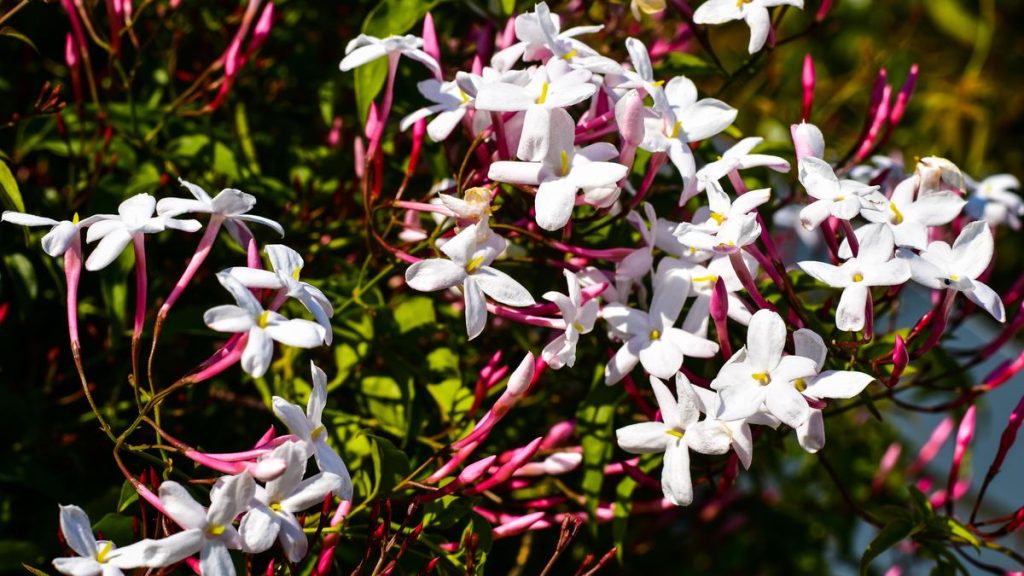
    Pink flower buds of Jasminum polyanthum next to the white flowers they open into
    On pink jasmine, bud color is the tell — pink means flower, not a smaller version of the white bloom.

    The three genera where the answer is specific

    This is the part the general articles skip, and it is where a fragrance-focused reader gets the most value.

    Hoya: the bud is on a structure you must not remove

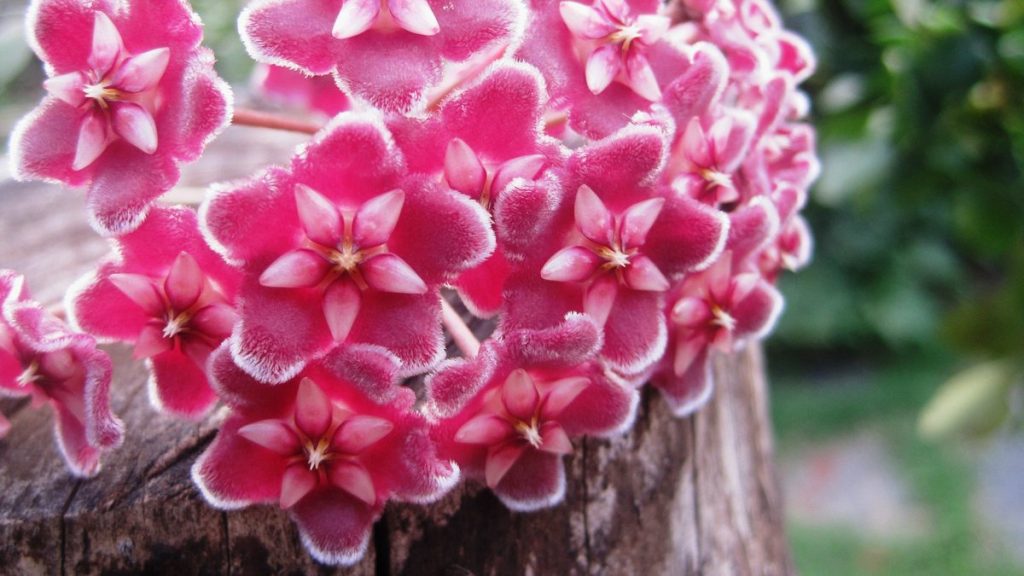
    Hoyas do not put flowers straight onto new vine growth. Aaron Steil, in Iowa State University Extension and Outreach’s “All About Hoyas,” dated February 2026 and read 7 September 2026, writes that “hoyas bloom from persistent structures called peduncles (spurs)” and that “many species rebloom from the same peduncle repeatedly.”

    The practical consequence in the same source is blunt: “always allow spent flowers to fall off naturally and never cut them off. Cutting them off can delay flowering for a long time, as you remove future flower sites,” and “for this reason, do not deadhead hoya.” A bare hoya peduncle looks like a short dead stub. It is the opposite of dead, and on a plant grown for scent it is the single most valuable thing on the vine. The wider set of questions about growing this genus indoors sits on our hoya coverage.

    Steil adds the sequel that catches people out once the buds do appear: “once buds form, leave it alone. Sudden changes in watering patterns, temperature swings, or moving the plant to a new location with different light can cause bud drop, sometimes called bud blast.”

    Pink jasmine: the bud color is the identification

    On Jasminum polyanthum the bud does not look like a smaller version of the flower, which is why people miss it. The Chicago Botanic Garden’s plant finder entry for the species, read 7 September 2026, records that it “produces an abundance of light pink flower buds in late winter and early spring,” and that these are “followed by masses of fragrant, trumpet-shaped, star-like white flowers,” with bloom time listed across January to April.

    So on this plant the tell is chromatic rather than structural. Pink means flower. A green tip elongating along the wire hoop is vine. Anyone who has waited for a white bud to appear has been looking for the wrong thing. Jasmine-specific growing questions sit on our jasmine coverage.

    Citrus: the bud has not chosen yet

    Citrus is the honest exception, and it is worth stating plainly because it makes a nonsense of any universal bud rule.

    In “Advances in Citrus Flowering: A Review,” by M. Agustí, C. Reig, A. Martínez-Fuentes and C. Mesejo, published in Frontiers in Plant Science in 2022 and read 7 September 2026, the authors state that “floral induction and floral differentiation take place 2 to 3 months before and at the time of bud release, respectively.” Induction happens months earlier, but the bud only differentiates as it opens.

    The same review sets out what a citrus bud can turn into: “(1) leafless inflorescences bearing one or (2) more flowers, (3) leafy inflorescences bearing one flower in a terminal position, and (4) many axillary flowers, and (5) vegetative shoots.” Five outcomes, and three of them mix leaves and flowers on the same shoot. A swelling citrus bud in spring is therefore not identifiable at the moment it swells, not because you lack the skill, but because the plant has not finished deciding. Watching the flush develop is the only method, and the fragrant-citrus questions readers ask most often sit on our citrus coverage.

    Why the identification is worth the week

    Three real consequences ride on it.

    Pruning. Cutting a stem that carries next season’s flower buds removes those flowers, and on plants that flower on old wood there is no second chance that year. Which growth carries the flowers, and when cutting is safe, is the subject of pruning at the wrong time.

    Worry. Readers regularly report bud drop on plants that never had buds. If the structure that vanished was a leaf shoot that stalled, the cause and the fix are different. If it really was a bud and it fell, that is a specific and well-documented failure, covered in buds forming and falling before they open.

    Tidying. As above, deadheading a hoya costs future flowers. The general rule that follows is a good one for any fragrant plant: do not cut a structure you cannot name.

    What this cannot tell you

    Bud shape varies too much between species for a single rule, and the four-signal table above is a starting point rather than a key. Nothing here identifies a bud on a plant nobody has published a description of, and for several popular fragrant houseplants no institutional description of bud morphology appears to exist at all. Where that is the case, the week-apart photograph is the answer.

    It also does not tell you why a plant is making leaves and no buds in the first place. That is a separate question with its own order of causes, set out in why a fragrant houseplant refuses to flower indoors.

    Frequently asked questions

    How do I tell flower buds from new growth? Look at shape, position and surface. The RHS describes fruit and flower buds as plump and round, often with downy scales, and growth buds as slender, pointed and set in a leaf axil. Then confirm by watching: a leaf shoot elongates and unfolds separate leaves, while a flower bud swells without extending.

    My hoya has a bare stalk with nothing on it. Should I cut it off? No. Iowa State University Extension and Outreach states that hoyas bloom from persistent peduncles and that many species rebloom from the same peduncle repeatedly, and it advises never cutting spent flowers off because that removes future flower sites.

    What color are jasmine flower buds? On Jasminum polyanthum they are light pink, according to the Chicago Botanic Garden, and they open to white flowers in late winter and early spring. If you are watching for white buds on this species you will miss them.

    Why can nobody tell me whether my citrus bud is a flower? Because on citrus the bud differentiates as it opens. The 2022 Frontiers in Plant Science review by Agustí and colleagues reports that floral differentiation happens at the time of bud release, and that a sprouting bud can produce a leafless inflorescence, a leafy inflorescence with flowers, or a purely vegetative shoot.

    Is a fat bud always a flower? Not always, and not on every species. It is the strongest single visual signal, which is why fruit growers use it, but shape varies between species and a terminal vegetative bud can be plump too. Time is the only test that does not depend on the species.

    Sources

    • Royal Horticultural Society. “Apples and pears: identifying fruit buds,” RHS Advice. Read 7 September 2026.
    • Steil, A. “All About Hoyas.” Iowa State University Extension and Outreach, Yard and Garden, February 2026. Read 7 September 2026.
    • Chicago Botanic Garden. Plant Finder entry for Jasminum polyanthum, pink jasmine. Read 7 September 2026.
    • Agustí, M., Reig, C., Martínez-Fuentes, A., Mesejo, C. “Advances in Citrus Flowering: A Review.” Frontiers in Plant Science, volume 13, 2022. Read 7 September 2026.
  • Does Being Root Bound Make Plants Bloom? The Evidence

    Does Being Root Bound Make Plants Bloom? The Evidence

    Sometimes, for a few species, and not for the reason most articles give. Named extension services do report that hoyas and holiday cacti flower better when slightly potbound, but the published reason is about how fast the pot dries, not about stress triggering flowers. Where root restriction has been tested directly on a flowering ornamental, the result went the other way: a hydrangea trial found less flower initiation in the smaller containers. So a snug pot is a normal condition for a mature flowering houseplant, not a lever you pull to force fragrance.

    What “root bound” actually describes

    The term describes a physical state of the container, not a mood. Isaac Wyatt, writing for NC State Extension’s Henderson County Center on 13 July 2023 and read 7 September 2026, defines it as the point where “the roots have displaced most of the media in the container,” which leads to “the container not retaining water.” The symptom he names first is drought stress: plants “become droopy and exhibit signs of drought stress.”

    That definition matters for the flowering question, because it means a root bound pot changes two things at once. It changes root volume, and it changes how long water stays available. Almost every claim about potbound plants flowering better is really a claim about one of those two, and the sources rarely say which.

    What the extension services actually say

    They do say it, and they are worth quoting exactly rather than paraphrasing into something stronger.

    Aaron Steil, in Iowa State University Extension and Outreach’s “All About Hoyas,” dated February 2026 and read 7 September 2026, writes that “hoyas commonly flower better when slightly potbound,” and repeats it in the troubleshooting section: “avoid oversized pots. Hoyas bloom best when slightly pot-bound.” Iowa State University Extension and Outreach’s Linn County page on holiday cacti, read the same day, says of Thanksgiving, Christmas and Easter cactus that “the plants seem to do the best when root bound.”

    Now read the reason Iowa State gives for the hoya advice. It is not that constriction signals the plant to reproduce. It is that an oversized container holds moisture too long for a plant that prefers to dry out. The observation and the mechanism have been quietly separated in most of the articles that repeat this. The extension source is making a watering argument that happens to end in more flowers on a plant that resents wet roots. Reasons like that matter more than the instruction, which is why the version of this question that is specific to hoya belongs with that genus rather than generalized to every fragrant plant.

    What happens when researchers restrict roots on purpose

    This is where the popular claim gets awkward, and where this page can tell you something the retail tier does not.

    Yeh and Chiang, in “Growth and flower initiation in hydrangea as affected by root restriction and defoliation,” published in Scientia Horticulturae volume 91 in 2001, grew Hydrangea macrophylla in a range of container volumes under conditions that favored flower initiation. The smaller containers reduced shoot and root dry weight, reduced the number of expanded leaves, and reduced flower initiation. Reduced, not increased. The paper links the loss of flowers to the loss of leaf area rather than to root confinement acting as a signal in its own right.

    Against that sits a genuinely different body of work in fruit trees. NIAB’s summary of the physiology of flower initiation and development, read 7 September 2026, reports that in trials at HRI-East Malling “root pruning or root restriction of young apple trees has been shown to increase the abundance of flower production,” citing Webster and colleagues in 2000. The same page then supplies the caveat almost nobody quoting this technique includes: results were not consistent across trials, and work in the USA on mature Golden Delicious trees found that root pruning did not always increase flowering, although it did advance the timing of bloom.

    Root restriction is also listed among the recognized ways to push a woody plant into flower. Richard Meilan’s review “Floral induction in woody angiosperms,” New Forests volume 14, 1997, groups girdling, root restriction and shoot training together as physical constraints used as inductive treatments, alongside phytohormones, growth retardants and cultural manipulations.

    So the fair summary is this. Root restriction is a real horticultural lever in some woody species, it is inconsistent even in the orchard trials where it is used deliberately, and in the one flowering ornamental trial quoted above it cost flowers rather than creating them.

    Three explanations, ranked by how well they are supported

    ExplanationWhat it saysHow well supported
    Water and nutrient supplyA packed pot dries fast and holds less feed, so growth slows and the plant shifts out of pure vegetative modeBest supported. It is the reason Iowa State gives for the hoya advice, and it is the mechanism NC State’s definition points at
    Root-derived hormonesRoots export cytokinins, and cytokinins are associated with continued vegetative growth, so fewer or constrained roots may shift the balanceA long-standing physiological hypothesis, not something a home grower can observe or verify
    Stress as a flowering signalThe plant “senses” danger and reproducesPopular, and the weakest of the three. The hydrangea trial restricted roots directly and got fewer flowers, which is not what a general stress-to-flower rule predicts

    The middle row is the one this site is least willing to state as fact. It appears in the physiology literature as a mechanism worth investigating, and it is not something you can confirm on a windowsill.

    Hoya flower cluster — Iowa State Extension notes hoyas bloom better when slightly potbound
    Extension sources link this to how fast the pot dries out, not to stress triggering blooms.

    What this means for a plant you bought for its scent

    Three practical conclusions, and none of them is “use a smaller pot.”

    Do not under-pot deliberately. A container that cannot hold water through a normal day puts the plant into repeated drying and rewetting, and swings like that are a well-known cause of buds forming and then coming off before they open. Trading flowers you might get for buds you will lose is a bad trade on a fragrant plant, where the flower is the entire product.

    Do not repot a plant that is in bud, either. Whatever root room does for flowering over a season, disturbing a plant while buds are developing is a separate and much better documented problem, which is the subject of why moving the pot costs you the flowers.

    Check the likelier causes first. In a plant that has never flowered at all, root room sits near the bottom of the list. Age is above it, and many woody and climbing plants simply cannot flower until they are old enough, which is covered in how old a plant has to be before it can flower. Feeding is above it too, since a plant kept in strong vegetative growth stays leafy, and that trade is set out in too much nitrogen and no flowers. The full order of causes is laid out in why a fragrant houseplant refuses to flower indoors.

    Where this article stops

    When to repot, what size container to move up to, how to handle the root ball, and what mix to use are general houseplant care questions rather than flowering questions. They have a large and good literature that this site is not the right place for. Your state cooperative extension service publishes it, and Iowa State University Extension and Outreach’s yard and garden pages and NC State Extension are both good starting points.

    The honest bottom line: if your gardenia, jasmine or citrus has never flowered, the pot is unlikely to be the reason, and making the pot tighter is not a treatment.

    Frequently asked questions

    Does being root bound make plants bloom? For a small number of species, being slightly potbound is associated with better flowering, and Iowa State University Extension and Outreach states this for hoyas and for holiday cacti. It is not a general rule. A root restriction trial on Hydrangea macrophylla published in Scientia Horticulturae in 2001 found reduced flower initiation in the smaller containers, so restricting roots is not a reliable way to produce flowers.

    Should I move my hoya to a bigger pot to get more flowers? The published advice points the other way. Iowa State says hoyas bloom best when slightly pot-bound and advises avoiding oversized pots, and the reason given is that a large container stays wet too long for the plant. Hoyas also flower from persistent structures that should never be cut off, which is a bigger risk to your flowers than pot size.

    Is a root bound plant stressed, and does stress make plants flower? A root bound container dries out faster and can leave the plant in drought stress, which NC State Extension names as the first symptom. Turning that into a general “stress makes plants flower” rule goes further than the evidence. Where root restriction has been used deliberately in orchard trials it has worked inconsistently, and in the hydrangea trial it reduced flowering.

    Why do orchard growers restrict roots then? Because in some woody species it does work. NIAB reports that root pruning or root restriction of young apple trees increased flower production in trials at HRI-East Malling, and Richard Meilan’s 1997 review lists root restriction among the physical constraints used to induce flowering in woody plants. NIAB also records trials where it did not increase flowering and only advanced bloom timing, which is why it is a managed orchard technique rather than houseplant advice.

    My plant is root bound and has buds. Should I repot now? Disturbing a plant that is in bud is a documented way to lose those buds. Whether the pot needs changing is a care question for after flowering, and the bud drop risk is covered separately on this site.

    Sources

    • Wyatt, I. “Root-Bound Plants.” NC State Extension, Henderson County Center, 13 July 2023, updated 21 July 2023. Read 7 September 2026.
    • Steil, A. “All About Hoyas.” Iowa State University Extension and Outreach, Yard and Garden, February 2026. Read 7 September 2026.
    • Iowa State University Extension and Outreach, Linn County. “Is it a Thanksgiving, Christmas or Easter Cactus?” Read 7 September 2026.
    • Yeh, D.M., Chiang, H.H. “Growth and flower initiation in hydrangea as affected by root restriction and defoliation.” Scientia Horticulturae, volume 91, issue 1-2, pages 123-132, 2001. Read 7 September 2026.
    • NIAB. “Physiology of flower initiation and development,” citing Webster et al., 2000, HRI-East Malling. Read 7 September 2026.
    • Meilan, R. “Floral induction in woody angiosperms.” New Forests, volume 14, issue 3, pages 179-202, 1997. Read 7 September 2026.