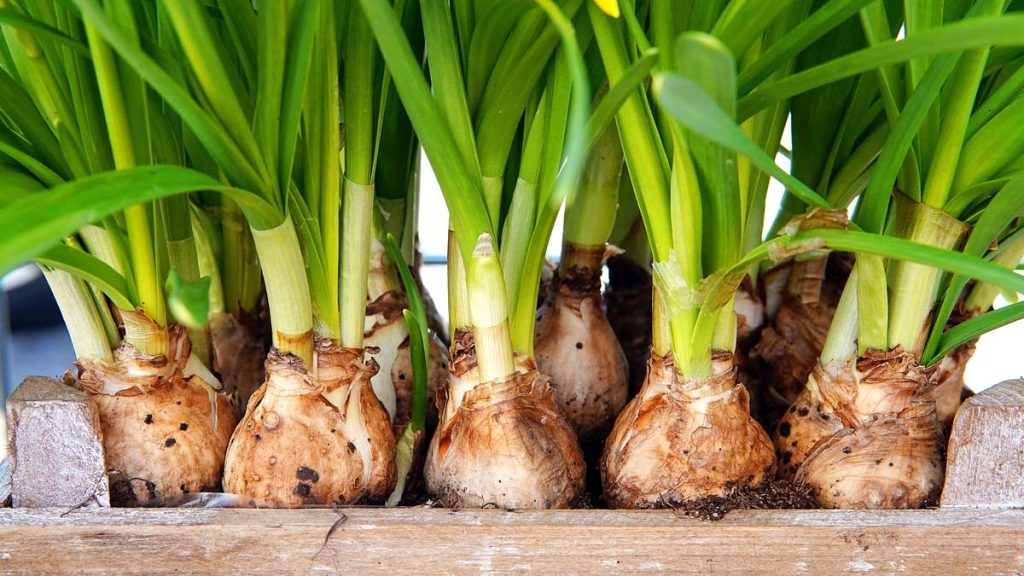
The RHS says prepared hyacinth bulbs, which are heat-treated for an earlier display, should be planted in September because they need 10 to 12 weeks for good root and shoot development. Pot them in peat-free multipurpose compost, or bulb fibre if the pot has no drainage holes, keep the room cool enough for the flower stalk to emerge, and note that the ASPCA lists hyacinth as toxic to dogs and cats.
Choosing and potting the bulbs
The RHS hyacinth growing guide says to use peat-free multipurpose compost in pots with drainage holes, and bulb fibre in pots without them, because bulb fibre holds water without becoming soggy. For indoor displays of prepared bulbs it says to arrange them closer than 7.5 cm (3 in) together, but without letting them touch. The 10 cm (4 in) planting depth and 7.5 cm spacing it gives apply to outdoor containers.
What the RHS page does not say
The page does not give a chilling length or temperature for forcing, an indoor planting depth for prepared bulbs, or room temperatures for the indoor display. If you buy prepared bulbs, follow the pack for the dark, cool stage.
Why the flower stalk does not emerge
The RHS says if the room is too warm the flower stalk may fail to emerge from the leaves before the flowers open, and a weak stalk also means the room is too warm. The fix it gives is to move the container to a cooler room until the stalk is taller than the leaves.
Watering and feeding
Keep bulbs moist while growing and flowering, add water only if the compost feels dry, and reduce water once the leaves begin to die off naturally. For water-grown bulbs, keep the water just below the bulb without touching it. Water-grown bulbs need no feeding. For bulbs that will be kept, the RHS suggests a liquid high-potassium feed, such as tomato fertiliser, from early spring until six weeks after flowering.
After flowering
Cut the stalk at the base when the flowers fade, then move pots to a sheltered spot outdoors or plant the bulbs in a sunny spot. The RHS says water-grown bulbs are usually discarded.
Hyacinths and pets
The ASPCA lists hyacinth, Hyacinthus orientalis, as toxic to dogs, cats and horses. It gives possibly narcissus-like alkaloids as the toxic principle and intense vomiting, diarrhea (occasionally with blood), depression and tremors as signs. See Fragrant Houseplants That Are Toxic to Cats and Dogs and keep bulbs and pots out of reach of pets.
Frequently asked questions
When should I plant prepared hyacinth bulbs?
The RHS says plant in September, because prepared bulbs need 10 to 12 weeks for root and shoot development.
Do hyacinths smell strong?
The RHS describes them as known for highly fragrant blooms.
Can I grow hyacinths in water?
Yes. The RHS says to keep the water just below the bulb without touching it, in a dark, cool place until the vase is full of roots, and that water-grown bulbs are usually discarded afterward.
Are hyacinths toxic to cats and dogs?
The ASPCA lists hyacinth as toxic to dogs, cats and horses.
Last reviewed 15 October 2026. Written by Md. Firozur Rahman. This page gives general guidance; see the Disclaimer and contact a veterinarian about any pet health concern. Browse more in Bloom & Fragrance.
Paperwhites need no chilling and bloom about 4 to 8 weeks after planting, according to UF/IFAS Gardening Solutions: Paperwhite Narcissus, or 4 to 6 weeks according to Illinois Extension (paperwhites). Both say heat and low light make the stalks tall and floppy, and the UF/IFAS page calls the flowers extremely fragrant. The ASPCA lists narcissus, including the paper white, as toxic to dogs and cats, with the bulbs the most poisonous part.
Planting
UF/IFAS says to use a well-drained potting mix, or gravel, pebbles or marble chips, in a pot 3 to 5 inches deep with drainage holes, with bulbs pointed end up and tips exposed. Illinois describes a soil method (pot two thirds full, tips showing) and a pebble method, with water to the bottom of the bulbs and not submerging them. It says to plant bulbs about an inch apart.
Light and temperature
Illinois says to keep the container at 50 to 60°F for a week or two after potting to encourage rooting, then move it to a warm area in the low 70s°F with bright light, and to a cooler place out of direct sun once buds open, to prolong the flowers. UF/IFAS says to use a sunny, cool location, that too little light or too much warmth makes leaves and stalks tall and floppy, and that too much sun makes the flowers deteriorate.
Topic
UF/IFAS
Illinois Extension
Time to bloom
About 4 to 8 weeks
Typically 4 to 6 weeks
Chilling
Not needed
Not needed; 50 to 60°F for a week or two after potting for roots
Light
Sunny, cool location
As much light as possible
Temperature
Cool; no number given
Low 70s°F after rooting; 60s°F to prevent lanky growth
Floppy stems
Linked to warmth or low light
Stake, keep cool, or use the alcohol method
Preventing floppy stems
Illinois lists staking and the Cornell alcohol method. Cornell research, as summarised by Illinois, found that adding alcohol to the water can reduce plant height by one third to one half while keeping the flower size, fragrance and longevity the same. Once shoots reach one to two inches, replace the water with a 4 to 6 percent alcohol solution, using 1 part 70 percent rubbing alcohol to 11 parts water, or 1 part hard liquor (about 40 percent) to 7 parts water. The article says to avoid beer and wine because their sugars can cause mold and bacteria, and that too much alcohol damages plants. UF/IFAS does not mention the alcohol tip.
Fragrance
UF/IFAS says the flowers are extremely fragrant and that yellow-flowered types are especially fragrant. Illinois adds that ‘Ziva’, the most widely grown variety, has a strong, musky scent some people find objectionable, and that ‘Inbal’, ‘Wintersun’ and ‘Grand Soleil d’Or’ have less or a more pleasing scent. For other scent topics, see Plant Fragrance and Headaches.
Paperwhites and pets
The ASPCA lists narcissus, which includes the paper white, as toxic to dogs, cats and horses, naming lycorine and other alkaloids and noting that the bulbs are the most poisonous part. See Fragrant Houseplants That Are Toxic to Cats and Dogs.
Frequently asked questions
Do paperwhites need to be chilled?
No. UF/IFAS says paperwhites do not need chilling, unlike most spring-flowering bulbs.
How long do paperwhites take to bloom?
About 4 to 8 weeks according to UF/IFAS, and typically 4 to 6 weeks according to Illinois Extension.
Why are my paperwhites floppy?
Too little light or too much warmth, according to both sources.
Can I plant paperwhites again next year?
The sources read here do not cover re-forcing. UF/IFAS says re-blooming is difficult, and Illinois treats paperwhites as annuals because they are only hardy to zone 8.
There is no reliable age at which a hoya blooms. Hoya maturity to bloom is a stage of growth, not a birthday. Iowa State University Extension says only that hoyas "often take several years to reach maturity and flower," and gives no number. The figures you see online, from two years to seven, are grower and retailer estimates that disagree with each other. What decides it is how much vine the plant has built, how much light it gets, and which species it is. A cutting from a flowering plant may bloom far sooner than a seedling.
Why the ages you read online disagree
Search this question and you get a spread of answers. One guide says two to three years. Another says two to five. A shop says two to seven. A blogger says about five, then adds that younger plants can bloom anyway.
None of these numbers is wrong, exactly. They are each describing a different situation and presenting it as the rule:
A plant grown from seed starts from zero and has the longest road.
A rooted cutting starts with whatever developmental stage the parent vine had reached.
A plant in a bright conservatory grows far faster than the same plant on a dim shelf.
Different species move at different speeds. Iowa State notes that Hoya australis "will often flower sooner indoors than other species," while Hoya kerrii plants "can take years to be mature enough to flower."
Put those variables together and a single calendar figure becomes almost meaningless. We could not find an extension service or botanic garden that puts a number of years on it, and we are not going to invent one. The honest answer to "how old" is "old enough in growth, which you can see, rather than in time, which you cannot."
What hoya maturity to bloom actually means
Plants go through a juvenile phase before they can flower. During that phase they are not simply slow. They are unable to respond to the signals that would otherwise trigger flowering, however good the conditions.
A New Mexico State University Extension guide on juvenile and adult phases (Guide H-616 by Esteban Herrera, dated February 2000, read September 27, 2026) describes it for pecan trees, but the principle is general to perennial plants. It defines the juvenile phase as "the period when young trees cannot be induced to flower, even when exposed to appropriate conditions," and it makes two points that matter for anyone waiting on a hoya:
"There is no exact point at which the phase change from juvenile to adult takes place." Maturity arrives gradually.
An adult plant "still may be largely vegetative but is capable of producing flowers." Being mature does not guarantee flowers. It only makes them possible.
That second point is where most frustration comes from. A hoya can be old enough and still not bloom, because maturity is permission, not a trigger. The trigger is usually light.
We should be clear about the limit here. We did not find a published study measuring the juvenile phase in hoyas specifically. The general principle is well established in plant science; how long it lasts in Hoya carnosa on a windowsill is not something anyone has pinned down.
Seed, cutting, or nursery plant: why the starting point matters
The same NMSU guide explains why propagation method changes the clock. When a tree is budded from bearing wood, "the bud is not juvenile and all growth from it is adult." The mature state lives in the growing tissue, and a piece taken from mature growth carries it along.
Applied cautiously to hoyas, this suggests:
Seed-grown hoyas have to pass through the whole juvenile phase. They are rare in the houseplant trade, but if you have one, it will take the longest.
Cuttings from a plant that has already flowered may not need to repeat that phase. Growers often report such cuttings blooming relatively young, sometimes while still small. That fits the principle, but it is grower observation, not a measured result.
A small nursery plant tells you nothing about age by its size alone. It may be a young cutting from a mature parent, or it may be a juvenile plant. A nursery plant already carrying old flower spurs has clearly flowered before.
There is one special case. Hoya kerrii is widely sold as a single heart-shaped leaf in a small pot. A leaf with no piece of stem attached has no bud to grow from, so it cannot produce a vine, and a plant that never builds vine never reaches the size to flower. That is not a maturity problem that time will fix.
Signs your hoya is approaching flowering age
Since age in years is unreliable, look at the plant instead. These are the observable signs that a hoya has the growth it needs:
Established, lengthening vines. Hoyas flower along their vines, so a plant that is still a compact tuft of leaves in the original pot has little to flower from. Steady, active vine growth is the first requirement.
Peduncles. Hoya flowers grow from short, leafless stalks called peduncles, or spurs, that emerge where a leaf meets the vine. Iowa State calls them "persistent structures" from which many species "rebloom from the same peduncle repeatedly." A spur appearing, even without buds yet, is the clearest sign the plant has moved into flowering mode. Never cut it off. A new spur can also sit bare for a while before buds appear at its tip, so an empty spur is not a failed one.
Old spurs on a bought plant. If a plant came from a shop with bare, stubby spurs, it has flowered before, and it is mature. If it is not blooming now, age is not the reason.
Flowers are a mature-plant trait. Colorado State University's PlantTalk page on the wax plant states simply that the "sweetly scented flowers are produced on mature plants." It gives no age, which is consistent with everything else here.
If it is mature and still not flowering
This is more common than most people think. A plant with long vines and years behind it is usually not too young. It is usually short of light.
The Iowa State University Extension guide "All About Hoyas" by Aaron Steil (last reviewed February 2026, read September 27, 2026) is direct about this: "Bright light is the primary driver, and many plants that never bloom simply are not receiving enough light indoors." Its checklist for a hoya that will not flower runs: provide brighter light, avoid oversized pots, fertilize lightly in spring and summer, provide a slight temperature drop, give it some time, do not prune dead flowers, and once buds form, leave it alone.
Light also feeds back into maturity itself. A plant in dim light grows slowly, so it takes longer to build the vine that flowering depends on. Two hoyas bought on the same day can reach flowering size years apart for that reason alone. For how light intensity relates to flowering in general, see how much light plants need to flower indoors.
On pot size, the "keep it root bound" advice is common for hoyas, and Iowa State does say they "bloom best when slightly pot-bound." What the evidence does and does not show about root restriction and flowering more broadly is covered in does being root bound make plants bloom.
How to tell "too young" from "wrong conditions"
This is the question behind most searches on this topic. A rough way to sort it out:
What you see
More likely explanation
Small plant, short vines, no spurs
Still building growth; time and light both matter
Long vines, no spurs, dim spot
Probably light, not age
Spurs present, no buds this season
Mature; conditions or season are holding it back
Buds formed, then dropped
Mature; something changed after buds set
Bought with old spurs, never rebloomed
Mature; look at light and whether spurs were cut
If buds are forming and falling, the plant has already answered the maturity question. What happens next is a separate problem, caused by a change after the buds set.
Does species make a difference?
Yes, and it is one of the few points where sources broadly agree. Iowa State describes Hoya australis as often flowering "sooner indoors than other species" and says Hoya kerrii plants "can take years to be mature enough to flower." Grower guides commonly add Hoya pubicalyx to the quicker group, though we did not find an extension source ranking it.
If you bought a hoya mainly to see it flower, the species on the label matters more than any general age figure. For a broader look at why flowering waits on maturity across fragrant plants, see how long before a plant flowers, and for more on this genus, our hoya page.
FAQ
How many years does it take a hoya to bloom?
There is no fixed number. Iowa State University Extension says hoyas "often take several years to reach maturity and flower." Online figures from two to seven years are estimates that mix seed-grown plants, cuttings and very different growing conditions.
Can a young hoya cutting flower?
It can. Cuttings taken from mature, flowering growth appear to carry that mature state with them, and growers report small cuttings blooming. It is not guaranteed, and light still has to be adequate.
How do I know my hoya is mature enough to flower?
Look for long, actively growing vines and, above all, peduncles: short leafless spurs at the leaf joints. A plant with spurs has reached flowering stage, whether or not it has buds right now.
My hoya is five years old and has never flowered. Is it too young?
Probably not. Iowa State says many hoyas that never bloom "simply are not receiving enough light indoors." Check light first, then pot size and whether any spurs have been cut off.
Will a single Hoya kerrii leaf ever flower?
Not usually. A leaf sold without any piece of stem has no bud to grow a vine from, and without vine growth the plant cannot reach flowering size.
Osmanthus fragrans, the fragrant tea olive, is a shrub rather than a typical houseplant. The RHS plant details says it is best grown in a temperate greenhouse outside mild areas, and the NC State Extension Gardener Plant Toolbox says that in cooler climates it can be grown in containers and overwintered indoors or as a houseplant. Both describe highly fragrant white flowers, in autumn according to the RHS and in early spring and fall according to NC State.
What the sources say about flowers and scent
The RHS describes small clusters of highly fragrant, tubular white flowers in autumn, and sometimes in spring and summer. NC State says small, very fragrant white flowers appear in early spring and again in fall, and says they smell like apricots. NC State also says flowers form on the previous season’s growth, so pruning can reduce next year’s bloom, and that frost damage reduces the following fall’s flowering.
Light, water and feeding
The RHS says to grow it in full light with shade from hot sun under glass, using peat-free loam-based compost, to water freely and feed with a balanced liquid fertiliser monthly while growing, and to water sparingly in winter. NC State says full sun to partial shade, that it is drought tolerant once established but needs supplemental water in hot, dry months, and that it prefers moist soil with good drainage.
Topic
RHS
NC State
Light
Full light, shade from hot sun under glass
Full sun to partial shade
Water
Freely while growing, sparingly in winter
Drought tolerant once established; extra water in hot, dry months
Feeding
Balanced liquid fertiliser monthly while growing
Not covered
Cold
Hardy in coastal, mild parts of the UK; elsewhere a temperate greenhouse
Frost sensitive; zones 8a to 11b
Pests
Generally pest-free; may suffer honey fungus
Aphids and scale
Size and houseplant limits
The RHS gives a height of 2.5 to 4 metres and 10 to 20 years to maturity, while its description says up to 5 metres, so the figures conflict. These describe the plant’s potential. The RHS does not call it a houseplant, only a conservatory or greenhouse plant. Neither source gives an indoor temperature, a pot size or an indoor light figure.
Pruning and pests
NC State warns that pruning can reduce next year’s flowers because they form on last season’s growth. The RHS puts it in pruning group 9 without further detail. Aphids and scale are the pests NC State names, and the RHS describes the plant as generally pest-free. For general pest handling indoors, see Gardenia Pests Indoors, which uses Colorado State guidance that applies to most houseplants.
Pets
I could not confirm an ASPCA entry for Osmanthus, and neither extension page addresses toxicity, so treat it as unconfirmed. See Pet-Safe Fragrant Houseplants for how to check a plant.
Frequently asked questions
Can osmanthus be grown as a houseplant?
NC State says it can be overwintered indoors or grown as a houseplant in cooler climates. The RHS lists conservatory and greenhouse use.
When does osmanthus flower?
The RHS says autumn, and sometimes spring and summer. NC State says early spring and fall.
Should I prune osmanthus?
Be cautious. NC State says pruning can diminish next year’s flowers because they form on old growth.
How cold can it get?
NC State calls it frost sensitive. The RHS rates it hardy in coastal, relatively mild parts of the UK. Neither gives an indoor minimum.
A hoya peduncle is the short, leafless stalk that a cluster of hoya flowers grows from, and in most hoyas it is permanent. When the flowers fade, the peduncle stays behind looking like a dead twig, but it is where the next flowers will appear. Many species bloom from the same peduncle year after year. Cutting it off removes a flowering site the plant has already built, and university extension guidance is unambiguous: leave it on the plant, and let spent flowers fall by themselves.
What a peduncle is
In botany, a peduncle is simply the stalk that holds a flower or a cluster of flowers. Most plants grow a new one each time they bloom, and it withers along with the flowers.
Hoyas are different. Their flowers sit in a rounded cluster, an umbel, at the tip of a stubby stalk that grows out from the junction between a leaf and the vine. When the flowers are done, that stalk does not die back. It waits. In the right conditions, a new cluster of buds forms at its tip.
The Iowa State University Extension guide, "All About Hoyas" by Aaron Steil (last reviewed February 2026, read September 27, 2026) puts it plainly: "Hoyas bloom from persistent structures called peduncles (spurs). Many species rebloom from the same peduncle repeatedly."
"Spur" and "peduncle" mean the same thing in hoya care. You will see both.
Why this is the most expensive mistake in hoya care
Most flowering houseplants forgive deadheading. You snip off a faded flower, perhaps with a bit of stem, and the plant carries on. Do the same to a hoya and you remove more than a spent flower. You remove the structure that would have produced the next one.
That is why Iowa State's advice is so direct: "Always allow spent flowers to fall off naturally and never cut them off," and "Do not deadhead hoya." The reason it gives: "Cutting them off can delay flowering for a long time, as you remove future flower sites."
It is easy to see how the mistake happens. A bare, brownish stub on an otherwise leafy vine looks like damage, and tidying it up feels like good care. On most plants it would be. On a hoya, it quietly undoes years of growth.
How to recognize a hoya peduncle
A peduncle is easy to confuse with two other kinds of bare growth on a hoya. This table sets out the differences as described by growers and extension sources, and the best test is always to wait and watch.
What you see
Where it grows
What it does next
Peduncle (flower spur)
A short stub from the joint where a leaf meets the vine
Stays short; buds form at its tip, now or later
New vine shoot
From the tip of a vine or a leaf joint, often long and thin
Keeps lengthening and eventually produces leaves
Aerial root
Along the vine, usually from near a node
Stays thin and root-like, may attach to a surface
The key signs of a peduncle are that it is short, stays roughly the same length between blooms, and often shows small scars or a slightly rough tip where the previous flowers were attached. If you have seen a flower cluster on a particular stub before, you can be certain it is a peduncle.
A new peduncle does not always carry buds straight away. It can sit for a while before a cluster forms at its tip, so a bare stub that has never flowered is not necessarily useless. If you are unsure whether something at a node is a bud or new growth, our guide on how to tell flower buds from new growth covers the general signs.
What to do when the flowers fade
The correct action after a hoya blooms is almost no action at all.
Let the flowers fall on their own. Individual flowers drop when they are finished. There is no need to pick them off.
Leave the peduncle exactly where it is, even if it looks dry and lifeless.
Do not move or turn the plant just because it has finished flowering. Iowa State links sudden changes in position, watering and temperature with bud drop, and a peduncle may already be preparing the next cluster.
Hoya flowers often produce a lot of nectar. Iowa State notes that the flowers "produce abundant reddish-brown nectar that can be messy." Protecting the surface below is reasonable; removing the flower stalk to stop the drip is not. If you see insects around the nectar, pest identification and treatment are outside the scope of this site, and your local university extension service is the right place to ask.
Pruning a hoya without losing peduncles
Sometimes a vine does need to be shortened. The rule is simple: cut the vine, never the spur.
Before cutting, look along the vine for peduncles. Every one you remove is a lost flowering site.
If a long vine has no peduncles on it, it can be shortened with far less cost to future flowers.
If a vine carries several peduncles, consider training it around its support instead of cutting it.
Remove only growth that is clearly dead or damaged.
The honest answer is that the removed spurs will not come back at the same spot as they were. The plant has not lost its ability to flower, though. Hoyas produce new peduncles from the leaf joints along growing vines, so a healthy plant in good light will, in time, build new flowering sites.
How long that takes is not something we can give a reliable figure for. It depends on the species, the plant's size and, above all, light. Grower estimates vary and we have not found an extension source that puts a number on it. What helps is giving the plant what it needs to grow new vine and flower, and then leaving every new spur alone. If a plant has flowered once and not since, our guide to why a plant blooms once and never again covers the other common causes to check at the same time.
Are there exceptions?
Yes, and this is not settled for every species. Iowa State says "many species" rebloom from the same peduncle, not all of them, and botanical descriptions of the genus describe the peduncle as usually persisting from year to year rather than always. Some hoya growers report species whose peduncles are shed after flowering.
For the common wax plant, Hoya carnosa, and most hoyas sold as houseplants, the persistent spur is the normal pattern. If you do not know your species, treat every peduncle as permanent. Leaving a stub that turns out to be spent costs you nothing. Cutting one that was about to flower costs you a season.
FAQ
Should I cut off the hoya peduncle after flowering?
No. The peduncle is where many hoyas produce their next flowers. Iowa State University Extension says to let spent flowers fall naturally, never cut them off, and not to deadhead hoya at all.
What does a hoya peduncle look like?
It is a short, bare stalk growing from the joint where a leaf meets the vine. After flowering it often looks dry and twig-like, sometimes with small scars at the tip where flowers were attached.
Will a hoya grow a new peduncle if I cut one off?
It can grow new peduncles at other leaf joints as the vine grows, but the one you removed is gone. How long a replacement takes varies with species, plant size and light.
Do all hoyas rebloom from the same peduncle?
Most commonly grown hoyas do, but not every species. Iowa State says "many species" rebloom from the same peduncle. If you are unsure, leave every peduncle in place.
Is a peduncle with no flowers dead?
Not necessarily. A peduncle can sit bare between blooms, and a new one may not carry buds when it first appears. Unless it is clearly shriveled and dead along with the vine around it, leave it on the plant.
The RHS says indoor winter jasmine, Jasminum polyanthum, may attract sap-feeding pests such as mealybugs and red spider mites, and advises regular checks because the earlier an outbreak is spotted, the easier it is to treat. Colorado State University Extension (houseplant pests) adds that spider mites are tied to hot, dry conditions, that scale is best treated with spray oils, and that new plants should be quarantined for at least three weeks. The RHS jasmine page covers J. polyanthum and does not mention jasmine sambac.
Spray oils are most effective; picking or rubbing for small infestations; treatment must cover a full generation of two to four months
Humidity and spider mites
Colorado State says spider mite problems are more likely in hot, dry sites and that increasing humidity around the plant is among the most effective controls. This ties spider mites to winter heating and dry air. General humidity and bud-drop issues are discussed in Low Humidity Bud Drop.
Quarantine and spraying cautions
Colorado State says new plants should be quarantined in a separate area for at least three weeks, then inspected carefully. It says to use only pesticides labeled for houseplants and follow the label precisely, that alcohol can burn leaves so test a small area first, that aerosols should be kept at least 18 inches from the plant, and that plants stressed by temperature extremes or drought should not be sprayed. This page does not recommend specific chemical products.
What the sources do not cover
Neither source gives jasmine-specific pest treatments, and the RHS page covers only J. polyanthum. The Colorado State guidance is for houseplants in general. If you grow sambac, treat the table as general houseplant advice, not jasmine research.
Frequently asked questions
What pests attack indoor jasmine?
The RHS names mealybugs and red spider mites for indoor jasmine. Colorado State describes scale, whiteflies, aphids, thrips and fungus gnats as common houseplant pests in general.
How do I get rid of mealybugs?
Colorado State says to swab with alcohol or use dilute alcohol or insecticidal soap, and notes that these are contact-only and miss root-feeding stages.
Does humidity help with spider mites?
Yes. Colorado State says increasing humidity around the plant is among the most effective controls, along with repeated water jets.
Last reviewed 15 October 2026. Written by Md. Firozur Rahman. This page gives general guidance and cannot diagnose a plant from a description; see the Disclaimer. Back to the Jasmine hub.
The two extension sources read for this guide agree on the pattern for feeding gardenia: use an acid-forming fertilizer, feed in the growing season, and do not feed in fall. The Clemson HGIC gardenia factsheet recommends a balanced, slow-release, acid-forming azalea fertilizer in spring after frost, repeated about six weeks later, in a 2-1-1 nutrient ratio. The UF/IFAS Gardening Solutions: Gardenias says to fertilize two or three times a year. Both are written for gardenias grown as outdoor shrubs, and neither gives an indoor schedule.
What Clemson says
Clemson says to apply a light feeding of a balanced, slow-release, acid-forming azalea fertilizer in spring after frost has passed, and to feed again about six weeks later to promote more flowers or faster growth in young plants. It looks for nutrients in the ratio 2-1-1, says organic acid-forming fertilizers are also suitable for spring and early summer, and says not to fertilize gardenias in the fall because late feeding stimulates tender growth that winter cold can kill.
What UF/IFAS says
UF/IFAS says to fertilize two or three times a year. In its Florida examples, the first application is around February in South Florida or March in North Florida, the second in September in North Florida or October in South Florida, with a third possible in summer. The page does not specify a fertilizer type, so the Clemson ratio is the more specific guide.
Topic
Clemson
UF/IFAS
Type
Balanced, slow-release, acid-forming azalea fertilizer; ratio 2-1-1
Not specified
Timing
Spring after frost, again about six weeks later
Two or three times a year; dates given for Florida
Fall
Do not fertilize
Second application in September or October in Florida
Soil pH
Less than 6.0
Between 5.0 and 6.5
Iron
Iron-containing product if new leaves yellow
Not covered
The two sources differ on fall. That is a regional difference, since the UF/IFAS dates are for Florida, so a colder climate is better served by the Clemson caution about late growth. An indoor plant does not face outdoor frost, but neither source says how this applies to a pot.
Soil pH and iron
Clemson wants soil that is acid, with a pH of less than 6.0, and says yellow new leaves point to iron deficiency, often after liming or planting near new concrete, which an iron-containing product can address during the growing season. UF/IFAS puts the pH between 5.0 and 6.5 and says that above 7.0 you should consider another plant or growing a gardenia in a container. See Soil pH for Gardenia and Gardenia Yellow Leaves for more.
What this means for a potted indoor gardenia
The practical reading is to use an acid-forming, balanced fertilizer lightly during the growing season and none in late fall. That is a reading of two outdoor sources. Neither gives an indoor rate, a pot-size adjustment, or a winter schedule, so follow the product label for container use, and fix soil pH before adding more fertilizer. Pests can also cause yellowing; see Gardenia Pests Indoors and the main Gardenia Indoor Care guide.
Frequently asked questions
How often should I fertilize an indoor gardenia?
Neither source gives an indoor schedule. Clemson says spring and again about six weeks later, UF/IFAS two or three times a year, both for outdoor shrubs.
What fertilizer is best for gardenia?
Clemson recommends a balanced, slow-release, acid-forming azalea fertilizer with a 2-1-1 ratio. UF/IFAS does not specify a type.
Should I feed in winter?
Clemson says not to fertilize gardenias in the fall. Neither source addresses winter feeding for houseplants.
Why are the new leaves yellow?
Clemson says yellow new foliage indicates iron deficiency, which can result from liming or planting near new concrete.
Last reviewed 15 October 2026. Written by Md. Firozur Rahman. This page gives general guidance and cannot diagnose a plant from a description; see the Disclaimer. Back to the Gardenia hub.
The ASPCA lists lemon, lime, orange and grapefruit as toxic to dogs, cats and horses. It names essential oils and psoralens as the toxic principles and lists vomiting, diarrhea, depression and potential dermatitis as signs. It adds that the fruit is edible but the skins and plant material can cause problems. I could not confirm ASPCA entries for kumquat, calamondin or Meyer lemon, so those are unconfirmed rather than safe.
The Lemon entry says the fruit is edible while the skins and plant material can cause problems. The Lime, Orange and Grapefruit entries say the same. In practice that means the leaves, stems and peel are the concern for a pet that chews a houseplant, not only the fruit. The ASPCA does not give amounts, so it does not say how much plant material causes signs.
What is not covered
The ASPCA entries read for this page are for lemon, lime, orange and grapefruit. They do not name kumquat, calamondin or Meyer lemon, which are common potted citrus, and I did not find confirmed entries for them. It would be reasonable to treat other citrus with caution, but that is an inference and not an ASPCA statement. Check the botanical name against the ASPCA database before buying.
If a pet chews a citrus plant
Note the plant’s botanical name and how much was eaten, then contact a veterinarian or the ASPCA Animal Poison Control Center at (888) 426-4435. The ASPCA also says consumption of any plant material may cause vomiting and gastrointestinal upset in dogs and cats.
The ASPCA lists lemon, Citrus limonia, as toxic to dogs, cats and horses, with vomiting, diarrhea, depression and potential dermatitis.
Is the fruit itself dangerous?
The ASPCA says the fruit is edible, and that skins and plant material can cause problems.
Is calamondin safe for cats?
I could not confirm an ASPCA entry for calamondin. Treat it as unconfirmed and ask a veterinarian.
What are psoralens?
The ASPCA names psoralens, along with essential oils, as the toxic principles in the citrus entries, and lists potential dermatitis among the signs. It does not explain them further.
The RHS hoya growing guide recommends a sharply draining, well-aerated mix for hoyas, such as equal parts orchid bark, peat-free multi-purpose compost and coarse perlite, with cactus compost plus added perlite as an alternative. It also says the pot should be only a few centimetres larger than the rootball, because oversized pots hold moisture longer and can rot the roots. That is one source, and this page does not claim it is the only workable recipe.
The RHS mix
Option
What the RHS describes
Main blend
Equal parts orchid bark, peat-free multi-purpose compost and coarse perlite
Alternative
Cactus compost with added perlite
Pot size
Only a few centimetres larger than the rootball
When to repot
Spring
After repotting
Do not feed for five to six weeks
The guide describes the goal rather than explaining each ingredient: a sharply draining, well-aerated blend. Orchid bark and perlite open up the mix compared with compost alone, which is why they appear in the recipe, but the RHS page itself does not spell that out.
Why drainage matters for hoyas
The RHS says overwatering or poor drainage can cause dropping leaves, blackening, dieback and root rot, and that root rot often kills the plant, so cuttings should be taken promptly. It says to keep compost moist but not waterlogged in the growing season, and from October to February to water moderately and let the compost become fairly dry without drying out completely.
Choosing the pot
The same guide says oversized pots hold moisture longer, which can rot roots. A pot only a few centimetres wider than the rootball is the RHS recommendation, repotted in spring. The RHS does not name a pot material or say whether drainage holes are needed, though drainage is the point of the whole advice.
Feeding and salt build-up
The RHS says to feed lightly every couple of weeks in spring and summer with a balanced, preferably urea-free orchid feed, and about once a month in autumn and winter until growth resumes. Too much fertiliser can cause salt build-up that stops roots absorbing water, so it advises flushing pots with plain water every few months.
Do not disturb a hoya in bud
The RHS says not to move plants once buds form, because they may drop them if the light changes, and that failure to flower may be due to insufficient light. For the wider picture on hoya flowering, see the Hoya hub.
Frequently asked questions
Can I use regular potting soil for hoya?
The RHS recommends a sharply draining, well-aerated blend and gives orchid bark, peat-free multi-purpose compost and perlite as an example. It does not say what happens with plain potting mix, but it warns that waterlogging causes root rot.
When should I repot a hoya?
The RHS says to repot in spring, into a pot only a few centimetres larger than the rootball.
Is hoya safe for pets?
The ASPCA lists a Hoya carnosa cultivar called wax plant as non-toxic to dogs and cats, but it does not cover other hoya species. See Pet-Safe Fragrant Houseplants.
Last reviewed 15 October 2026. Written by Md. Firozur Rahman. This is one source’s guidance and may not suit every growing condition; see the Disclaimer.
The New York Botanical Garden lists about two dozen fragrant orchids with the scents it attributes to each, and says most fragrant orchids are strongest in the morning when the light is bright. Scent fades as the afternoon heat builds, and sunny days increase it because warmth helps the volatile oils diffuse. The page is about scent, not culture: it gives no indoor care advice, so this guide covers which orchids smell like what and when, and where the information stops.
When orchids smell strongest
The New York Botanical Garden (fragrant orchids) page says most fragrant orchids are strongest in the morning, when light is bright, and fade as afternoon heat builds. Some are evening-scented: Brassavola nodosa, the queen of the night, begins at dusk when its nocturnal moth pollinators appear. The same pattern is discussed for other plants in Why Do Flowers Smell Stronger at Night?.
Conditions that change the scent
The page says sunny days increase scent, because warmth helps the volatile oils diffuse, and that high humidity makes scent linger longer. It also says scent changes over time and often becomes more complex the longer you smell it. For a general look at temperature and scent, see Temperature and Flower Fragrance and How Far Does Flower Fragrance Travel?.
Examples from the NYBG list
Orchid
Scent the NYBG gives
Brassavola nodosa
Lily-of-the-valley, starting at dusk
Dendrobium anosmum
Raspberry, then strawberry, rhubarb and hyacinth as it develops
Encyclia fragrans
Vanilla, honey
Neofinetia falcata
Coconut and jasmine
Oncidium Sharry Baby
Chocolate and vanilla
Vanda coerulescens
Grape bubble gum
Zygopetalum
Hyacinth
The page also says Cattleya-alliance orchids generally have floral, sweet or citrus scents, and that its list suits beginner and early-intermediate growers. It recommends holding your nose just above a bloom without touching it, or wafting air toward your nose, to avoid damaging the petals.
What the source does not cover
The NYBG page does not give light, watering, temperature or humidity advice for growing these orchids indoors, and it does not say which species are easiest to keep in a home. It points to a book for home-growing tips. It also dates from 2010, so some species names may be out of date, and it does not give scientific sources for its scent and pollination claims. Treat the list as a starting point, and check care needs for a specific orchid before buying.
Orchids and pets
The ASPCA lists ASPCA: Phalaenopsis Orchid, the moth orchid, as non-toxic to dogs, cats and horses. I did not check the other genera in the table above, so do not assume they share that listing. See Pet-Safe Fragrant Houseplants for how to check a plant.
Frequently asked questions
When are orchids most fragrant?
The NYBG says most are strongest in the morning when light is bright, with some, like Brassavola nodosa, scented at dusk.
Does humidity affect orchid fragrance?
The NYBG says high humidity makes scent linger longer.
Which fragrant orchids are best for beginners?
The NYBG says its list suits beginner and early-intermediate growers, but it does not rank individual species by ease of care.
Last reviewed 15 October 2026. Written by Md. Firozur Rahman. This page gives general information and cannot advise on a specific plant; see the Disclaimer. Browse more in Bloom & Fragrance.
If you want to know how to get a hoya to bloom, start with light, because it is the factor university extension sources put first. A hoya needs bright light, it needs to be mature enough to flower, and it needs its old flower spurs left in place, since many hoyas flower from the same spurs again and again. Get those three right and most healthy plants will eventually bloom. Fertilizer tricks, tight pots and other popular tips come a long way behind, and some rest on little evidence.
Why a healthy hoya can refuse to flower
A hoya that grows new vines and leaves but never flowers is not sick. It is doing the job it can afford. Flowering is expensive for a plant: it has to produce clusters of waxy flowers, often with plenty of nectar and scent, and it only commits to that when it has the energy to spare and the signals to start.
That is why "healthy but not flowering" is so common with this genus. The plant can have enough light to survive and grow, but not enough to fund flowers. It can be large enough to look established but still be too young. Or it can have flowered once, been tidied up, and lost the very structures it flowers from.
The good news is that the causes are few, and they can be ranked. The hoya is also the most realistic plant on this site for an ordinary room, which is why we open the genus with our hoya pillar guide.
How to get a hoya to bloom: the causes, ranked by evidence
Cause
What the sources say
How confident to be
Too little light
Iowa State: "Bright light is the primary driver"
Strong, and consistent across sources
Plant too young
Iowa State: hoyas "often take several years to reach maturity and flower"
Strong, but no fixed age applies to every species
Flower spurs cut off
Iowa State and Colorado State both say never remove them
Strong, and it explains many "it flowered once" cases
Buds formed, then dropped
Iowa State links bud drop to sudden changes in watering, temperature or position
Good, for plants that do make buds
Pot too big
Iowa State: hoyas "bloom best when slightly pot-bound"
Stated by extension, but research is thin
Wrong fertilizer
Iowa State advises feeding "lightly in spring and summer"
Weak as a cause of no flowers on its own
The order matters. People often switch fertilizer or leave a plant root-bound for years while it sits in a dim corner, and the missing ingredient was light the whole time.
Light comes first
The Iowa State University Extension guide, "All About Hoyas" by Aaron Steil (last reviewed February 2026, read September 27, 2026) is blunt about it: "Bright light is the primary driver, and many plants that never bloom simply are not receiving enough light indoors." It also notes that hoyas "thrive in bright, indirect light."
The mechanism is simple. A plant makes the sugars it spends on flowers through photosynthesis, and indoor light, even near a window, is far weaker than outdoor light. A plant can keep its leaves green on that budget without ever having enough left over to flower.
In practice, the fix is placement: moving the plant to the brightest spot you have that does not scorch the leaves. How much light "enough" is, and what an indoor window actually delivers, is covered in our guide to how much light plants need to flower indoors. We do not recommend specific hour counts or light levels here, because the extension sources we read do not give them for hoyas and the figures that circulate online vary widely.
Maturity: some plants are simply too young
A hoya grown from a cutting spends its first years building vine. Iowa State says hoyas "often take several years to reach maturity and flower" and that "young plants need more time to flower." Colorado State University's PlantTalk says the same in fewer words: the flowers "are produced on mature plants."
There is no single age that applies to every hoya. Species differ, and so do growing conditions, since a well-lit plant reaches flowering size faster than a dim one. Grower guides often suggest that some small-leaved species flower younger than the common wax plant, but we have not found an extension source that confirms which ones. If your plant is still small, patience is a legitimate answer. We look at the general question of flowering age in how long before a plant flowers.
The spurs: the rule that costs people the most flowers
This is the part that makes hoyas different from almost every other houseplant.
Hoya flowers do not grow from fresh stems each year. They grow from short, leafless stalks called peduncles, or spurs. When a flower cluster finishes, the spur stays behind looking like a dead twig. It is not dead. Iowa State explains: "Hoyas bloom from persistent structures called peduncles (spurs). Many species rebloom from the same peduncle repeatedly."
Its advice follows directly: "Always allow spent flowers to fall off naturally and never cut them off," because "cutting them off can delay flowering for a long time, as you remove future flower sites." The Colorado State University PlantTalk page on the wax plant (read September 27, 2026) says the same: "Do not remove the leafless spurs or stubs, on which new flowers appear every year."
So if your hoya flowered once, was trimmed tidy, and has not flowered since, the trim is a likely reason. The plant can make new spurs, but that takes time. It is the one mistake in hoya flowering that you cannot quickly undo, which is why it gets its own article on this site.
Once buds appear, leave the plant alone
Getting buds is not the finish line. Iowa State warns that "sudden changes in watering patterns, temperature swings, or moving the plant to a new location with different light can cause bud drop, sometimes called 'bud blast.'"
The practical rule is consistency. When a cluster of buds forms on a spur, avoid turning, moving or rearranging the plant until the flowers open. The mechanism behind this, and why a plant sheds buds rather than finishing them, is explained in our guide to why moving a plant causes bud drop.
Pot size and fertilizer: real, but secondary
Two tips dominate hoya forums: keep it pot-bound, and switch to a "bloom" fertilizer.
On pot size, Iowa State says hoyas "bloom best when slightly pot-bound," and many growers agree. The research behind the wider idea that root restriction triggers flowering is less clear-cut than the advice suggests. The honest position is that a snug pot is unlikely to hurt, but it will not rescue a plant in poor light.
On feeding, Iowa State recommends that plants be "fertilized lightly in spring and summer and allowed to rest in winter." That is general care advice, not a flowering trigger. We have not found evidence that a special bloom fertilizer makes a hoya flower when light or maturity is the real limit.
A slight night-time drop may help some species
Iowa State also notes that "some hoyas benefit from a slight drop in nighttime temperatures compared to daytime temperatures." Colorado State lists 70 to 75°F during the day and 60 to 65°F at night as the wax plant's preferred range. The word "some" is worth taking seriously: this is a helpful condition for certain species, not a universal switch, and it is not a substitute for light.
What this advice cannot promise
Hoya is a large genus, and most published guidance is written around the common wax plant, Hoya carnosa. Other species can be slower, fussier or simply different. Even with good light, a mature plant and every spur intact, a hoya may take its time, and there is no reliable way to force a flowering date. What the evidence does support is the order of priorities: light, then age, then protecting the spurs, then avoiding disturbance once buds show.
FAQ
Why is my hoya growing but not blooming?
The most common reason is not enough light. Iowa State University Extension calls bright light "the primary driver" of flowering and says many plants that never bloom are simply not getting enough of it indoors. Age and removed flower spurs are the next things to check.
How long does it take for a hoya to bloom?
It depends on the species and conditions. Iowa State says hoyas "often take several years to reach maturity and flower," and there is no single age that applies to every plant. Better light generally shortens the wait.
Should I cut off the dead flower stalks on my hoya?
No. The leafless stalks are the spurs, or peduncles, that many hoyas flower from again. Iowa State says to let spent flowers fall naturally and never cut them off, and Colorado State University says not to remove the spurs.
Does a hoya need to be root bound to flower?
Iowa State says hoyas "bloom best when slightly pot-bound," but a tight pot is a secondary factor. It will not make a plant flower if it lacks light or maturity.
Why did my hoya's buds fall off before opening?
Usually because something changed while the buds were developing. Iowa State lists sudden changes in watering, temperature swings and moving the plant to a spot with different light as causes of bud drop.
The ASPCA lists these fragrant plants as toxic to dogs and cats: gardenia (entered as cape jasmine), lavender, geranium (Pelargonium), citrus including lemon, lime, orange and grapefruit, hyacinth, narcissus (which includes paperwhites) and Brunfelsia (Paraguayan jasmine). The signs it lists range from mild stomach upset to tremors and seizures, so the plant matters. For plants with non-toxic listings, see Pet-Safe Fragrant Houseplants.
This page uses the ASPCA’s plant entries as its source. A plant not on this page is not proven safe, and the ASPCA list is not meant to be all-inclusive.
What the ASPCA lists for each plant
Plant
ASPCA botanical name
Toxic principle
Signs the ASPCA lists
Gardenia (cape jasmine)
Gardenia jasminoides
Genioposide, gardenoside
Mild vomiting and/or diarrhea, hives
Lavender
Lavandula angustifolia
Linalool, linalyl acetate
Nausea, vomiting, loss of appetite
Geranium
Pelargonium species
Geraniol, linalool
Vomiting, anorexia, depression, dermatitis
Lemon, lime, orange, grapefruit
Citrus limonia, C. aurantifolia, C. sinensis, C. paradisii
The ASPCA does not rank the plants, but the signs it lists suggest an order. Brunfelsia lists tremors and seizures lasting several days. Narcissus lists convulsions, low blood pressure, tremors and cardiac arrhythmias for larger ingestions, and the ASPCA notes that the bulbs are the most poisonous part. Hyacinth lists intense vomiting, diarrhea, depression and tremors. Gardenia, lavender, geranium and citrus list vomiting, diarrhea or skin signs. That ranking is a reading of the entries, not an ASPCA statement.
Citrus, geranium and gardenia in more detail
For citrus, the ASPCA entries for Lemon, Lime, Orange and Grapefruit all name essential oils and psoralens, and add that the fruit is edible but the skins and plant material can cause problems. The Geranium entry covers Pelargonium species; scented geraniums are Pelargonium, which is an inference, and the care guide is Scented Geranium Indoors. For the gardenia, see the Cape Jasmine entry and Gardenia Indoor Care.
Plants where the ASPCA entry was not confirmed
I could not confirm ASPCA entries for night-blooming jasmine (Cestrum nocturnum), Carolina jessamine or plumeria. Treat them as unconfirmed rather than safe, and check the ASPCA’s plant database or a veterinarian. The jasmine-named plants are sorted out in Is Jasmine Toxic to Cats and Dogs?.
If a pet has eaten one of these plants
Note the botanical name and how much was eaten, and contact a veterinarian or the ASPCA Animal Poison Control Center at (888) 426-4435. The ASPCA also says consumption of any plant material may cause vomiting and gastrointestinal upset in dogs and cats.
Frequently asked questions
Is lavender toxic to cats?
The ASPCA lists Lavender as toxic to dogs and cats, naming linalool and linalyl acetate and listing nausea, vomiting and loss of appetite as signs.
Are citrus plants toxic to dogs?
The ASPCA lists lemon, lime, orange and grapefruit as toxic to dogs, cats and horses, with vomiting, diarrhea, depression and potential dermatitis.
Are paperwhites poisonous to pets?
The ASPCA lists narcissus, including the paper white, as toxic to dogs, cats and horses, and says the bulbs are the most poisonous part.
What about essential oils from these plants?
This page covers live plants only. The ASPCA entries for lavender and citrus name essential-oil compounds as toxic principles, but this page does not assess diffusers or oils.
Last reviewed 15 October 2026. Written by Md. Firozur Rahman. This page is general information, not veterinary advice; see the Disclaimer. Find more guides in Find a Plant.
Good jasmine after flowering care is mostly about timing, because the months right after bloom are when next year's flowers are made possible. For the winter-flowering Jasminum polyanthum sold on hoops, spring is the window: prune the stems that flowered, give the plant bright light and a regular feed through the warm months so it grows strong new stems, and let it spend summer somewhere warm and sunny. Then, from autumn, stop cutting and let it cool slightly so those new stems can set buds.
Why the weeks after bloom decide the next bloom
A jasmine that has just finished flowering looks like it has nothing left to do. In fact it is at the start of the cycle that produces the next display.
The plant flowers on stems it grew earlier. For J. polyanthum, the stems that carry the winter flowers are grown during the preceding spring and summer, and the buds form on them in autumn and early winter. So the care you give in spring is not rewarding the bloom that just ended. It is building the stems that the next one will come from.
That gives the whole year a simple shape:
Spring: tidy up and start the new growth.
Summer: grow as much healthy stem as possible.
Autumn into winter: stop disturbing the plant and let the buds form.
Almost every mistake with a once-a-year jasmine is doing one of those jobs in the wrong season. If you are not sure which jasmine you own, check our guide to identifying the jasmine on your windowsill first, because the timing below is written for J. polyanthum, with notes on Arabian jasmine where it differs.
Step one: prune soon after the last flowers fade
Spring pruning is the most useful single thing you can do after flowering. The Chicago Botanic Garden's jasmine profile (read September 27, 2026) is direct about it: "Pruning and repotting should take place in spring."
For a winter bloomer, pruning early in spring gives the plant the longest possible growing season to replace what you removed. Pruning late, in autumn, removes stems that are already setting next winter's buds.
What to do, in practice:
Cut stems that carried flowers back to a strong side shoot or a healthy pair of leaves.
Remove dead, broken and very weak stems.
Leave healthy new shoots. They are the stems next winter's flowers will come from.
Removing faded flower clusters is optional. If you do it, take off only the spent cluster, not the stem below it.
One caution before you reach for the scissors: make sure flowering has really finished. A plant can put out a second, smaller flush of flowers after the main one, and waiting a few weeks costs nothing. For the old-wood and new-wood logic behind this across other bloomers, see when to prune a flowering houseplant without losing blooms.
Step two: feed through the growing season, and know the sources disagree
The plant is now going to grow a lot of stem, and it needs nutrients to do it. The two authorities we read agree that jasmines should be fed through the warm months. They do not agree on what to feed.
Source (read September 27, 2026)
What it says
Chicago Botanic Garden
"In spring and summer, water regularly and fertilize every two weeks with a high phosphorus fertilizer to encourage good flower development."
RHS
"To boost flowering, feed plants growing in containers with a high-potassium liquid feed (such as tomato fertiliser)"
That is a real disagreement, not a difference in wording: phosphorus and potassium are different nutrients. The honest summary is that both sources want a regular feed in spring and summer, and both favor a flowering-type fertilizer over a high-nitrogen one. The specific claim that extra phosphorus produces extra flowers is weaker than it sounds; we look at the research in does phosphorus make plants bloom.
What matters more than the bottle is the season. Feeding belongs to the months when the plant is actively growing. Heavy feeding late in the year pushes soft leafy growth at exactly the time you want the plant to settle into bud-setting.
Step three: give it as much light as you can
Light is what turns stems into flowering stems. The Chicago Botanic Garden profile says jasmines "all need bright light with at least four hours of direct sun per day."
Indoors that usually means the brightest window you have. A jasmine that spends spring and summer in dim light tends to make long, thin stems with few flowering points, and no amount of feeding makes up for it.
Step four: consider a summer outdoors
Both sources treat an outdoor summer as a good thing for this plant, with a temperature limit on bringing it back in.
The Chicago Botanic Garden says of J. polyanthum: "A summer spent outdoors in full sun is the preferred warm-weather treatment."
The RHS jasmine growing guide (read September 27, 2026) says tender jasmines can move "outside in summer, to a warm, sheltered spot," and advises bringing them back indoors before night temperatures fall below 13 to 15˚C, which is roughly the mid 50s Fahrenheit.
A summer outside gives stronger light than almost any window, which suits the goal of the season: sturdy, well-lit stems. If moving the plant is not practical, the brightest indoor spot you have is the fallback.
Timing the move back in matters too. A change of position can upset a plant that is already carrying buds, so bring it in before buds appear rather than after.
Step five: from autumn, stop and let it cool
This is where after-flowering care ends and bud-setting begins. From autumn, the plant needs to be left alone:
No pruning, apart from dead or broken stems.
Less feeding, in line with slower growth.
A cooler spot, if you can manage one.
On temperature, the sources do not agree, and we would rather show you that than pick one. The Chicago Botanic Garden says J. polyanthum "requires much cooler growing conditions than many of the other varieties and can actually tolerate temperatures between 40 and 50 degrees from September until the plant sets its buds." It also says jasmine "requires at least a 15-degree difference between day and night temperatures." The RHS, on the other hand, groups J. polyanthum with tender jasmines that "need to be kept consistently warm, above 13˚C (55˚F)."
Both can be partly right: a plant can want cool autumn nights to set buds while still being damaged by real cold. What the two share is that a warm, heated room held at one temperature day and night is not what either describes. We go through what a cool period actually does, and which plants genuinely need one, in the cold period some plants need to bloom.
Arabian jasmine is on a different schedule
Jasminum sambac, the tea and perfume jasmine, does not follow the one-big-bloom pattern in warm conditions. It flowers in repeated flushes, so "after flowering" comes round several times a year.
For this plant, the Chicago Botanic Garden notes that its cultivars "can either be pruned right after blooming or their stiff, upwardly climbing branches can be woven through a low window trellis or even miniblinds." A light trim after each flush, rather than one spring cut, fits that habit. The spring-to-autumn rhythm above still applies to feeding and light, because warmth and light are what drive its new, flowering growth.
After-flowering care at a glance
Season
Main job
What to avoid
Spring, as flowers fade
Prune flowered stems; start regular feeding
Cutting before the bloom is truly over
Late spring to summer
Maximum light, outdoors if possible; keep feeding
Dim corners; cutting off shoots as "untidy"
Late summer
Bring indoors before cool nights
Moving it once buds show
Autumn to bloom
Leave alone; reduce feeding; cooler nights if possible
Pruning; a warm, constant-temperature room
The limits of this advice
Most published jasmine care is written for garden plants in climates with real seasons. Indoors, a heated room blurs those seasons, so the table above is a pattern, not a calendar. The feeding and temperature advice also comes from sources that disagree with each other, and we have not found research that settles either question for J. polyanthum grown as a houseplant. What does hold across every source is the order of the year: cut and feed in spring, grow in summer, and leave the plant alone while it sets buds.
FAQ
Should I cut off dead jasmine flowers?
It is optional. Removing spent clusters makes the plant look tidier but does not decide next year's bloom. If you do it, snip only the faded cluster, not the stem beneath it, because that stem may still produce growth that flowers later.
When should I stop pruning jasmine after flowering?
For J. polyanthum, finish pruning in spring and stop by late summer. From autumn the plant is setting buds on its new stems, and cutting then removes next winter's flowers.
Should I fertilize jasmine after it flowers?
Yes, through spring and summer while it is growing. The Chicago Botanic Garden recommends a high-phosphorus feed every two weeks, while the RHS recommends a high-potassium liquid feed for container plants. Both agree on feeding in the growing season and easing off later.
Can I put my jasmine outside after it finishes flowering?
Yes, once the weather is warm. Both the Chicago Botanic Garden and the RHS support a summer outdoors in a warm, sunny or sheltered spot, and the RHS advises bringing tender jasmines back in before nights drop below 13 to 15˚C.
Why does my jasmine grow well after flowering but never bloom again?
Usually because of what happens in autumn rather than spring: late pruning, a room that stays warm day and night, or too little light while the buds should be forming.
The pests that extension sources name most often on gardenia are whiteflies, scale insects, aphids, thrips, spider mites and mealybugs, including root mealybugs. The Clemson HGIC gardenia factsheet calls whiteflies the most common gardenia pest, and Colorado State University Extension (houseplant pests) says root-infesting mealybugs are associated with gardenias. Most gardenia-specific pest guidance is written for garden shrubs, so this page separates what is gardenia-specific from the general houseplant advice.
The pests named for gardenia
Pest
Signs the sources describe
First steps the sources describe
Whiteflies
Yellowing leaves, stunted growth, early leaf drop, sticky honeydew and sooty mold; check leaf undersides and new growth (Clemson)
Sticky cards for adults and vacuuming on small plants (Colorado State)
Scale insects
Weak or dying branches, stunted growth, smaller leaves and flowers; scales are often mistaken for plant parts (Clemson)
Scrape or rub off light infestations (Clemson, Colorado State)
Mealybugs and root mealybugs
Sap feeding, leaf drop, honeydew and cottony egg masses (Colorado State)
Swab with alcohol; contact controls miss root-feeding stages (Colorado State)
Aphids
Small, soft-bodied insects clustered on new growth, distorted growth, reduced flowering, honeydew (Clemson)
Wash off with water; yellow sticky traps for winged adults (Clemson, Colorado State)
Thrips
Silvery speckles on leaves, flower buds that die before opening, distorted or brown flowers (Clemson)
Soaps or oils for exposed stages; blue or yellow sticky traps for adults (Colorado State)
Spider mites
Fine webbing, yellow or white stippling, worst when hot and dry (Clemson)
Repeated water jets and higher humidity (Colorado State)
Thrips and bud drop can look alike, since Clemson lists flower buds that die before opening as a thrips sign. The gardenia-specific causes of bud drop are covered in Gardenia Bud Drop and Gardenia Humidity Indoors.
Checking and quarantine
Colorado State says new plants should be placed in quarantine in a separate area of the household for at least three weeks and inspected carefully. Clemson advises inspecting leaf undersides and new growth. Colorado State also says plants under stress are more susceptible to insect and mite injury, which fits the general advice to keep light, watering and humidity steady.
Treatments and cautions
For light whitefly infestations Clemson suggests insecticidal soap or horticultural oil, covering upper and lower leaf surfaces and repeating three times at 5- to 7-day intervals. Colorado State says to use only pesticides labeled for houseplants and to follow the label precisely. It also says alcohol can burn leaves, so test a small area first, and that sprays should be avoided on plants already stressed by temperature extremes or drought.
Clemson adds a gardenia-specific warning: gardenias are sensitive to some insecticidal soaps, so use only products labeled safe for gardenias. It also says not to apply oils or soaps above 90°F or to drought-stressed plants. Both sources describe soil-applied systemic insecticides. This page does not recommend specific chemical products, because labels, local rules and risks to bees vary.
Pest problem or something else?
Clemson lists the causes of gardenia bud drop as low humidity, over- or under-watering, insufficient light and high temperatures, and lists yellow new growth as iron deficiency (chlorosis). Sticky leaves with a black film point to honeydew and sooty mold, which point to sap-feeding insects. For yellowing, see Gardenia Yellow Leaves and Soil pH for Gardenia.
Frequently asked questions
Why are my gardenia leaves sticky?
Sticky leaves are usually honeydew from sap-feeding insects such as whiteflies, scale or mealybugs. Clemson says honeydew supports sooty mold, the black film that grows on it.
What are root mealybugs?
Colorado State describes mealybugs that live mainly on roots and says root-infesting mealybugs are associated with African violet and gardenias. Alcohol and soap are contact-only, so they miss root-feeding stages.
Last reviewed 15 October 2026. Written by Md. Firozur Rahman. The Clemson pages are written for garden gardenias, so apply them to potted plants with care. This page gives general guidance and cannot diagnose a plant from a description; see the Disclaimer. Back to the Gardenia hub.
Scented geraniums are Pelargonium plants grown mainly for fragrant leaves rather than flowers. University of Illinois Extension says there are literally hundreds of types, with scents including apple, mint, lemon, coconut and rose, and that the plants prefer a full sun location, a container with ample drainage holes and soil kept uniformly moist but allowed to dry between waterings. Indoors, give the plant the brightest spot you have. Pet owners should know that the ASPCA lists Pelargonium species as toxic to dogs and cats.
What scented geraniums are
The extension page identifies scented geranium as Pelargonium sp. and says plants range from two to three feet tall to nearly cascading, with foliage that varies in size, shape, color and texture. Flowers are described as secondary and not very attractive. For other plants grown for scented foliage, see Plants With Fragrant Leaves.
Light, soil and pot
The page says to use a full sun location, a prepared soil mix and containers with ample drainage holes. It gives no number of sun hours and no pot size. Indoors the practical reading is the sunniest window available, and a pot that can drain freely.
Watering and feeding
Keep soil uniformly moist and let it dry between waterings, according to the extension page. During the growing season it says to apply liquid fertilizer about every two weeks, and to reduce fertilizer when the plant is indoors. It does not give a watering interval in days or a fertilizer strength.
Bringing the plant in for winter
The page says scented geraniums will not overwinter outdoors in cold climates. Before frost, move the plant to a bright location, water as needed, and cut a large plant back before bringing it indoors. It gives no temperature ranges, so this page does not invent any.
Pruning and cuttings
Occasional pruning or pinching maintains a good plant habit, and plants are most often grown from tip cuttings, which root easily, according to the extension page.
Topic
What University of Illinois Extension says
Light
Full sun location
Soil and pot
Prepared soil mix; ample drainage holes
Water
Uniformly moist, dry between waterings
Fertilizer
Liquid fertilizer about every two weeks in growing season; reduce indoors
Winter
Move to a bright location before frost; cut back large plants
Propagation
Tip cuttings root easily
Pests and temperature
Not covered
Using the leaves, and the pet caution
The extension page says leaves can be harvested as needed and used fresh or dried. It lists flavoring desserts, beverages, vinegars and jellies, and says the more pungent, spicy types are used for potpourri, sachets and perfumes. It lists no cautions.
The ASPCA lists geranium, Pelargonium species, as toxic to dogs, cats and horses. It names geraniol and linalool as the toxic principles and lists vomiting, anorexia, depression and dermatitis as signs. Reading the two together is an inference, because the extension page and the ASPCA entry use slightly different names, but the extension page identifies scented geranium as a Pelargonium. With pets in the home, keep cuttings and dried leaves out of reach.
Frequently asked questions
Do scented geraniums need full sun?
The University of Illinois Extension page says they prefer a full sun location. No number of hours is given.
How often should I fertilize?
About every two weeks during the growing season, with less fertilizer when the plant is indoors.
Can I bring my outdoor scented geranium inside for winter?
The extension page says to move it to a bright location before frost, water as needed, and cut a large plant back first.
Are scented geraniums safe for cats and dogs?
The ASPCA lists Pelargonium species as toxic to dogs and cats. See Is Jasmine Toxic to Cats and Dogs? for how to check other scented plants.
Last reviewed 15 October 2026. Written by Md. Firozur Rahman. This page gives general guidance and cannot diagnose a plant from a description; see the Disclaimer. For other scent topics, browse Bloom & Fragrance.
The ASPCA lists several fragrant houseplants as non-toxic to dogs and cats: Jasminum species, Madagascar jasmine, star jasmine, moth orchid, rosemary, basil and a wax plant (a Hoya carnosa cultivar). Other popular scented plants, including gardenia, lavender, citrus and scented geranium, carry toxic listings. Non-toxic does not mean harmless, because the ASPCA says eating any plant material may cause vomiting and stomach upset in dogs and cats.
This guide is limited to what the ASPCA’s plant entries say, and it marks the gaps. A plant missing from the list is not proven safe, and the ASPCA list is not meant to be all-inclusive.
How to read the ASPCA list
Each ASPCA entry gives a botanical name, says whether the plant is toxic to dogs, cats and horses, and where it applies lists the toxic principle and signs. The ASPCA says plants listed as non-toxic, or as potentially toxic with mild stomach upset, are not expected to be life-threatening to pets. That is a smaller risk than the plants it lists as toxic, but it is not a promise that a pet can eat a whole plant without a problem.
Entries are by botanical name, so the label on a pot matters. “Jasmine” alone is not enough, as Is Jasmine Toxic to Cats and Dogs? explains.
Three details from the entries are worth knowing. The jasmine entry is listed at genus level, as Jasmine (Jasminum species), so it does not separately name sambac or polyanthum. The Wax Plant entry is for a specific cultivar of Hoya carnosa with the common names Hindu rope plant and porcelain flower, and it lists dogs and cats but does not mention horses. The Basil entry lists dogs and cats and does not mention horses either.
Plants to check before you buy
The ASPCA lists gardenia (entered as cape jasmine), lavender, geranium (Pelargonium species), citrus such as lemon, lime and orange, and Brunfelsia (Paraguayan jasmine) as toxic to dogs and cats. If any of these are already in your home, see the care guides for gardenia and lavender and keep them out of reach.
How to choose a pet-safer fragrant plant
Find the botanical name on the tag, not just the common name.
Search the ASPCA plant database for that exact name.
Check the entry for your pet: some entries list dogs and cats but not horses.
If there is no entry, treat the plant as unconfirmed and ask a veterinarian.
Place any plant out of reach of a pet that chews, even if the entry says non-toxic.
Frequently asked questions
Are orchids safe for cats and dogs?
The ASPCA lists Phalaenopsis Orchid as non-toxic to dogs, cats and horses, under the common names moth orchid and moon orchid.
Is rosemary safe for pets?
The ASPCA lists Rosemary (Rosmarinus officinalis) as non-toxic to dogs, cats and horses.
Does a non-toxic listing mean my pet can eat the plant?
No. The ASPCA says consumption of any plant material may cause vomiting and gastrointestinal upset in dogs and cats. A non-toxic listing means the entry does not name a toxin.
What should I do if a pet eats a plant?
Contact a veterinarian or the ASPCA Animal Poison Control Center at (888) 426-4435, and have the plant’s botanical name ready.
Last reviewed 15 October 2026. Written by Md. Firozur Rahman. This page is general information, not veterinary advice; see the Disclaimer. For other scent topics, browse Bloom & Fragrance.
Indoor lavender usually dies from wet roots and too little light. The RHS lavender growing guide says lavender needs lots of sun and fast-draining soil, and the University of Arkansas Cooperative Extension advises putting an indoor plant in the sunniest and coolest room of the house. An ordinary windowsill with regular houseplant watering and standard potting compost gives it close to the opposite of both.
Neither source is a houseplant guide. Both are written for lavender in the ground or in outdoor containers, so the indoor advice below is a reading of those conditions, and this page marks where it goes beyond what the sources say.
Cause 1: not enough light
The RHS says lavender needs lots of sun and recommends full sun. The Arkansas Extension page gives no number of sun hours, only the advice to use the sunniest room. No source read for this page says how many hours of light indoor lavender needs, so treat “brightest window you have” as the minimum and expect a plant behind a north-facing or shaded window to struggle. If you are deciding whether a grow light can substitute, Will a Grow Light Make Plants Flower? covers what is and is not established, and How Much Light Do Plants Need to Flower? covers the general question.
Cause 2: roots that stay wet
Root rot is the problem the RHS names. It says root rot is caused by wet or heavy soil and recommends a raised bed or container where drainage is poor. It also says containers need regular summer watering when it is hot and the compost starts to dry out, but should be kept fairly dry in winter, and that wet compost raises the risk of root rot when containers are overwintered. The Arkansas Extension says lavender does best in dry conditions and struggles when drainage is poor.
Indoors, the practical reading is to water only when the compost has dried out, empty any saucer, and cut watering back in winter. The RHS figure of once or twice a week applies to a hot outdoor summer, not a heated room, so do not copy it as a schedule.
Cause 3: the wrong compost and pot
The RHS recommends a container 30 to 40 cm across with large drainage holes, filled with peat-free multipurpose or loam-based compost such as John Innes No. 2, with lots of coarse grit mixed in, up to 25 percent by volume. A pot that size is outdoor advice and may not fit a windowsill, and neither source gives an indoor pot size. The reasonable reading is that a plain houseplant mix with no grit holds more water than lavender is described as wanting, and that a pot with no drainage hole is the likeliest way to rot the roots.
Cause 4: feeding, heat and humidity
The RHS says lavender prefers low-nutrient soil and generally does not need feeding, and the Arkansas Extension says it does better in soil that is not heavily fertilized or watered. The Arkansas page also describes lavender as difficult in the hot, humid south during summer. That is outdoor climate evidence, but it points the same way as the rest: a warm, humid, closed room is a poor match.
Cause 5: pruning into old wood
The RHS says to trim annually in late summer just after flowering, removing spent flower stalks and about 2.5 cm of leaf growth, and not to cut into woody stems because lavender does not regrow well from them. Leggy or woody growth is usually a sign of missed pruning, and the RHS says to replace older plants that have become straggly or misshapen. The Arkansas page, written for garden plants, says to prune back by a third to a half before new growth in spring. The two timings differ, so for a potted plant follow the RHS limit on not cutting into bare wood.
What you see
What the sources point to
What they advise
Wilting or collapsing with wet compost
Root rot from wet or heavy soil (RHS)
Improve drainage, keep fairly dry in winter
Stretched, sparse growth and no flowers
Too little light (inference from RHS full sun)
Move to the brightest, coolest spot (Arkansas)
Straggly, woody plant
Missed annual pruning (RHS)
Trim after flowering, do not cut into old wood
Struggling in a warm, humid room
Hot, humid conditions are difficult (Arkansas)
Choose the coolest bright spot
What a rescue looks like
This is a plan built from the sources, not a tested protocol. Move the plant to the brightest, coolest window. Let the compost dry out before watering again and make sure water can leave the pot. If the roots are sitting in dense, wet mix, repot into a free-draining compost with plenty of grit, following the RHS grit proportion. Stop feeding. If it has not recovered after a full growing season in good light, the plant may simply not suit indoor conditions, and the honest answer is to try a more forgiving fragrant plant. The plants with fragrant leaves guide and the Find a Plant page are good places to look.
Is lavender safe around cats and dogs?
The ASPCA lists lavender, Lavandula angustifolia, as toxic to dogs and cats. It names linalool and linalyl acetate as the toxic principles and lists nausea, vomiting and loss of appetite as clinical signs. If a pet has chewed a lavender plant, call a veterinarian or the ASPCA Animal Poison Control Center.
Frequently asked questions
Can lavender live indoors all year?
The sources read here do not describe year-round indoor growing. The Arkansas Extension says an indoor plant should go in the sunniest and coolest room, and the RHS says lavender needs lots of sun. Both suggest it is demanding, so expect better results with a very bright spot than a typical living room.
How often should I water indoor lavender?
No source gives an indoor schedule. The RHS says containers need regular water in a hot summer and should be kept fairly dry in winter, and the Arkansas Extension says lavender prefers dry conditions. Water when the compost has dried out, not on a calendar.
Should I fertilize it?
The RHS says lavender prefers low-nutrient soil and generally does not need feeding. The Arkansas Extension also advises against heavy fertilizing.
Is lavender poisonous to pets?
The ASPCA lists lavender as toxic to dogs and cats, with nausea, vomiting and loss of appetite as the signs it gives.
Last reviewed 15 October 2026. Written by Md. Firozur Rahman. This page gives general guidance and cannot diagnose a plant from a description; see the Disclaimer. For other scent topics, browse Bloom & Fragrance.
Jasmine flowers turning brown within a day or two is often normal. Many jasmine flowers are short-lived by design, and Arabian jasmine (Jasminum sambac) opens in the evening and is finished by the next morning. Browning becomes a real problem when it hits flowers that have only just opened, when it spreads as soft patches or gray fuzz, or when it starts right after something changed. The usual causes then are heat and dry air, a plant that ran short of water, gray mold in still humid air, or insects feeding on the petals. The pattern of the browning tells you which one you are looking at.
This page is about the flowers. If the leaves are also yellowing or dropping, that is a wider plant health question, and a local university extension service is a good place to take it.
First, check which jasmine you actually have
"Jasmine" on a plant label can mean at least four different plants, and what counts as normal browning depends entirely on which one is on your windowsill. Two of them are not jasmines at all. If you are not sure, start with our guide to identifying which jasmine you actually have, because every answer below depends on it.
Sold as
Botanical name
What normal flower browning looks like
Arabian jasmine, sambac, pikake
Jasminum sambac
Each flower lasts roughly a night. A steady trickle of spent brown flowers alongside fresh buds is the plant working as designed.
Chinese jasmine, pink jasmine, the winter plant on a hoop
Jasminum polyanthum
One large flush in late winter and spring. Because the flowers open close together, they also age close together, so mass browning at the end of the flush is expected.
Star jasmine, Confederate jasmine
Trachelospermum jasminoides
Not a true jasmine. It belongs to a different plant family, so jasmine-specific advice may not apply.
Night-blooming jasmine
Cestrum nocturnum
Not a true jasmine either. It is in the nightshade family, and its flowers follow their own schedule.
Sambac flowers are short-lived by nature: growers commonly describe each one opening in the evening and fading within about a day. A plant that produces clusters of short-lived flowers will always carry some brown ones.
For J. polyanthum, the RHS jasmine growing guide, which we read on September 23, 2026, describes highly fragrant white flowers opening from pink buds in late winter and spring. A plant bought smothered in flowers in January is near the start of a single show, and that show has an end.
Normal aging or a problem? Read the pattern
The fastest way to sort this out is to look at which flowers are browning and how. This table ranks the common patterns by how confidently the pattern alone points to a cause.
What you see
Most likely cause
How far the pattern alone can take you
Older flowers brown while new buds keep opening
Normal aging (senescence)
Strong, especially on sambac
The whole flush browns together at the end of the season
The bloom period ending
Strong, especially on J. polyanthum
Flowers brown within hours of opening, with crisp, papery edges
Heat, dry air, or the plant running short of water
Moderate: these causes look alike
Soft brown patches, collapsed petals, gray-brown fuzz
Gray mold (Botrytis)
Strong if you can see the fuzz
Pale or dark streaks and flecks on the petals, distorted buds
Thrips feeding
Suggestive only until the insects are confirmed
Browning began within days of a move
A sudden change of conditions
Moderate, based on timing alone
Buds turn brown and drop before they ever open
Bud blast, a separate problem
Covered further down
Notice that the two most reassuring rows are also the most common ones. The honest answer to "why are my jasmine flowers turning brown" is, more often than not, "because they are old."
Why a jasmine flower turns brown at all
A flower is temporary tissue. Once it has opened and released its scent, the plant has little reason to keep supplying it, and it starts taking the flower apart. This is called senescence, and it is an active, programmed process, not simple wear. Plant hormones signal the petal cells to break down, the tissue loses water, and it discolors.
Jasmine has been studied here because of the garland and perfume trade, where flowers that brown quickly lose their value. A 2016 study in the Journal of Applied and Natural Science (Lavanya and colleagues) tracked stored J. sambac flowers and found that abscisic acid, a stress-related plant hormone, rose in the petals as they senesced. The authors concluded that a boric acid treatment prevented the early rise in ethylene production and considerably improved shelf life. In other words, the browning is driven from inside the flower, by hormones, rather than only from outside damage.
One caution: that research looked at picked flowers in storage, not flowers still attached to a potted plant in a living room. It explains the mechanism well. It does not tell you how many hours a flower on your plant should last.
Scent follows the same clock. A flower that is browning is usually also a flower whose fragrance is fading, which is covered in more depth in our piece on why flowers lose their scent as they age.
Causes of jasmine flowers turning brown too early
If the pattern table pointed away from normal aging, the question becomes what brought the schedule forward. Stress tends to do that: anything that pulls water out of a petal faster than the plant can replace it, or that damages the petal directly, shortens its life.
Heat and dry air
Petals are thin, with little protection against water loss. A flower near a heating vent, a radiator or hot glass in direct afternoon sun can dry faster than the plant supplies it. The giveaway is dry, crisp browning that starts at the edges of freshly opened flowers, often on the side of the plant facing the heat source. We could not find a published temperature or humidity threshold for this in potted jasmine, so treat it as a comparison: if the flowers on the cooler side of the plant last longer, heat is the likely driver.
Cold drafts on tender plants
The opposite extreme matters too. The RHS guide linked above says tender jasmines such as J. polyanthum need to be kept consistently warm, above 13°C (55°F). A plant pressed against cold winter glass, or sitting in the path of a door that opens onto a cold hallway, is outside that range, and its flowers are among the first tissues to show it.
The plant ran short of water, or sat waterlogged
Flowers are expensive for a plant to keep hydrated, and under water stress they are among the first things it gives up. Both dry roots and roots sitting in waterlogged soil, which cannot take up water properly, leave the flowers thirsty. The result looks like the heat pattern: whole flowers wilting and browning together. If the browning lines up with a pot that dried out completely or stayed soggy for days, that is your likely cause. General watering technique is beyond the scope of this page.
Gray mold in still, humid air
This is the cause that looks different. The RHS advice page on gray mold (Botrytis), read on September 23, 2026, says buds and flowers in particular shrivel and die, that the fungus can infect flowers without any wound, particularly under humid conditions, and that fuzzy gray-brown mold grows on decaying flowers. Its spores are airborne and always present.
Jasmine flowers grow in tight clusters, so a spent flower left in place sits against fresh ones. In a still, humid spot, such as a steamy bathroom or a crowded group of plants, that dead flower can become a starting point. Soft, water-soaked browning, collapse and visible fuzz point here rather than to heat.
Insects feeding on the petals
Streaks, flecks or pale patches on otherwise fresh petals suggest something is feeding. The University of California Statewide IPM Program's thrips pest notes (updated May 2014) describe petals with pale or dark discoloring called "color break," dark streaks and spots, and buds that deform and fail to open. The RHS guide also lists mealybugs and red spider mites as pests of jasmine grown indoors. Identification and treatment are best confirmed with a local extension service, since the right response depends on which insect it is.
A sudden change of place
Jasmine is often bought in full flower, having been grown in a greenhouse, and then carried into a home with different light, temperature and air. Flowers that were already open can brown quickly after that change. If the browning began within days of bringing the plant home or moving it to a new room, timing is the strongest clue, and our explainer on why moving a plant causes bud drop walks through the mechanism.
What to do with brown jasmine flowers
Remove them. Pinch or snip spent flowers off at their base, which keeps the cluster tidy and, more importantly, follows the RHS advice for gray mold: remove dead and dying buds and flowers promptly, improve ventilation, and do not overcrowd plants.
Then change one thing at a time. If you suspect heat, move the plant away from the heat source and watch the next flowers that open. If you suspect water, look at what the pot has been doing before changing anything. If a single change is followed by fresh flowers that hold for longer, you have found the cause. Changing four things at once tells you nothing.
Removing spent flowers is not the same as pruning. Cutting back stems at the wrong time can remove next season's flowering wood, so treat that as a separate decision.
For J. polyanthum at the end of its flush, a plant covered in brown flowers is finished for the season, not failing. The question then is what it needs next, not what went wrong.
What we could not find
It would be convenient to give you a number of hours a healthy jasmine flower should last indoors. We could not find a published figure for flowers on a potted plant in a home, and online claims vary. The sambac research above measured picked flowers under storage conditions, which is a different situation.
Ripening fruit gives off ethylene, and ethylene is known to shorten the life of many cut flowers. Whether a fruit bowl near a potted jasmine speeds up its flowers is a reasonable suspicion, but we found no test of it on jasmine. This is not settled, so we are not going to present it as a cause.
Finally, several causes produce the same crisp brown flower. Heat and thirst look nearly identical. The pattern table narrows the field, and timing (what changed just before the browning started) usually does the rest.
Browning buds are a separate question
Everything above concerns flowers that opened and then browned. If the buds are going brown and dropping before they ever open, the plant is aborting flowers it had already committed to, which is usually a response to stress rather than aging. That problem has its own causes and its own fixes, covered in our guide to buds turning brown before opening.
FAQ
Is it normal for jasmine flowers to turn brown after one day?
For Arabian jasmine (Jasminum sambac), yes. Its flowers open in the evening and close by the following morning, so a steady supply of spent brown flowers next to fresh buds is normal. On other plants sold as jasmine, flower life varies, so check which plant you have first.
Should I remove brown jasmine flowers?
Yes. Removing dead and dying flowers promptly is part of the RHS advice for preventing gray mold, which can spread from decaying flowers to healthy ones in humid, still air. Pinch spent flowers off at their base, and keep this separate from pruning.
Why are my jasmine flowers turning brown and falling off?
If older flowers brown and drop while new buds keep coming, that is normal aging. If fresh flowers brown quickly and fall, look for heat or dry air, a pot that dried out or stayed waterlogged, gray fuzz from mold, streaked petals from feeding insects, or a recent move.
Do brown jasmine flowers mean the plant is dying?
Not on their own. Brown flowers tell you about the flowers, not the whole plant. If the leaves look healthy and new buds are forming, the plant is usually fine. Browning together with widespread leaf loss is a broader health question worth taking to a local extension service.
Why did all the flowers on my hoop jasmine turn brown at once?
The jasmine sold on a wire hoop is usually Jasminum polyanthum, which flowers in one large flush in late winter and spring. Flowers that open together also age together, so browning across the whole plant at the end of that flush is expected rather than a sign of damage.
It depends on which plant you mean. The ASPCA lists true jasmine (Jasminum species), Madagascar jasmine and star jasmine as non-toxic to dogs and cats, but lists cape jasmine (the gardenia) and Paraguayan jasmine (Brunfelsia) as toxic. “Jasmine” is a common name used for plants from different genera, so the label on the pot is not enough to know whether a plant is pet safe.
This page uses the ASPCA’s plant entries as its source and says where an entry could not be found. It covers live plants only, not essential oils or diffusers, which are a separate question.
What the ASPCA lists, plant by plant
Common name
Botanical name on the ASPCA entry
Dogs and cats
Signs the ASPCA lists
Jasmine
Jasminum species
Non-toxic
None listed
Madagascar jasmine
Stephanotis floribunda
Non-toxic
None listed
Star jasmine and Confederate jasmine
Trachelospermum jasminoides
Non-toxic
None listed
Cape jasmine (gardenia)
Gardenia jasminoides
Toxic
Mild vomiting and/or diarrhea, hives
Paraguayan jasmine (yesterday, today and tomorrow)
The ASPCA entry for jasmine is listed at genus level, as Jasminum species, with the family given as Oleaceae and no clinical signs. It does not name the individual species, so it does not separately mention jasmine sambac or jasmine polyanthum. For the species grown indoors on this site, see Jasminum Sambac Indoor Care and Jasminum Polyanthum Care.
The jasmines that are not toxic
The ASPCA lists Jasmine (Jasminum species) as non-toxic to dogs, cats and horses. It lists Madagascar Jasmine (Stephanotis floribunda) the same way, and both Star Jasmine and Confederate Jasmine, entered under Trachelospermum jasminoides, as non-toxic to dogs, cats and horses. Star jasmine is a different plant from true jasmine, which is explained in Is Star Jasmine a Real Jasmine?, but the ASPCA gives it a non-toxic listing too.
The ASPCA also says the consumption of any plant material may cause vomiting and gastrointestinal upset for dogs and cats. A non-toxic listing means the entry does not name a toxin, not that a pet can safely eat unlimited leaves or flowers.
The plants called jasmine that are toxic
Two are worth knowing by their other names. Cape Jasmine is the ASPCA’s entry for the gardenia, Gardenia jasminoides. The ASPCA lists it as toxic to dogs, cats and horses, names genioposide and gardenoside as the toxic principles, and lists mild vomiting and/or diarrhea and hives as signs. If you grow a gardenia indoors, the care guide is Gardenia Indoor Care.
Paraguayan Jasmine is the ASPCA’s entry for Brunfelsia species, also called yesterday, today and tomorrow and lady-of-the-night. The ASPCA lists it as toxic to dogs, cats and horses, names brunfelsamidine as the toxin, and lists tremors, seizures lasting for several days, diarrhea, vomiting, hypersalivation, lethargy, incoordination and coughing. This is the most serious of the jasmine-named plants in the ASPCA list read for this page.
Night-blooming jasmine: no ASPCA entry confirmed
Night-blooming jasmine is the common name for Cestrum nocturnum, covered on this site in Night Blooming Jasmine vs True Jasmine. I could not confirm an ASPCA entry for it, and I could not confirm one for Carolina jessamine either. Treat both as unconfirmed rather than safe, and check the ASPCA’s plant database or a veterinarian before keeping either around a pet. Do not assume a “jasmine” is safe because another plant with that name is.
How to check a plant before you buy it
Find the botanical name on the tag or label, not just the common name.
Search the ASPCA’s toxic and non-toxic plant database for that botanical name.
If the common name is “jasmine”, note whether the botanical name starts with Jasminum, Stephanotis, Trachelospermum, Gardenia, Brunfelsia or Cestrum, because those genera appear in the table above or need separate checking.
If you cannot find an entry, treat the plant as unconfirmed and ask a veterinarian.
What to do if a pet has chewed a jasmine-named plant
Note the botanical name and how much was eaten, and contact a veterinarian or the ASPCA Animal Poison Control Center at (888) 426-4435. With the toxic plants above, signs such as repeated vomiting, tremors or seizures need prompt veterinary care.
Frequently asked questions
Is jasmine toxic to cats?
The ASPCA lists Jasminum species, Madagascar jasmine and star jasmine as non-toxic to cats. It lists cape jasmine (gardenia) and Paraguayan jasmine as toxic to cats.
Is jasmine toxic to dogs?
The ASPCA entries give the same listings for dogs as for cats: non-toxic for Jasminum, Madagascar jasmine and star jasmine, and toxic for cape jasmine and Paraguayan jasmine.
Is a gardenia a jasmine?
No, but the ASPCA lists it under the name cape jasmine. The gardenia, Gardenia jasminoides, is listed as toxic to dogs and cats.
Are jasmine essential oils safe for pets?
This page does not cover that. The sources read for it are the ASPCA’s entries for live plants.
Last reviewed 15 October 2026. Written by Md. Firozur Rahman. This page is general information, not veterinary advice; see the Disclaimer and contact a veterinarian about any pet health concern. For the rest of the jasmine guides, start from the Jasmine hub.
Stephanotis floribunda, sold as Madagascar jasmine, can be grown indoors as a climbing houseplant, but it asks for more than most fragrant plants on this site: bright light, steady warmth, humid air, a trellis and a cooler, drier rest in winter. The two plant references read for this guide agree on those basics and differ on how much direct sun it should get.
Stephanotis is not a true jasmine. It does not belong to the genus Jasminum, so care advice for jasmine sambac or polyanthum does not carry over. If you are still working out which plant you own, start with Is Star Jasmine a Real Jasmine? and the Jasmine hub.
What stephanotis is, and what it is not
The Royal Horticultural Society (RHS) describes Stephanotis floribunda as a twining evergreen climber that can reach 4 to 8 metres tall and takes 10 to 20 years to reach maturity. It is rated H1B, meaning it can be grown outside in summer but needs protection in winter, with a minimum temperature of 10 to 15°C, and the RHS notes it is usually grown under glass or as a houseplant. The NC State Extension Gardener Plant Toolbox describes the flowers as white, fragrant and tubular.
Those size figures describe the plant’s potential, not what a pot-grown specimen will do. Neither source gives an indoor size, so plan for a vigorous vine that needs support rather than a tidy tabletop plant. The vine is also not the same plant as the gardenia sometimes called cape jasmine, which has very different needs; see Gardenia Indoor Care if that is the plant you have.
Light: where the sources differ
The RHS plant record lists full sun and a west-, south- or east-facing, sheltered position. Its houseplant notes say to keep the plant in full light with shade from hot sun. The NC State toolbox is more specific: full sun, defined as six or more hours of direct sunlight a day during summer growth, with exposure increased gradually because sudden full sun can cause leaf blister and sunburn.
A reasonable reading is to give it the brightest spot you have, build up direct sun slowly, and screen the hottest midday sun behind glass. That is an interpretation of the two sources, not a figure either one gives. For the wider question of how much light flowering houseplants need, see How Much Light Do Plants Need to Flower? and Will a Grow Light Make Plants Flower?.
Temperature and winter rest
NC State says the plant does best in the 68 to 90°F range (about 20 to 32°C) and should be brought indoors before temperatures approach 39°F (about 4°C). Over winter it recommends a cool, sunny, dry spot where the plant can rest until outdoor temperatures rise. The RHS minimum of 10 to 15°C is a floor, not a comfortable target, so a cold windowsill at night is a risk.
Neither source gives a winter rest temperature or a number of weeks, so this page does not invent one. The general idea of a cool rest before flowering is discussed in Cold Period for Plants to Bloom, but that is a general houseplant question, not a stephanotis protocol.
Water and humidity
NC State says to give abundant water during summer growth, very little in cool conditions, and warns that too much water causes root rot. It also calls for high humidity during summer growth without giving a percentage. The RHS houseplant notes say to water and mist freely while the plant is growing and to water sparingly in winter.
Neither source gives a watering schedule in days. Treat the pattern as the guide: generous and regular while it is actively growing in warm light, much less when it is cool and resting, and never standing in water.
Pot, soil, feeding and support
NC State recommends a mix with a high content of loam and peat moss plus generous drainage material such as perlite or coarse sand, and says the plant appears to do best when root bound. That is a reason not to jump to a much larger pot. For feeding, the RHS suggests a balanced liquid fertiliser every two to three weeks while growing, and NC State recommends a balanced fertiliser in summer. The RHS also says the climbing stems need support, so fit a trellis or hoop when you pot the plant, not after the vine has tangled.
Topic
RHS
NC State Extension
Light
Full sun in the plant record; houseplant notes add shade from hot sun
Full sun, 6 or more hours direct in summer growth; build up gradually
Temperature
Minimum 10 to 15°C
Best 68 to 90°F; bring in before 39°F
Winter
Water sparingly
Cool, sunny, dry spot to rest
Water
Water and mist freely when growing
Abundant in summer growth; root rot if too wet
Feeding
Balanced liquid feed every 2 to 3 weeks while growing
Balanced fertiliser in summer
Roots
Support climbing stems
Does best slightly root bound
Pests
Scale, glasshouse red spider mite, mealybugs, root mealybug
No pests or diseases listed
Pests and problems
The RHS lists scale insects, glasshouse red spider mite, mealybugs and root mealybug as possible pests and describes the plant as generally disease free. NC State lists no insect or disease pests and mentions only leaf blister and sunburn from sudden full sun. Both are consistent with a plant that is mostly troubled by watering and light rather than disease. Check leaf joints and stems regularly for the sticky or cottony signs of scale and mealybug.
If the plant is not flowering, NC State says commercially grown plants with enough light, water and climate control bloom year-round, with flowers listed in spring, summer and fall. Neither source explains bud drop or gives a stephanotis-specific cause. General houseplant causes are covered in Low Humidity Bud Drop, Moving a Plant Causes Bud Drop and Temperature and Bud Drop, but those are general explanations, not stephanotis research.
Is stephanotis safe for cats and dogs?
The ASPCA lists Madagascar jasmine, Stephanotis floribunda, as non-toxic to dogs and cats, and NC State tags it non-toxic to cats, dogs and horses. The ASPCA also notes that eating any plant material can cause vomiting and stomach upset in dogs and cats, so keep chewing pets away from the vine anyway. Do not confuse it with cape jasmine, the ASPCA’s name for the gardenia, which the ASPCA lists as toxic.
Frequently asked questions
Is stephanotis the same as jasmine?
No. Madagascar jasmine is a common name only. The plant is Stephanotis floribunda, not a member of the genus Jasminum, so jasmine care guides do not apply to it.
Will stephanotis flower indoors?
It can. NC State says plants with enough light, water and climate control bloom, and lists spring, summer and fall as bloom seasons. Neither source promises flowers on a home windowsill, and light is the first thing to check.
How big does it get in a pot?
The RHS gives 4 to 8 metres as the plant’s size and 10 to 20 years to maturity. Neither source gives a pot-grown size, so plan on a climbing plant that needs permanent support.
Do I need to let it rest in winter?
NC State recommends a cool, sunny, dry resting spot over winter and the RHS says to water sparingly. Neither gives a precise temperature range for the rest, so do not push it near the 10°C floor.
Last reviewed 15 October 2026. Written by Md. Firozur Rahman. This page gives general guidance and cannot diagnose a plant from a description; see the Disclaimer.
Jasmine hoop training comes down to one rule: wind new shoots back into the hoop through spring and summer, and do all real cutting right after the plant finishes flowering. The hoop jasmine sold in bloom in winter is usually Jasminum polyanthum, and the stems it grows during the warm months are the stems that carry next winter's flowers. Winding those shoots around the frame keeps them, and their future buds, on the plant. Cutting them off in autumn, when the plant looks messiest, removes the flowers you were hoping for.
What the hoop is doing, and what it is not
The wire hoop is a display support, not a growing requirement. The grower wound the young stems around it so the plant would arrive looking like a wreath of buds. After that first bloom, the hoop is simply the place where you park new growth.
That matters because most "training" advice is really two separate jobs:
Winding in. Guiding a long new shoot back around the frame so it stays tidy. This removes nothing.
Cutting back. Shortening or removing stems. This removes whatever those stems were going to produce.
Winding in is almost always safe for flowers. Cutting back is where people lose a season, and the loss is invisible until winter comes and the hoop stays green.
This article covers where on the vine this plant flowers and what pruning and winding do to that. It does not cover building, replacing or mounting a support of any kind.
First, confirm the plant on your hoop
Several unrelated plants are sold on wire hoops, and they do not all behave the same way. The classic winter hoop plant with pink buds opening to white, starry flowers is Jasminum polyanthum, often called pink jasmine. Madagascar jasmine (Stephanotis floribunda) is also sold on hoops and is not a true jasmine at all. If the label only says "jasmine," our guide to which jasmine plant you actually have will help you check before you cut.
Everything below is written for J. polyanthum. The RHS jasmine growing guide (read September 25, 2026) describes it as "a tender houseplant with highly fragrant, white flowers, opening from pink buds, in late winter and spring." That flowering window is what the rest of the year has to be planned around.
Where next winter's flowers come from
A flower bud does not appear from nowhere in January. The plant first switches a stem tip or side shoot from making leaves to making flowers, and the bud then develops for weeks before it is visible. By the time you can see pink clusters on the hoop, that decision was made months earlier.
For J. polyanthum, the stems that do the flowering are the ones grown during the preceding spring and summer. Sources word this differently. Some growers' guides describe it as blooming on the previous year's wood, while others say it flowers on new wood. Read side by side, they describe the same stems: growth made after last spring's bloom, which is new at the time it grows and last year's by the time it flowers. What neither description allows is cutting those stems off in the months before bloom.
The timing of bud set is where the danger sits. The Chicago Botanic Garden's jasmine profile (read September 25, 2026) says J. polyanthum "can actually tolerate temperatures between 40 and 50 degrees from September until the plant sets its buds," and that it "usually blooms around Valentine's Day." Put those together and the buds form in autumn and early winter. A tidy-up in October or November is the single most expensive mistake you can make with this plant.
This table summarizes what to do with the stems at each stage. The seasons are typical patterns for a plant flowering in late winter, not fixed dates; your plant's own bloom is the signal.
Stage
What the stems are doing
Winding in
Cutting back
In flower (late winter to spring)
Carrying this year's blooms
Leave alone
Only spent flower clusters, if you wish
Just after flowering (spring)
Finished; new shoots about to start
Yes, as shoots lengthen
Yes, this is the window
Spring to late summer
Growing next winter's flowering stems
Yes, regularly
Light trims only, and early in the season
Autumn to bloom
Setting buds
Only if a shoot is flailing
No, except dead or broken stems
The pattern is simple: the safe cutting window opens when the flowers fade and narrows the longer you wait.
How to wind a shoot back into the hoop
J. polyanthum is a twining climber: the stem itself wraps around whatever it touches. That makes hoop training mostly a matter of steering.
Wait until a shoot is long enough to reach the frame comfortably. Very soft, short tips snap easily.
Guide the shoot around the hoop in the same direction the older stems already run, so the plant is not wrestling itself.
Wrap loosely. A stem that is wound tight can be pinched as it thickens.
Spread shoots around the whole circle rather than stacking them on one side. Every stretch of hoop that carries a stem is a stretch that can carry flowers.
The plant does not lose anything by being wound. The same stem, curled around the hoop instead of hanging off it, still carries its future buds. This is the main reason winding is the better choice than cutting whenever a shoot is merely untidy.
When cutting is the right call, and how much
Winding cannot solve everything. After a few years, a hoop jasmine often turns into long, bare runners with flowers bunched at the far ends. Growers' guides broadly agree that this is what happens to J. polyanthum when it is never cut back after flowering: growth races to the tips and the inner stems stop producing.
The fix is a cut made at the right time:
Right after flowering, cut the stems that carried flowers back to a strong side shoot or a healthy pair of leaves closer to the pot.
Thin stems that are crossing, tangled or clearly weak.
Keep healthy young shoots. Those are next winter's flowering stems, and they are what you will be winding in all summer.
The Chicago Botanic Garden profile states that "pruning and repotting should take place in spring," which for this plant lines up with the end of the bloom. Pruning then gives the vine the longest possible growing season to replace what you removed. For how the old-wood and new-wood logic applies across other flowering plants, see when to prune a flowering houseplant without losing blooms.
What to do when the hoop is simply full
This is the question most owners actually have: every inch of wire is covered and new shoots keep coming. There are three honest options, and each trades something.
Keep winding, layering shoots over older ones. Nothing is lost in flowers, but the hoop thickens and the inner leaves get shaded.
Cut back after flowering to make room. You lose some stems but regain space for new ones, which is the usual long-term approach.
A hard renovation after flowering, cutting most stems well back. This resets an overgrown plant, but expect to trade at least one winter's bloom, because most of the stems that would have flowered are gone.
What you should not do is solve a full hoop with scissors in autumn. That empties the hoop and next winter's display at the same time.
If you already cut at the wrong time
The honest answer is that removed buds do not come back that season. The plant will usually regrow without trouble, but the flowers that were forming in those stems are gone.
What you can do is protect the next cycle. Let the plant grow freely from spring through summer, wind in rather than cut, and treat the following winter as your realistic target. If a well-trained plant still refuses to flower, timing is probably not the cause. Light and a cool autumn matter too, and the Chicago Botanic Garden profile says all jasmines "need bright light with at least four hours of direct sun per day." The cool part is less settled: the RHS groups J. polyanthum with tender jasmines to be kept "consistently warm, above 13˚C (55˚F)," which is warmer than the Chicago range quoted above. We look at that disagreement, and what a cool period actually does, in who actually needs a cold period to bloom.
The limits of this advice
Most published pruning guidance for jasmine is written for garden plants in a real seasonal climate. A heated room can blur those seasons, so the calendar above is a pattern, not a promise. We also could not find a university extension fact sheet that states the flowering wood of J. polyanthum in so many words; the "stems grown in the preceding warm months" description comes from the agreement between botanic garden timing and growers' guides. Treat it as well-supported, not settled botany. The dependable signal is your own plant: note when it finishes flowering, do your cutting then, and keep the scissors away once autumn arrives.
FAQ
Can I cut my jasmine off the hoop and let it trail?
You can, and the plant will not mind, but a trailing stem still carries its future buds, so the question is only where you want the flowers. If you unwind it, do it after flowering and avoid snapping the stems.
Should I remove the spent flowers on a hoop jasmine?
It is optional. If you do it, snip off only the faded flower cluster, not the stem beneath it, because that stem may still be useful. Save any real cutting for after the whole bloom is over.
Why does my hoop jasmine only flower at the ends of the stems?
That is the usual result of years without a post-flowering cut. Growth runs to the tips and the older inner stems stop producing. Cutting flowered stems back to a strong side shoot right after bloom encourages new flowering growth closer to the pot.
Is jasmine hoop training different for Stephanotis?
Yes. Madagascar jasmine is a different plant with its own flowering habit, so the J. polyanthum calendar here should not be applied to it. Identify the plant first.
When is it too late to prune a hoop jasmine?
Once autumn arrives and the plant starts setting buds, it is too late for anything beyond removing dead or broken stems. From then until it flowers, wind in stray shoots instead of cutting them.
Why does jasmine smell stronger at night? For the best-studied species, Arabian jasmine (Jasminum sambac), it is not your imagination and it is not the darkness itself. The flowers open at dusk and start releasing scent as they open, and in one laboratory study the total scent output peaked around midnight. Plant scientists explain timed scent as a way of matching emission to the hours when pollinators are active. But "jasmine" is a label on several different plants, and the evidence is strong for some of them and thin for others.
This article goes plant by plant, separates what has been measured from what is assumed, and explains the part of the effect that comes from your room and your nose rather than the flower.
What happens inside a jasmine flower at dusk
The clearest measurements come from Jasminum sambac, the jasmine used for tea and perfume. A 2021 study by Wang and colleagues in the journal Plants, characterizing two scent enzymes in J. sambac flowers and read September 25, 2026, describes the species as night-blooming and states that the flower starts to emit fragrance "when it opens at dusk."
The researchers sampled open flowers every three hours starting at 8 p.m. and found that "total volatiles peaked at around midnight." The main compounds they identified included alpha-farnesene, linalool, germacrene, benzyl acetate and other benzoic acid esters. Those are the molecules your nose reads as "jasmine."
So the first part of the answer is simple timing. A J. sambac flower is not open and smelling all day and then getting stronger. It opens in the evening, and the scent arrives with the opening. By the time you are sitting down after dinner, the flowers are reaching their most productive hours.
That study measured flowers under research conditions, not in a living room, and it looked at one species. It tells you what the flower is capable of and when. It does not tell you exactly how strong your own plant will smell at 10 p.m. on a Tuesday.
Why a plant would time its scent at all
Making scent costs the plant something. The molecules are built from the plant's own resources, and releasing them advertises the flower to anything that can smell it, useful visitors and harmful ones alike.
A 2016 review in Frontiers in Plant Science by Fenske and Imaizumi, "Circadian Rhythms in Floral Scent Emission," read September 25, 2026, lays out the reasoning. Plants maintain their side of the relationship with pollinators "by emitting scent only during specific times of day, which corresponds with the activity periods of the pollinators." The review adds that this timing "allows for efficient resource utilization, as well as limiting the visibility of the plant to herbivores."
In plain terms: if the insects that pollinate a flower fly at night, scent released at noon is mostly wasted, and it may attract the wrong visitors. Releasing it in the evening puts the signal out when it can do its job. We cover this logic across flowering plants in general in why flowers smell stronger at night. Here we stay with jasmine.
We are careful with one point. The review explains the general logic. We did not find a source in our reading that names which insects pollinate J. sambac in its native range, so we are not going to name one. Many jasmine guides say "moths" with great confidence. That may be right, but we could not confirm it for this species from a primary source.
Is it a clock or just the dark?
This is the part most jasmine articles skip, and it changes what you should expect indoors.
There are two ways a plant could produce night scent. It could simply react to darkness, turning production up when the lights go down. Or it could run an internal clock, a roughly 24-hour rhythm that keeps going even when the light does not change.
For at least one plant sold as jasmine, the answer is the clock. The Fenske and Imaizumi review describes a 1960 study by Lillian Overland on Cestrum nocturnum, the shrub sold as "night-blooming jasmine." Under constant conditions, "a clear 24-h rhythm was observed, with scent occurring during the time periods corresponding with what would be night." The plant kept its schedule without the dark to cue it.
The same review reports that Hoya carnosa, another fragrant houseplant, kept its scent rhythm under continuous light. Not every plant works this way: the review notes that in garden petunias the rhythm "does not persist in continuous light or dark," while a wild parent species of petunia does keep it. So clock control varies from plant to plant.
For Jasminum sambac specifically, the sources we read document the timing (opening at dusk, a peak near midnight) but do not test whether the rhythm runs on a clock under constant conditions. That question is open for true jasmine, as far as we could find.
The practical consequence: switching off the lights at 4 p.m. is unlikely to make a clock-driven plant release its evening scent early. The rhythm is set by the plant's internal timekeeping, which is itself tuned by the normal day and night it experiences.
Why does jasmine smell stronger at night? Plant by plant
"Jasmine" on a label can mean several different plants, and the night-scent evidence differs for each. Here is what we could and could not confirm.
Plant sold as jasmine
Night scent documented?
What the source says
Arabian jasmine (Jasminum sambac)
Yes, measured
Opens at dusk, total scent peaked around midnight (Wang et al., 2021). Indiana University's greenhouse: "The fragrance seems to be stronger at night."
Night-blooming jasmine (Cestrum nocturnum, not a true jasmine)
Yes, clock-driven
24-hour scent rhythm kept under constant conditions (Overland, 1960, as described by Fenske and Imaizumi, 2016)
Pink or winter jasmine (Jasminum polyanthum)
Not in what we read
Oregon State University describes the flowers as "very fragrant" but says nothing about time of day
Star jasmine, Madagascar jasmine and others
Not checked here
Different genera, each needs its own evidence
The Indiana University Biology Building Greenhouse page on Jasminum sambac, read September 25, 2026, describes the flowers as "heavily perfumed" and says the fragrance "seems to be stronger at night." Note the word "seems." That is an observation from people who look after the plant, and it lines up with the laboratory timing.
The honest gap is Jasminum polyanthum, the jasmine often sold in bloom in late winter. Oregon State University's landscape plant database, read September 25, 2026, calls it "very fragrant" and says it "blooms heaviest in late-winter," but we found no study measuring when during the day it releases scent. If yours seems stronger in the evening, the room effects in the next section may explain some or all of it. We simply do not know how much is the flower.
The part that comes from your room, not the flower
Even with a flower that emits evenly, a room can make scent seem stronger at night. None of the effects below has been measured for jasmine in a home, so treat them as plausible contributors, not proven causes.
Still air. During the day, doors open, people move around, heating or cooling cycles run and windows may be open. At night the house is quieter and scent can build up in a room rather than being carried away. We explain how air movement and room size shape what you smell in how far flower fragrance travels.
Your nose resets. Smell adapts to a constant odor. If you have spent the afternoon in the same room as the plant, you may stop noticing it. Walk in from another room in the evening and the scent can register fresh. Our piece on why you stop smelling your own plant covers this adaptation in more detail.
Temperature changes. Room temperature affects how scent behaves around a flower. The direction and size of that effect depends on the plant and the room, which we go through in temperature and flower fragrance. We are not going to give you a target number here, because we did not find a jasmine-specific source for one.
Fewer competing smells. Cooking, cleaning products and outdoor air all compete during the day. In a quiet evening room, the jasmine may simply be the only thing left to smell.
These effects can stack on top of a flower that genuinely peaks at night, which may be why jasmine owners so often describe the change as dramatic. They can also explain why the strength seems to vary from one evening to the next even when the plant has not changed.
What this means if you want to enjoy the scent
You cannot move the flower's schedule, but you can put yourself in the right place at the right time.
Expect the peak in the evening, not the afternoon. For J. sambac, the flower is not doing much until it opens at dusk. Judging the scent at midday will undersell it.
Newly opening flowers matter. The J. sambac data tie scent to the opening event. A plant with many buds about to open is a better evening bet than one with only older flowers.
Think about where you are at night. A plant in a room you leave at 7 p.m. will do its best work to an empty room. Whether you want that scent in a bedroom is a personal call; some people find strong floral scent pleasant at night and some do not.
Do not try to trick it with darkness. For clock-driven plants, early darkness is not a switch.
What is still not settled
To stay honest about the limits of this answer: the strongest timing data come from one true jasmine species studied under research conditions. The clock evidence comes from Cestrum nocturnum, which is not a true jasmine at all, and from a study published in 1960. For J. polyanthum, one of the most widely sold jasmines, we found no timing measurement. And the room effects are reasonable but unmeasured for jasmine in homes. If a future study changes any of this, the answer here should change with it.
FAQ
Why does jasmine smell stronger at night?
For Arabian jasmine (Jasminum sambac), the flowers open at dusk and release scent as they open, with total scent peaking around midnight in a 2021 study. Researchers explain timed scent as matching emission to pollinator activity. Still night air and a rested nose likely add to the effect indoors.
Does all jasmine smell stronger at night?
Not as far as the evidence goes. Night timing is documented for Jasminum sambac and for Cestrum nocturnum, which is sold as night-blooming jasmine but is not a true jasmine. We found no timing study for Jasminum polyanthum, a common winter-flowering houseplant jasmine.
Will turning off the lights make my jasmine smell sooner?
Probably not for a plant whose scent runs on an internal clock. Cestrum nocturnum kept its night scent rhythm under constant conditions in a 1960 study. Whether true jasmine behaves the same way has not been tested in the sources we read.
Why can I barely smell my jasmine during the day?
Partly because the flowers may not be open or emitting much yet, and partly because your nose adapts to a constant smell. Daytime air movement and competing household odors may also dilute the scent.
Is night-blooming jasmine the same as jasmine that smells at night?
No. "Night-blooming jasmine" usually means Cestrum nocturnum, a shrub in the nightshade family. Some true jasmines, such as Jasminum sambac, are also most fragrant at night, so night scent alone does not tell you which plant you have.
Jasmine leaves turning yellow can be normal or a warning, and which one it is depends first on which jasmine you have. The genus Jasminum includes both evergreen and deciduous species, so a plant that sheds some leaves may simply be following its species habit. Widespread yellowing on a plant that should hold its leaves points instead to its conditions: roots that stay wet, a cold spot, weak light or sap-feeding pests. Check the botanical name on the tag, then look at the pattern of loss before changing anything.
Jasmine leaves turning yellow: start with the species
North Carolina State Extension's Jasminum entry describes the genus as "evergreen or deciduous shrubs or vines" and notes that leaves "vary between species." That single line is the reason one rule for "jasmine leaf drop" cannot be right.
NC State's page for common jasmine, Jasminum officinale, lists the plant as both deciduous and semi-evergreen. A common jasmine that loses a share of its leaves in autumn is behaving as its species is described, not failing. The same behavior in a plant sold as an evergreen houseplant would be a reason to look harder.
If the tag is missing, assume nothing. A plant sold as "jasmine" may not be a Jasminum at all. Star jasmine, Madagascar jasmine and Cape jasmine are all different plants that share the name, and their leaves follow different rules. A Cape jasmine is a gardenia, and its yellow-leaf pattern has its own explanation, covered in our article on gardenia yellow leaves and the iron question. For help telling which plant you own, our jasmine identification overview sorts the common names.
What the sources say, and where they stop
The honest summary is that jasmine-specific evidence on indoor leaf yellowing is thin. We did not find a university or botanic garden source that gives a leaf-drop temperature, a light level or a watering interval for yellowing in an indoor jasmine. What exists is general guidance for jasmine plus lists of problems that can occur. Here is what can be said with a named source behind it.
What you see
What the sources support
What they do not say
Some leaves yellow and fall on a deciduous or semi-evergreen species
NC State records common jasmine as deciduous and semi-evergreen
How many leaves count as normal
Yellowing with stippling, stickiness or cottony masses
RHS notes that indoor jasmine may attract sap-feeding pests including mealybugs and red spider mites
How to treat them for a specific plant
Yellowing in a pot that stays wet
NC State lists root rot among problems that can occur in jasmine, and RHS advises only very light watering in winter
Which interval suits your pot and room
Leaves lost after a cold night
RHS says Jasminum polyanthum needs consistent warmth, above 13°C (55°F), and to avoid a cold spot at night
What damage appears at which temperature
Yellowing across the whole plant at once
Nothing jasmine-specific found
The cause
The table is deliberately short on certainty. A guide that names one cause with confidence for every yellow jasmine is reading more into the evidence than the evidence holds.
The cold and warmth problem, and why the sources do not settle it
Temperature is where the available advice clashes. RHS's jasmine growing guide says tender jasmines such as J. polyanthum "need to be kept consistently warm, above 13˚C (55˚F)," and warns against "a cold spot at night." The Chicago Botanic Garden's jasmine profile says jasmine "can actually tolerate temperatures between 40 and 50 degrees from September until the plant sets its buds."
Those cannot both be general rules for every indoor jasmine, and neither source links its figure to leaf loss. The Chicago profile gives no author or date and does not say whether its figures are for a particular species. The practical reading is that a plant yellowing in a cold spot is a reasonable suspect, but we found no published temperature at which a given jasmine starts to drop leaves. Treat any single number you see in a care article, including the two quoted here, as unsettled. Our guide to which plants need a cold period to bloom covers how the cool-rest question differs from plant to plant.
Why a yellowing jasmine is a flower question too
A jasmine's flowers and leaves are tied together by the plant's wood. NC State advises pruning jasmine after flowering because "flowers are borne on old growth." That matters here because yellow leaves tempt an owner to cut back hard and tidy the plant. If the plant is deciduous and about to shed on schedule, or the cause is a pest, a heavy cut can remove the stems that would have carried the next flowers.
Moves matter as well. A jasmine carried from a bright outdoor spot into a dimmer room is a plant whose conditions changed all at once, and plants can respond to a sudden change by shedding. We did not find a jasmine-specific source for how much shedding to expect, but the general mechanism for flowering plants is covered in our piece on why moving a plant causes bud drop. The same logic applies to temperature swings, which our guide to temperature bud drop in houseplants explains.
If a jasmine is dropping buds and leaves together after a change of position or temperature, that combination is worth noting. It suggests the plant is reacting to the change itself rather than to a disease, though no source we found tests that for jasmine.
What to check, in order
These steps use only what the sources support. They are an order of inspection, not a diagnosis.
Read the tag. Confirm it is a Jasminum, and which species. A deciduous or semi-evergreen species may shed on schedule.
Look at the pattern. Older leaves low on the plant going first may be a different signal from new growth yellowing or the whole plant yellowing at once.
Check the undersides and stems for cottony masses, stickiness or fine stippling, the signs that go with the sap-feeding pests RHS names.
Ask about the roots. If the pot stays wet and the plant is in its winter rest, root rot is listed by NC State among the problems that occur in jasmine. Pot, soil and drainage choices are general plant care, so this article stops there.
Note what changed. A new window, a cold night, a move from outdoors or a trip to the hallway is often the missing piece.
Hold off pruning until flowering is over, unless a cause such as disease clearly requires it.
Where this site stops, and who to ask
This article stays on the jasmine and its flowers. Diagnosing a yellowing houseplant in general, choosing a watering interval, repotting and treating pests are the work of general plant-care references. Your state's university Cooperative Extension service, or a local botanic garden, can look at a photo of your plant and its pot, which no article can do. Ask them with the botanical name in hand.
Frequently asked questions
Is it normal for a jasmine to lose some yellow leaves?
It can be. NC State records common jasmine as both deciduous and semi-evergreen, so some loss may be species habit. A plant sold as an evergreen houseplant that drops many leaves at once is a different case.
Why are my jasmine leaves turning yellow in winter?
The sources do not give a single cause. RHS advises very light watering in winter and consistent warmth for tender jasmines, so a cold spot or wet roots are reasonable things to check. Neither source ties a specific figure to leaf loss.
Can pests make jasmine leaves yellow?
RHS notes that indoor jasmine may attract mealybugs and red spider mites. Both feed on sap, so check leaf undersides and stems. An extension service can advise on treatment for your plant.
Should I cut off yellow jasmine leaves or prune the whole plant?
Removing a single dead leaf is harmless, but hold off on hard pruning. NC State advises pruning jasmine after flowering because flowers form on old growth, and a heavy cut can remove next season's buds.
Is the same advice true for star jasmine?
No. Star jasmine is Trachelospermum jasminoides, not a Jasminum, so advice written for true jasmines does not carry over directly.
Dry indoor air causes bud drop because an unopened flower bud loses water through its surface faster than a leaf does, and has almost no way to slow that loss down. So when humidity drops, the bud is usually the first visible casualty, sometimes weeks before a leaf shows so much as a brown tip. That single fact explains a pattern a lot of readers report and cannot make sense of: "the leaves are fine, so why are the buds shriveling?" The leaves being fine is not evidence against humidity. It is exactly what low-humidity bud stress looks like before it spreads.
Why a bud fails before a leaf does
Leaves have a defense against dry air that buds mostly lack. A leaf's surface carries stomata, tiny pores the plant can partially close to slow water loss when the air turns dry, along with a cuticle built up over the leaf's lifetime to resist evaporation. A developing flower bud has neither advantage to the same degree. Recent floral-transpiration research, reported as a 2024 study posted on bioRxiv, found that flowers have comparatively few stomata and that this limits their ability to regulate how much water they lose to the surrounding air, with total water loss from a flower driven largely by the humidity gradient between the flower's surface and the room, rather than by anything the plant can actively control there. The same body of work reports that petal and bud tissue commonly has a more water-permeable cuticle than leaf tissue.
Put plainly: a leaf can partially defend itself against dry air. A bud largely cannot. That is the mechanism behind the pattern, not just a coincidence of timing.
What the pattern actually looks like
Clemson Cooperative Extension's gardenia factsheet lists low humidity first among the recognized causes of bud drop, alongside overwatering, under-watering, insufficient light and high temperatures, and describes the visible result plainly: buds "turn brown and drop off." The New York Botanical Garden's plant information service is specific about the threshold that matters for gardenia, as reported: the plant "will struggle in humidity below 60%," a level that is genuinely hard to sustain in a heated home through a northern winter. The University of Connecticut's Home & Garden Education Center generalizes the same point across houseplants broadly: "Lack of humidity, especially in the winter, frequently causes leaf and/or bud drop."
The honest caveat belongs here rather than buried at the end: that 60% figure is reported specifically for gardenia, the most bud-drop-prone plant in this niche and the one with the most published guidance behind it. Jasmine, hoya and citrus do not have an equally well-documented humidity threshold in the sources checked for this article, and printing a number for them without a named source behind it would be a guess dressed up as fact. What transfers across all four genera is the mechanism above, not a specific percentage: buds are more humidity-sensitive tissue than leaves, on every fragrant houseplant this site covers, whether or not a research figure exists for that particular species yet.
Reading the shape of the drop, not just the fact of it
Because low humidity is one of several bud-drop triggers rather than the only one, the shape of the drop is a more useful clue than the drop itself. This is not a diagnostic test, and none of the sources above claim it is one, but the underlying mechanisms point in a consistent direction worth using as a starting point.
A slow, staggered loss over a week or more, buds going one at a time while the plant otherwise looks normal, fits a chronic, low-grade stress that accumulates, which is the pattern humidity and inconsistent watering both produce. See inconsistent watering as a bud-drop trigger for the watering version of the same shape.
Every bud going at once, close together in time, often right after a change in the room, fits an acute shock such as a move or a sudden temperature swing more than a slow environmental drift. That pattern is covered in temperature swings, drafts and heat vents at bud stage.
Buds that brown and dry while still firmly attached, rather than falling cleanly, is a distinct failure called bud blast, and it is covered separately in flower buds falling off before opening, which also explains the plant-level mechanism behind why a bud is sacrificed at all.
Low humidity can contribute to more than one of these shapes, so use this as a starting hypothesis to test against what else changed in the room, not as a standalone verdict.
The heating-season trap
Winter is when low humidity and bud drop show up together most often, and it is not a coincidence of season. Forced-air heating lowers indoor relative humidity as a direct physical effect of warming cold outdoor air, which holds far less moisture than warm air even before it is heated further indoors. A plant that set buds successfully in a mild, humid month can lose them weeks later purely because the furnace came on, with nothing else in the room having changed. This is one reason a bud-drop episode that starts in late autumn or winter deserves humidity as an early suspect, independent of watering habits or plant placement.
What this article does not cover
Raising humidity is an environmental and equipment question, and comparing humidifiers, pebble trays, misting and grouping plants together is outside what this site covers. What matters here is recognizing humidity as a plausible cause from the pattern, not choosing a fix. For method-level guidance on managing indoor humidity, a university extension service or botanical garden's plant information service, such as the Clemson Home and Garden Information Center, is the right place to ask.
Gardenia: the genus with the most published humidity guidance behind it.
Frequently asked questions
How do I know if bud drop is from low humidity and not something else?
No single symptom confirms it on its own. Low humidity is more likely when the loss is gradual, buds going one at a time over a week or more, the leaves still look normal, and the change coincides with heating season starting. A sudden, all-at-once loss right after a move points elsewhere first.
Is 60% humidity really necessary for a fragrant houseplant to hold its buds?
That specific figure is reported for gardenia by the New York Botanical Garden's plant information service and is genuinely difficult to sustain in a heated home. It is not confirmed at the same precision for jasmine, hoya or citrus, so treat it as a gardenia-specific benchmark rather than a universal rule for every plant in this niche.
Can low humidity cause bud drop even if the plant looks perfectly healthy otherwise?
Yes, and this is the pattern that confuses the most readers. Bud tissue is more vulnerable to dry air than leaf tissue, so buds commonly fail well before a leaf shows any visible stress from the same conditions.
Does low humidity affect all four fragrant genera the same way?
The underlying mechanism, buds losing water faster than leaves in dry air, applies across gardenia, jasmine, hoya and citrus. How sensitive each genus is in practice is not equally well documented; gardenia has by far the most published evidence behind it.
If I fix the humidity, will the buds that already dropped come back?
No. Once a bud has separated at its abscission point or dried in place, that individual bud is gone regardless of what changes afterward. Stabilizing humidity protects buds that have not yet failed and improves the odds for the next flowering cycle.
Yes, but only for the right jasmine. The jasmine cool period to bloom applies mainly to Jasminum polyanthum, the pink-budded vine sold on a wire hoop in winter. US growing sources describe several weeks of cool autumn nights, around 40 to 50°F (4 to 10°C), before it sets buds. The RHS, by contrast, tells growers to keep it above 55°F (13°C). The exact numbers are disputed. The direction is not: nights clearly cooler than a heated living room, always above freezing, with bright days. Arabian jasmine (J. sambac) is a tropical plant, and none of the sources we checked describe a cold rest for it.
Which jasmines actually need a cool rest?
Most "my jasmine will not flower" advice assumes one plant. Shops sell several. Before changing the temperature of anything, it is worth knowing which plant is on your windowsill, because a cool rest that triggers one jasmine can stall another. If the label only says "jasmine", our guide to identifying which jasmine you actually have is the place to start.
Plant
What the sources say about cool conditions
Does the cool rest apply?
Jasminum polyanthum (pink, Chinese or winter jasmine)
Tolerates 40 to 50°F from September until it sets buds (Chicago Botanic Garden); nights below 60°F and above freezing initiate buds (Logee's)
Yes. This is the plant the advice was written for
Jasminum officinale (grandiflorum form)
Grown in "a cool (40 to 50 degree) greenhouse" and flowers June to October (Chicago Botanic Garden)
Cool-tolerant, but a summer bloomer, so an autumn schedule does not map onto it
Jasminum sambac (Arabian jasmine)
"Truly tropical", listed hardy only to Zone 9, flowers spring to fall (Central Texas Gardener)
No cold rest described. Cold is a risk, not a trigger
Jasminum nitidum
"Does quite well in 65 to 80 degrees" (Chicago Botanic Garden)
No
Star, Madagascar and night-blooming "jasmine"
Different genera (Trachelospermum, Stephanotis, Cestrum)
Do not transfer jasmine advice to them
The rest of this article is about J. polyanthum, because that is the jasmine for which a cool period is a documented part of flowering.
What the sources say, side by side
Here is where it gets less tidy. Four credible sources give four different framings, and the RHS figure does not overlap with the two US ranges at all.
Source
What it says
Read on
Chicago Botanic Garden
J. polyanthum "can actually tolerate temperatures between 40 and 50 degrees from September until the plant sets its buds"; jasmine needs "at least a 15-degree difference between day and night temperatures"
2026-09-23
White Flower Farm (US nursery)
"4-5 weeks of nighttime temperatures between 40 and 50°F, plenty of sunlight, and the complete absence of artificial light after sundown"
2026-09-23
Logee's (US nursery)
"Cool nighttime temperatures, kept below 60° and above freezing on a consistent basis, initiate the flower buds"
2026-09-23
RHS (UK)
Tender jasmines such as J. polyanthum "need to be kept consistently warm, above 13˚C (55˚F)"
2026-09-23
When we read the Chicago Botanic Garden's jasmine profile on September 23, 2026, it framed the 40 to 50 degree range as something the plant "can tolerate" through autumn, not a precise target. The RHS jasmine growing guide, read the same day, leans the other way: keep it above 55°F and "even indoors avoid leaving them in a cold spot at night."
How can both be true? We could not find a source that reconciles them, so treat what follows as our reading, not a settled answer. The RHS line reads as a general minimum for a tender houseplant kept year-round. The US sources are describing a bud-setting routine for a few weeks in autumn. Logee's framing, below 60°F and above freezing, is the widest, and it is the only one that overlaps with the RHS minimum. Nights between 55 and 60°F would satisfy both Logee's and the RHS, but no source names that band as the ideal, and we will not invent one.
What every source agrees on is simpler and more useful: a heated living room that stays warm around the clock is the wrong place for J. polyanthum in autumn, and frost is the wrong place too.
Why cool nights trigger buds, and what is not known
A growing tip on any flowering plant has two options: keep making leaves and stem, or switch to making a flower. Plants make that switch in response to signals. Across flowering plants, the two best-studied signals are temperature and day length, and some species use both. The general pattern, and which plants depend on it, is covered in our guide to which plants need a cold period to bloom.
Botanists use the word vernalization for a specific version of this: a long exposure to cold that makes flowering possible later, the classic case being winter cereals. Whether J. polyanthum is vernalizing in that strict sense, or simply responding to cool nights as a direct bud trigger, is not something we could find answered in published research. We looked for a peer-reviewed study on flower initiation in this species and did not find one. The honest answer is that the cool-rest advice comes from growers watching what works, not from a controlled experiment you can read.
Two details in the grower advice hint at what is going on:
The day-night gap. The Chicago Botanic Garden's "15-degree difference between day and night" suggests the contrast matters, not only the low point. A room held at one steady temperature, warm or cool, gives the plant no contrast at all.
Darkness after sundown. White Flower Farm's instruction to avoid artificial light after dark suggests day length may play a part alongside temperature. How day length steers flowering in houseplants is its own subject, covered in our piece on photoperiod and houseplant flowering. For jasmine, the relative weight of light and cold has not been pinned down.
One more wrinkle worth knowing: White Flower Farm also says the plant "sets flower buds in late summer" and advises stopping pruning by August 1. That sits awkwardly beside the idea that autumn cold is the trigger. One possible reading is that shoots grown in summer are the ones the autumn cool then brings into flower, which would explain why late pruning and a warm autumn can both cost blooms. We could not confirm this from a primary source.
Setting up a jasmine cool period to bloom indoors
None of this needs special equipment. It needs a cool, bright spot and a few weeks of patience.
Start in early autumn. The Chicago Botanic Garden dates the cool stretch "from September until the plant sets its buds."
Find the coolest bright place you have. An unheated spare room, an enclosed porch, a sunroom or a window in a room you keep cool. Light still matters during the rest: the Chicago Botanic Garden says indoor jasmines "need bright light with at least four hours of direct sun per day." A cold, dark garage fails on light.
Measure, do not guess. A simple thermometer beside the plant for a few nights tells you more than the thermostat does. A windowsill can run colder than the middle of the room, especially overnight.
Keep it above freezing. Every source draws that line. The RHS warns against leaving jasmine outside "when night-time temperatures start to drop," so a plant that summered outdoors should come in before frost, not after.
Let evenings be dark. Following White Flower Farm, avoid a spot where lamps stay on for hours after sunset.
Water less. During the cool period, the Chicago Botanic Garden advises watering "only when the soil has dried out."
Judge the end by buds, not the calendar. White Flower Farm's figure is 4 to 5 weeks of cool nights. The Chicago Botanic Garden's end point is simply when the buds have set. Once you can see clusters of small pink buds, the rest has done its job.
After the buds appear: warming up without losing them
This is the stage where plants that did everything right can still lose their flowers. Logee's advises keeping nights cool after buds form so the plant is not pushed into leafy growth, then warming it once the buds show color to hasten opening. The Chicago Botanic Garden notes that J. polyanthum "usually blooms around Valentine's Day," and White Flower Farm puts the start of flowering in late January or early February.
The risk is the move itself. Carrying a budded plant from a cold porch straight into a warm, dry room is exactly the kind of abrupt change that growers blame for buds dropping before they open. Why that happens so quickly is explained in our article on temperature bud drop in houseplants. If you can, warm the plant in stages: a slightly warmer room first, then its display spot once the buds are clearly colored.
When a cool period is not the problem
A cool autumn is one requirement, not the only one. If J. polyanthum had a genuine cool rest and still set no buds, the usual suspects are:
Too little light during the rest. Cool and dim does not add up to cool and bright.
Late pruning. Cutting back after late summer can remove the shoots that would have flowered, which is the logic behind White Flower Farm's August 1 cutoff.
A room that was never really cool at night. This is why the thermometer step matters. Radiators, heat vents and warm kitchens can keep a "cool" room warmer than it feels.
The wrong plant. If it turns out to be Arabian jasmine, the cool rest will not help, and cold nights may hold it back.
FAQ
How cold does jasmine need to be to bloom?
For Jasminum polyanthum, US sources describe nights of about 40 to 50°F (4 to 10°C) in autumn, and Logee's gives a wider band of below 60°F and above freezing. The RHS advises keeping it above 55°F (13°C). The sources disagree on the exact figure, but all agree on cooler nights than a heated room and no frost.
How long is the jasmine cool period?
White Flower Farm gives 4 to 5 weeks of cool nights. The Chicago Botanic Garden describes the cool stretch as running from September until the plant sets its buds. The practical answer is to keep it cool until you can see buds, then warm it gradually.
Does Arabian jasmine need a cool period to bloom?
None of the sources we checked describe a cold rest for Jasminum sambac. The Central Texas Gardener calls it "truly tropical" and lists it as hardy only to Zone 9, flowering spring to fall. For this plant, warmth and bright light matter more, and cold nights are a risk.
Can jasmine get too cold during its rest?
Yes. Every source keeps it above freezing, and the RHS warns against cold spots at night. The rest is meant to be cool, not frosty, so check the actual temperature beside the plant rather than trusting how the room feels.
Is a garage a good place for the cool period?
Only if it is bright and stays above freezing. The Chicago Botanic Garden says indoor jasmines need at least four hours of direct sun a day, so a dark garage gives the cool without the light.
A jasmine not blooming indoors is almost always missing a signal, not fighting a disease. The usual causes are too little direct sun, a room held at the wrong temperature for that particular species, pruning that removed the shoots that would have carried buds, and feeding that favors leaves over flowers. The catch is the word "jasmine" itself. Winter-flowering Jasminum polyanthum sets its buds after a cool autumn, while Arabian jasmine (Jasminum sambac) wants warmth. The fix for one can stall the other, so identify your plant before changing anything.
First, which "jasmine" is not blooming?
Shops sell several unrelated plants under the same name, and their flowering triggers differ. Before trying any fix, including the ones below, check the label for a botanical name or compare your plant against this table.
Sold as
Botanical name
True jasmine?
What the sources say about flowering
Pink, Chinese or winter jasmine
Jasminum polyanthum
Yes
Flowers in late winter and spring (RHS); wants cooler conditions than most jasmines (Chicago Botanic Garden)
Arabian jasmine
Jasminum sambac
Yes
A warm-temperature jasmine with a long bloom time (Chicago Botanic Garden)
Common or poet's jasmine
Jasminum officinale
Yes
Blooms best with cool nights (New York Botanical Garden)
Star or Confederate jasmine
Trachelospermum jasminoides
No, dogbane family
Different genus; jasmine advice does not transfer
Madagascar jasmine
Stephanotis floribunda
No, dogbane family
Different genus
Night-blooming jasmine
Cestrum nocturnum
No, nightshade family
Different genus
The hoop-trained plant sold in winter is usually J. polyanthum. The compact shrub with double or semidouble flowers is usually J. sambac. Everything below applies to the true jasmines, the genus Jasminum. The other three plants need advice written for their own species.
Why a healthy jasmine skips flowering
A leafy, green, growing jasmine with no flowers is not failing. It is doing what a plant does when the conditions for flowering have not all lined up. Flowering needs four things at once:
Energy. Flowers are expensive to build. A plant that makes only enough sugar from its light to maintain its leaves has nothing spare to fund buds.
A cue. Some jasmines switch from making shoots to making buds only after an environmental signal, most often a shift in temperature.
The right shoots. Buds form on particular stems. Remove those stems and the cue arrives to nothing.
Maturity. A young plant grown from a cutting may spend its effort on growth for a while first.
Each cause below breaks one of those links. That is why a generic list of "proven fixes" often fails: it treats the causes as interchangeable, and they are not.
Cause 1: Not enough direct light
Light is the most commonly cited reason, and the sources agree on the direction even where they disagree on the dose. The Chicago Botanic Garden jasmine profile (read September 23, 2026) says jasmines "all need bright light with at least four hours of direct sun per day." The New York Botanical Garden's library answer on jasmine houseplants (last updated February 2021, read September 23, 2026) asks for "bright light with some direct sunlight each day, in eastern or western exposure." Many consumer care pages go higher, to six hours or more, usually without saying where that number comes from.
A jasmine a few feet back from a window can look perfectly healthy while receiving far less light than it would on the sill. Long stems with widely spaced leaves, leaning toward the glass, are the visible sign. For why a room that looks bright to us can still be dim to a plant, see our explainer on how much light plants need to flower indoors.
Cause 2: The room is the wrong temperature for your species
This is where most generic advice goes wrong, because the true jasmines point in opposite directions.
Jasminum polyanthum: needs cool, but how cool is disputed
Chicago Botanic Garden says J. polyanthum "requires much cooler growing conditions than many of the other varieties and can actually tolerate temperatures between 40 and 50 degrees from September until the plant sets its buds," and that it "usually blooms around Valentine's Day." The RHS jasmine growing guide (read September 23, 2026) takes a warmer line. It says tender jasmines, "such as Jasminum polyanthum, need to be kept consistently warm, above 13°C (55°F)," and that plants summered outdoors should come in before night temperatures fall below 13 to 15°C (55 to 59°F).
Those two statements do not agree, and we will not pretend they do. What they share is more useful than where they differ: neither describes a warm, evenly heated living room as the right autumn home for this plant. Several growers' guides also tie bud set to the shorter days of autumn. The two botanical sources we read discuss temperature, not day length, so treat that part as grower practice rather than an established trigger. Our piece on the cold period some plants need to bloom explains why a chill works as a signal at all.
Jasminum sambac: needs warmth
Arabian jasmine is the opposite case. Chicago Botanic Garden calls it a "warm-temperature jasmine," and the New York Botanical Garden says J. sambac "prefers a night temperature above 60°F." Giving a sambac the cool autumn treatment meant for a polyanthum is a reliable way to get no flowers from it.
Jasminum officinale: cool, and hard indoors
The New York Botanical Garden says J. officinale 'Grandiflorum' "blooms best with a night temperature of 55°F or lower." Chicago Botanic Garden goes further: as an indoor plant, it "only does well if given a cool (40 to 50 degree) greenhouse where it can climb." The honest reading is that an average home is a poor fit for this one.
Across species, Chicago Botanic Garden adds one more condition. Jasmine, "like many other tropical flowering plants, requires at least a 15-degree difference between day and night temperatures." A room held at one steady temperature around the clock removes that difference.
Cause 3: Pruning took off the flowering shoots
Pruning is the cause people least suspect, because the plant responds by looking better. The RHS explains where flowers form on summer-flowering jasmines: "Early flushes of flowers are produced on the previous year's growth, but later flushes form on the tips of the current year's growth." Its advice is to prune just after flowering. Chicago Botanic Garden likewise says jasmine can be pruned right after blooming.
The mechanism is simple. A trim just after flowering gives the plant a full season to grow and ripen the shoots that will carry next year's buds. A trim later in the year removes those shoots after they have formed. For a winter-flowering J. polyanthum, a tidy-up in late summer or autumn can take off most of a season's flowers in one afternoon, and the plant answers with fresh leafy growth that reads as health. Our guide on when to prune a flowering houseplant without losing blooms walks through the same timing logic for other plants.
Cause 4: Feeding that favors leaves
Nitrogen drives leafy growth. A jasmine fed generously with a nitrogen-heavy general fertilizer can put its resources into shoots and leaves rather than buds, which produces exactly the lush, flowerless vine people describe.
What to feed instead is less settled than most pages admit. The three named sources we checked give three different answers:
Source
Feeding advice for jasmine
Chicago Botanic Garden
A high-phosphorus fertilizer every two weeks to encourage flower development
RHS
A high-potassium liquid feed, such as tomato fertilizer, to boost flowering in containers
New York Botanical Garden
A standard water-soluble fertilizer once a month in the growing season
None of them recommends a high-nitrogen feed. Beyond that, they disagree, and we found no source showing that one approach reliably beats the others for a jasmine kept in a home.
Cause 5: It bloomed in the shop, then never again
A jasmine bought in full flower and silent ever since is a common version of this problem, especially a J. polyanthum on a hoop. The display you bought was produced under a grower's conditions, not in your living room. That season's cue has already been used. The next display depends on whether your home supplies the light, the temperature pattern and the unpruned shoots described above.
If the plant is small or was grown from a cutting, it may also simply need more time. Maturity is the one cause on this list that no change of position or feeding can speed up, and no source we read gives a reliable age at which an indoor jasmine starts to flower.
Jasmine not blooming? Match the symptom to the cause
What you see
Most likely cause
What to check first
Long, stretched stems, plenty of leaves, no buds
Too little direct light
Distance from the window and hours of direct sun
Healthy J. polyanthum, warm room all autumn, no buds by winter
Missed its cool period
Night temperature in that room during autumn
J. sambac stalled in a cool room
Too cold for this species
Night temperature against the NYBG figure above
Flowered last year, nothing after a late trim
Pruning removed flowering shoots
When the last cut was made
Vigorous leafy growth after regular feeding
Nitrogen-heavy feed
The fertilizer label
Buds form, then brown or drop
A different problem: bud drop
Recent moves, drafts or drying out
Buds that form and then fail are a separate problem from a plant that never sets buds at all, with different causes. Diagnose them separately.
What the sources do not settle
This topic has less agreement behind it than confident "fix it fast" articles suggest, so here is where the gaps are.
The temperature numbers conflict. Chicago Botanic Garden describes J. polyanthum tolerating 40 to 50 degrees through autumn; the RHS says to keep it above 55°F. We have not found a controlled study that settles which is right for a plant in a home.
Day length is asserted more than shown. Grower guides often say shorter autumn days help J. polyanthum set buds. The botanical sources we read frame the trigger as temperature.
The fertilizer question is open. Phosphorus, potassium or balanced: each has a named institution behind it.
Light hours vary by source, from "some direct sunlight" to "at least four hours" to six or more on commercial pages.
What holds across every source: the true jasmines differ from one another, light matters, and pruning at the wrong time costs flowers. Start there.
What to change, plant by plant
For J. polyanthum: give it the brightest window you have and prune only right after it finishes flowering. From autumn, keep it in a bright room that runs cooler than your heated living space and drops further at night. If you want the cautious option, the RHS floor of 55°F is the warmer of the two published figures. Expect flowers in late winter or spring, not within weeks.
For J. sambac: maximize light and keep it warm, especially at night. Do not give it a cold autumn rest.
For any true jasmine: keep a real gap between day and night temperatures, stop late-season pruning, and move away from a nitrogen-heavy fertilizer toward one of the three approaches in the table above.
Then give it a full season. A jasmine that missed its cue this year will not make up for it in a few weeks, so the result of any change shows at the next normal flowering time.
Frequently asked questions
Why is my jasmine healthy but not blooming?
Healthy growth without flowers usually means the plant has energy for leaves but has not received its flowering cue, or its flowering shoots were pruned away. Check light first, then whether your species needs a cool autumn (J. polyanthum) or steady warmth (J. sambac), then when you last pruned.
Does jasmine need a cold period to bloom?
It depends on the species. Chicago Botanic Garden describes Jasminum polyanthum as needing much cooler conditions than other jasmines before it sets buds. Jasminum sambac is a warm-temperature jasmine and does not want a cold rest. Star jasmine belongs to a different genus entirely.
When does indoor jasmine bloom?
The RHS gives late winter and spring for J. polyanthum, and Chicago Botanic Garden says it usually blooms around Valentine's Day. J. sambac is described as having a long bloom time. If your plant is outside its normal window, it may not be failing at all.
Will a bloom booster fertilizer make jasmine flower?
Not on its own. Named sources disagree about whether jasmine benefits most from phosphorus, potassium or a balanced feed, and no fertilizer replaces missing light or a missing temperature cue.
Is my jasmine too young to bloom?
It can be. Small plants grown from cuttings often put their effort into growth before flowering. If the plant is young and its light, temperature and pruning are all right, time may be the only thing missing.
Is star jasmine a real jasmine? No. Star jasmine, also sold as Confederate jasmine, is Trachelospermum jasminoides, a vine in the dogbane family (Apocynaceae). True jasmines belong to the genus Jasminum in the olive family (Oleaceae). The two are not closely related. Star jasmine borrowed the name because its white, sweetly scented flowers resemble jasmine's, and the botanical name admits it: jasminoides means "jasmine-like."
That one fact explains a lot of frustration. A shop label that says "jasmine" can mean at least a dozen different plants from half a dozen plant families, and they do not flower on the same calendar or smell exactly alike. Advice written for one of them, applied to another, is a common reason a "jasmine" never does what its owner expected. This article sorts the names, shows you how to tell star jasmine from a true jasmine with the plant in front of you, and explains what the difference means for bloom and scent. If you have a jasmine and are not yet sure which one, the jasmine identification overview is the place to start.
Is star jasmine a real jasmine? What the botany says
Plant names that matter are the botanical ones, and here the botany is not in dispute. NC State Extension's plant toolbox entry for Trachelospermum jasminoides (read September 23, 2026) places the plant in the family Apocynaceae, gives its native range as western and southern Japan to Vietnam, and states it plainly: "The flowers are very fragrant like jasmine but are not part of the jasmine genus."
The University of Florida's IFAS Gardening Solutions page on star jasmine goes one step further on its other common name. It notes that the plant "is not native to the southeast, nor is it a true jasmine," which matters because the name "Confederate jasmine" leads many readers to assume a native Southern plant.
The family difference is not a technicality. Apocynaceae is the dogbane family, which also contains Madagascar jasmine and Chilean jasmine, two more plants that carry the jasmine name without being jasmines. Oleaceae, the olive family, holds the genus Jasminum, which most botanical references put at around 200 species, along with olives, lilacs and privets. A star jasmine and an Arabian jasmine are about as closely related as a lilac and a periwinkle.
Star jasmine vs Confederate jasmine: same plant, two names
This is the question behind a lot of searches, and the answer is simple. Star jasmine and Confederate jasmine are the same plant, Trachelospermum jasminoides. NC State lists both as common names for it. "Star" describes the flower, which is small, white and shaped like a five-pointed pinwheel. Neither name changes the botany.
There is a related plant worth knowing about if fragrance is the reason you are growing one. Asiatic jasmine, Trachelospermum asiaticum, is in the same genus and is commonly used as a groundcover. The University of Florida's star jasmine page describes it as a groundcover alternative that "rarely blooms." If you were sold a low, spreading "jasmine" that has never perfumed anything, check whether it is the Asiatic species before you start troubleshooting light or feeding. A plant that is not known for flowering much is not failing when it does not.
The other plants sold as jasmine
The confusion is not limited to star jasmine. The Royal Horticultural Society's jasmine plant guide (read September 23, 2026) puts it this way: "True jasmines have the botanical name Jasminum. However, many other popular plants are widely known as jasmine, due to their similarly scented, white flowers." It names star jasmine, Madagascar jasmine, Cape jasmine and Chilean jasmine as examples.
Here is how the common names line up against the botany. The family is the column that tells you whether two plants are likely to behave alike.
Name on the label
Botanical name
Family
True jasmine?
Arabian jasmine, sambac
Jasminum sambac
Oleaceae (olive)
Yes
Pink jasmine, winter-flowering jasmine sold on hoops
Jasminum polyanthum
Oleaceae (olive)
Yes
Common jasmine, poet's jasmine
Jasminum officinale
Oleaceae (olive)
Yes
Winter jasmine
Jasminum nudiflorum
Oleaceae (olive)
Yes, but unscented
Star jasmine, Confederate jasmine
Trachelospermum jasminoides
Apocynaceae (dogbane)
No
Asiatic jasmine
Trachelospermum asiaticum
Apocynaceae (dogbane)
No
Madagascar jasmine, stephanotis
Stephanotis floribunda
Apocynaceae (dogbane)
No
Chilean jasmine
Mandevilla laxa
Apocynaceae (dogbane)
No
Cape jasmine
Gardenia jasminoides
Rubiaceae (coffee)
No
Night-blooming jasmine
Cestrum nocturnum
Solanaceae (nightshade)
No
Carolina jessamine
Gelsemium sempervirens
Gelsemiaceae
No
Orange jasmine
Murraya paniculata
Rutaceae (citrus)
No
Three rows deserve a note. Winter jasmine is a real Jasminum, yet the RHS describes its yellow flowers as unscented, so "true jasmine" does not guarantee fragrance. Cape jasmine is a gardenia, and its care has far more in common with other gardenias than with any vine on this list; the guide to what an indoor gardenia actually needs covers it properly. Night-blooming jasmine is a Cestrum, a relative of tomatoes and peppers, and its evening perfume runs on a different schedule from a sambac's, which the piece on why flowers smell stronger at night explains.
If you share your home with pets, look up any "jasmine" by its botanical name on the ASPCA's toxic and non-toxic plants list, because the common name alone does not tell you which plant you have.
How to tell star jasmine from a true jasmine in your hands
No single field trait is foolproof, and it is worth saying that up front. Several together, though, will sort most plants you are likely to meet in a garden center or a supermarket.
1. Read the botanical name on the tag. This is the most reliable check and the one most often skipped. Jasminum means a true jasmine. Trachelospermum means star or Asiatic jasmine. If the tag only says "jasmine," treat the plant as unidentified.
2. Look for milky sap. NC State describes the stems of Trachelospermum jasminoides as producing a milky latex when bruised. Milky sap is characteristic of the dogbane family, so a snapped leaf stalk that beads white points strongly away from Jasminum. The University of Florida warns that the sap is sticky and can stain clothing, and advises cleaning tools and any soiled clothing promptly after pruning.
3. Check the leaves. Star jasmine has simple, oval leaves arranged in opposite pairs. Many true jasmines, including the pink-budded Jasminum polyanthum sold on wire hoops, have compound leaves divided into several leaflets. This check has a known exception: Jasminum sambac has simple leaves too, so a simple leaf does not rule out a true jasmine.
4. Look at the flower's shape. Star jasmine's five petals are twisted and overlapping, which NC State describes as "5, spreading, slightly twisted, overlapping," and which gives the pinwheel look. True jasmines vary much more. The Flora of China description of the genus gives corolla lobes numbering anywhere from 4 to 16, and sambac is often sold in double forms. Petal count alone is weak evidence, because plenty of true jasmines also have five lobes.
If the tag is missing, the sap and leaves together will usually settle it. If they disagree, a local extension office or botanic garden can identify the plant from a photo.
Does star jasmine smell like real jasmine?
Close, but not the same, and the chemistry is less settled than most articles suggest. For true jasmine, a 2017 study of Jasminum sambac published in Molecules (Yu and colleagues) found that α-farnesene, linalool and benzyl acetate were the most abundant compounds among the volatiles the flowers released, with emission highest around the opening and fully open stages.
For star jasmine the published picture is thinner and less consistent. A 2014 study in Natural Product Communications (Pansanit and Pripdeevech) analyzed essential oil from star jasmine flowers collected in two areas of northern Thailand. The oil from one area was dominated by E-nerolidol and α-phellandrene, while the other area's oil had a different main profile. Where a plant grows appears to shift what its flowers emit.
Two caveats keep this honest. An essential oil is not the same thing as the scent a living flower gives off in a room, and these studies used different methods on different plants, so they are not a side-by-side test. We did not find a study that measures star jasmine and a true jasmine under identical conditions. What can be said is that both produce a sweet, heady floral scent, and that the resemblance is real enough to have earned star jasmine its name without making the two interchangeable.
Why the difference matters for getting flowers
On a fragrance site, this is the practical point. A plant's identity says a great deal about when and why it flowers, and a "jasmine" label hides that.
Star jasmine is a spring bloomer. NC State gives its bloom time as spring, with sporadic flowering into summer, and the University of Florida describes it flowering in early spring and summer. The supermarket Jasminum polyanthum is sold in bloom in winter and is a different species with a different calendar. Arabian jasmine is a tropical true jasmine again, with its own habits. Treating all three as one plant with one set of rules is how a well-meaning owner ends up cutting off next season's buds or waiting for flowers at entirely the wrong time of year.
The same applies to bloom triggers. Whether a plant needs a cool spell before it sets buds is a species question, not a "jasmine" question, and the article on which plants actually need a cold period to bloom walks through why the answer changes from plant to plant. Identify first, then look up the care for the plant you actually have.
Star jasmine can live indoors. NC State notes it can be clipped to grow as a houseplant, and in colder regions grown in containers that are overwintered indoors. Whether it flowers well inside depends on how much light it gets and whether its seasonal rhythm is respected, which is where most indoor attempts fall short.
Is star jasmine worse than a true jasmine?
No, and nothing in this article should read that way. Star jasmine is a well-loved fragrant vine in its own right; the University of Florida says its flowers "can easily perfume an entire yard." The point is not that it is a fake. The point is that it is a different plant, and knowing which one you own is the first step to getting the flowers and the fragrance you bought it for.
Frequently asked questions
Is Confederate jasmine the same as star jasmine?
Yes. Both names refer to Trachelospermum jasminoides, a vine in the dogbane family. NC State Extension lists both as common names for the same plant, and neither name makes it a true jasmine.
Is Madagascar jasmine a real jasmine?
No. Madagascar jasmine is Stephanotis floribunda, in the dogbane family alongside star jasmine. The RHS lists it among the popular plants called jasmine for their scented white flowers that are not in the genus Jasminum.
Is night-blooming jasmine a real jasmine?
No. Night-blooming jasmine is usually Cestrum nocturnum, a member of the nightshade family, the same family as tomatoes and peppers. Its strong evening scent is the reason it was given the jasmine name.
Does star jasmine smell the same as true jasmine?
Similar but not identical. Published scent studies show different dominant scent compounds in star jasmine and in Jasminum sambac, though the studies used different methods, so a direct comparison is not yet settled. Most people describe both as sweet and heady.
How can I tell if my plant is a true jasmine?
Check the botanical name on the tag first: only Jasminum is a true jasmine. Without a tag, milky sap from a snapped leaf stalk and twisted, pinwheel-shaped flowers point to star jasmine rather than a true jasmine.
Jasminum polyanthum care, if the goal is flowers, turns on one thing the plant label leaves out: this jasmine sets its buds in response to cool autumn nights, and a steadily heated living room rarely provides them. Give it bright light, prune only straight after it blooms, and let it spend several weeks of autumn somewhere cool but frost-free. That is why the hoop that arrived covered in pink buds in January so often stays green the next winter. The plant did not fail. The room never gave it the signal to flower.
One honest complication before the details: the most authoritative sources do not agree on how cool "cool" should be. We set that disagreement out below instead of hiding it, because it changes what you should do.
First, check that you actually have Jasminum polyanthum
At least four different plants are sold under the word "jasmine," and they flower on different triggers. Star jasmine is Trachelospermum, Madagascar jasmine is Stephanotis, and the plant sold as night-blooming jasmine is usually Cestrum nocturnum, which is not a jasmine at all. If the label only said "jasmine," start with our guide to working out which jasmine you actually have.
The supermarket winter jasmine has a recognizable signature. Oregon State University's landscape plant database describes flowers that are "star-shaped, white, rose on the outside, borne in dense clusters," opening from buds that are "delicate, pink, long, pointed," with the heaviest bloom in late winter. The Chicago Botanic Garden adds that the leaves are compound, with five to seven leaflets. If your plant matches that description and flowered in winter, the rest of this article applies to it. If it does not, the cool-night advice below may be wrong for your plant, so check the name first.
Why it bloomed in January and never again
The flush you bought was not produced in a house. Winter jasmine sold in bloom is raised by commercial growers and timed to reach the shop in bud. The flowers on your hoop were decided months before you carried it home, under conditions your home does not repeat.
At home, three things usually break the cycle, and each has a mechanism behind it:
No cool cue in autumn. Central heating keeps nights warm and even, so the signal that starts bud formation never arrives.
Pruning at the wrong time. The flowers form on side shoots that grew during the previous summer. Cut those shoots in autumn and you cut off the buds with them.
Too little light. A plant that grows weakly over summer makes fewer of the shoots that carry flowers.
The OurHouseplants guide describes the summer side shoots as the stems "on which the flower buds will later form," but only if they get the chance to "harden off," which happens "when temperatures start to drop." So there are two ingredients: first the shoots, then the cool nights. This pattern is common well beyond jasmine, and our piece on why a plant blooms once and then stops looks at it across other fragrant plants.
What triggers Jasminum polyanthum to flower
Every source we read agrees that cool nights in autumn are the trigger. They differ on the numbers.
The Chicago Botanic Garden's jasmine profile (read 2026-09-23) says the winter-blooming jasmine "can actually tolerate temperatures between 40 and 50 degrees from September until the plant sets its buds," and that it "usually blooms around Valentine's Day." During that cool period it advises watering "only when the soil has dried out."
Two US nurseries that grow the plant describe the same trigger in more detail. White Flower Farm's growing guide says the plant needs "4-5 weeks of nighttime temperatures between 40 and 50°F, plenty of sunlight, and the complete absence of artificial light after sundown," after which "flowering generally begins in late January or early February." Logee's says that "cool nighttime temperatures, kept below 60° and above freezing on a consistent basis, initiate the flower buds."
For readers who work in Celsius, 40 to 50°F is roughly 4 to 10°C, and 60°F is roughly 16°C. The pattern of a cool spell that switches on flowering is not unique to this plant, and our explainer on which plants genuinely need a cold period to bloom covers the wider group.
Where the sources disagree, and what we make of it
Here is the part most Jasminum polyanthum care guides skip. The Royal Horticultural Society does not recommend a cold autumn at all. Its RHS jasmine growing guide (read 2026-09-23) says: "Tender jasmines, such as Jasminum polyanthum, need to be kept consistently warm, above 13˚C (55˚F)." It advises bringing them indoors "before night temperatures fall below" 13 to 15°C (55 to 59°F), and says "even indoors avoid leaving them in a cold spot at night."
Source
What it says about autumn nights
RHS growing guide
Keep consistently above 13°C (55°F); avoid a cold spot at night
Chicago Botanic Garden
Can tolerate 40 to 50°F from September until buds set
White Flower Farm
4 to 5 weeks of nights between 40 and 50°F
Logee's
Nights below 60°F and above freezing, consistently
This is not settled, and we could not find a controlled study of bud formation in this species to settle it. Our reading, offered as a reading and not a finding: the RHS figure looks like a floor for keeping a tender plant alive through a British winter, while the US sources describe what their growers do to make it flower. Those are different goals.
Two of the four sources do leave a narrow overlap. Nights that stay below 60°F but above 55°F satisfy both the RHS minimum and the Logee's ceiling, although they are warmer than the 40 to 50°F the other two describe. No source tested that band. It is simply a starting point that avoids both the RHS warning and a fully heated room. Every source agrees on one hard limit: no frost.
Light, and the question of lamps after dark
Light matters in two different ways, and the sources split along that line.
For growth and bud set, the Chicago Botanic Garden says indoor jasmines "need bright light with at least four hours of direct sun per day," and Logee's says the plant needs "as much light as possible even though the day length may be short." Bright light over summer builds the side shoots that will carry next winter's clusters.
For open flowers, White Flower Farm prefers "bright indirect light" with "little or no direct sun," because "flowers will open too quickly in direct sun." That is not a contradiction once you separate the seasons. Strong light builds the plant; softer light stretches out the display once it is in bloom.
The advice to avoid "artificial light after sundown" comes from White Flower Farm alone. We found no published study showing that evening lamplight blocks bud formation in this jasmine, so treat it as grower practice rather than established fact. It is also cheap to follow: an autumn spot in a room that is not lit late into the evening costs nothing and removes one variable.
Pruning without cutting off next winter's flowers
Pruning is where many reblooming plans quietly fail, because the damage does not show until the following January.
The rule the sources share is to prune straight after flowering. The Chicago Botanic Garden says pruning "should take place in spring." Logee's says to prune after flowering, but no later than early to mid summer. White Flower Farm sets a hard cut-off: "stop pruning by August 1, because the plant sets flower buds in late summer."
The mechanism is the side shoots again. Anything that grows after your spring cut is next winter's flowering wood. A trim in September to tidy an unruly hoop removes exactly the stems that would have bloomed. If the plant has outgrown its hoop, the time to cut it back hard is the spring window, not the autumn one. Our wider guide on when to prune a flowering houseplant without losing blooms explains why this timing matters more than the size of the cut.
A year of Jasminum polyanthum care, timed to the buds
The calendar below assumes a Northern Hemisphere home. Each line is tied to the source that supports it.
Season
What the plant is doing
What to do
Late winter to spring
Flowering
Keep it cool to prolong the display (White Flower Farm); water lightly in winter (RHS)
Straight after flowering
Starting new growth
Prune now, if at all (Chicago Botanic Garden, Logee's)
Summer
Growing the side shoots that will flower
Bright light; outdoors in full sun is the Chicago Botanic Garden's preference; feed with a high-potassium liquid feed (RHS)
Late summer
Beginning to set buds
Stop pruning; White Flower Farm's cut-off is August 1
Autumn
Needs the cool cue
Cool, bright, frost-free nights; decide where you stand on the RHS disagreement above
Buds showing pink
Close to opening
Warming the plant speeds flowering (Logee's); keeping it cool slows it down
The scent: why a cool room gives you more of it for longer
Oregon State describes the flowers as "very fragrant," and the dense clusters mean a plant in full bloom puts out a lot of scent at once. How long you get to enjoy it depends on how fast the flowers open and fade.
White Flower Farm's guide says the plant prefers cool temperatures and that the bloom lasts longer in the cool. The mechanism is straightforward: warmth speeds up the opening of each cluster, so the whole display arrives and passes faster. A plant kept on a warm windowsill may give you a shorter burst, while the same plant in a cooler room releases its flowers more gradually. We have not found a source that measures scent output against room temperature for this species, so the claim here is about the length of the bloom, not the strength of each flower.
If the plant shares a room with a cat or dog, check it against the ASPCA's toxic and non-toxic plants list.
What this guide cannot promise
No source we found offers a guaranteed reblooming method for Jasminum polyanthum indoors. The authorities disagree on the temperature, the evidence on evening light is grower practice rather than research, and a home never reproduces the conditions your plant was raised in. Some years a well-kept plant may flower lightly. That is not a sign you did something wrong.
What the evidence does support is a short list: bright summer light, no pruning after early summer, and a frost-free autumn that is noticeably cooler than a heated living room. Get those three right and you have given the plant everything the sources agree on.
Frequently asked questions
Will my Jasminum polyanthum flower again next year?
It can, but not by accident. The plant needs to grow new side shoots over summer and then receive cool autumn nights. A plant kept warm all year and trimmed in autumn usually stays green.
Does Jasminum polyanthum need to go outside to bloom?
No. The Chicago Botanic Garden prefers a summer outdoors in full sun, but what the plant needs is bright summer light and cool autumn nights. A bright, unheated room can provide both. Bring it back inside before any risk of frost.
How cold is too cold for Jasminum polyanthum?
Freezing is too cold by every source. Beyond that, sources disagree. The RHS says to keep it above 13°C (55°F), while US sources describe autumn nights of 40 to 50°F as the flowering trigger. Nights between 55 and 60°F satisfy the RHS minimum and the Logee's ceiling, though they are warmer than the other US advice.
When should I prune Jasminum polyanthum?
Straight after it finishes flowering, in spring. Logee's says no later than early to mid summer, and White Flower Farm says to stop by August 1, because the plant sets buds in late summer.
Why are the buds pink but the flowers white?
The flowers are white on the inside and rose on the outside, according to Oregon State University. The closed bud shows the pink outer surface; when it opens, the white face turns toward you.
Jasminum sambac indoor care comes down to four conditions held together, not any single trick: six to eight hours of bright light a day, a steady indoor temperature that does not swing with drafts or heater vents, soil that dries partway between waterings rather than staying soggy or bone dry, and a feeding schedule that slows down once the room cools. Miss one and the plant usually survives. What it stops doing is producing the intensely fragrant white flowers it is grown for, which is the actual complaint behind most "my jasmine won't bloom indoors" questions.
Arabian jasmine has a reputation as an easy houseplant, and mostly that holds. The honest answer is that "easy" describes staying alive, not flowering well. Those are different bars, and the gap between them is almost always one of the four conditions below drifting without anyone noticing. For how Jasminum sambac fits among the fragrant jasmines this site covers, see the jasmine overview.
Jasminum sambac indoor care starts with light
Light is the condition most often underestimated. According to Epic Gardening (last updated December 2, 2025, read September 23, 2026), Arabian jasmine grown indoors needs at least six to eight hours of bright light daily, and a plant that is not producing flowers is most often simply not receiving enough of it.
A south- or west-facing window is the practical target. An east window can work but tends to fall short on flowering because the light is less intense and shorter in duration through the day. A north-facing room, or a spot several feet back from any window, reads as "bright" to a human eye but is well under what the plant is asking for, and the honest fix in that situation is a grow light rather than hoping the plant adjusts.
Watering without pushing it toward root rot
Jasminum sambac wants soil that dries partway down between waterings, not soil that stays wet. Epic Gardening's guidance is to water when the top two inches of potting mix has dried out, which for most indoor pots works out to a rough one-inch equivalent of water weekly, more often in brighter light or warmer weather and less in winter when growth slows.
The failure mode in most homes is overwatering on a fixed schedule rather than checking the soil, since a container that never gets to dry partway down keeps roots wet enough for fungal rot to set in. The reverse mistake, letting the pot go fully dry for an extended stretch, shows up as sudden leaf drop and wilting that does not always fully reverse. Checking the soil directly, rather than watering by the calendar, avoids both ends of that problem.
The temperature range that keeps it blooming indoors
Jasminum sambac is a tropical plant with no cold tolerance, and temperature swings are one of the more common reasons an otherwise healthy-looking plant stops flowering. Per Epic Gardening, indoor temperatures below 70°F should come with reduced fertilizer, since the plant's growth slows meaningfully below that point, and cold drafts or placement near an exterior door can trigger yellowing or bud loss even when the room's average reading looks fine on a thermostat.
The practical instruction is less about hitting one exact number and more about avoiding swings: keep the plant away from heating and cooling vents, exterior doors, and drafty single-pane windows in winter, since those spots can run many degrees colder than the room average even when the thermostat reads comfortable. How a day-to-night temperature difference interacts with the scent itself, separate from whether the plant flowers at all, is covered in temperature and flower fragrance.
Humidity: a tropical plant in a dry room
Jasminum sambac comes from humid tropical and subtropical regions, and most centrally heated or air-conditioned homes run considerably drier than that native range, especially in winter. The plant tolerates average room humidity without dying, but flowering and leaf condition both improve with more moisture in the air around it.
A pebble tray with the pot sitting above the waterline, grouping it with other plants, or running a humidifier nearby are the standard ways to close that gap without wetting the foliage directly, since standing water on leaves and buds invites the same fungal problems that overwatering the soil does. Keeping the plant away from a heater vent matters here too, since direct airflow from a heater dries both the soil and the surrounding air faster than the room average would suggest.
Fertilizing on a schedule that matches the season
Feeding Jasminum sambac indoors works best as a monthly task during active growth, tapering to roughly every six weeks once indoor temperatures drop below 70°F and growth slows, per Epic Gardening's guidance. A lower concentration applied more often is safer than an occasional strong dose, since overfeeding a container plant is easier to cause than underfeeding it and shows up as scorched leaf edges or salt buildup on the soil surface rather than more flowers.
Feeding through a period when the plant is not actively growing does not push more blooms. It mostly risks pushing soft new leaf growth at a time the plant is not equipped to support it, which is the same pattern seen across most flowering houseplants and is not specific to jasmine.
Repotting: why a bigger pot is not a bigger favor
Jasminum sambac does better in a container only modestly larger than the one it is already in. Epic Gardening recommends choosing a pot only two to three inches wider or deeper when repotting, because an oversized container holds far more moisture than the plant's roots can use, and that excess moisture sitting around roots that have not yet filled the space is a common, avoidable cause of root rot in an otherwise well-watered plant.
Repotting is best timed to when the plant is visibly root-bound rather than to a fixed calendar. A plant repotted too often, into pots that are each a large step up in size, tends to spend its energy on roots reaching to fill unused soil rather than on setting flower buds.
Pruning: cutting for shape without cutting off next season's flowers
According to NC State Extension (read September 23, 2026), jasmine species flower on old growth, so the extension's general guidance is to prune after flowering to protect the next season's bud set rather than cutting hard in early spring before flowering has finished. For an indoor Jasminum sambac, which can flower on and off through much of the year rather than in one tight window, that means pruning lightly after a flowering flush rather than on a single fixed date, and reserving harder shaping cuts for whenever the plant is between flushes.
Removing dead or damaged stems can happen anytime. Shaping cuts that would remove a meaningful amount of the growth the plant is currently flowering on are the ones worth holding until that flush has finished, since cutting into actively flowering wood trades this round of blooms for a tidier shape.
Why the fragrance itself varies even when care is right
Jasminum sambac is a night-blooming species: its flowers characteristically open in the evening and remain open overnight before closing the following morning, and the scent most people associate with the plant is strongest during that window rather than in full daylight. This is a trait of the flower's own biology, not a sign that daytime care is somehow wrong. The mechanism behind why many fragrant flowers, jasmine included, release more scent after dark is explained in why do flowers smell stronger at night.
Room conditions layer on top of that daily rhythm. Airflow, room temperature, and how long a person has been in the room before noticing the scent all change how strong the fragrance reads to a human nose, independent of how much the flower is actually releasing, a distinction covered in more depth in how far does flower fragrance travel. None of that is specific to a care mistake; it is closer to how the plant and the room interact once the flowers are already open.
A short troubleshooting pass
Most "my Jasminum sambac won't flower" situations trace back to one of the conditions above rather than a mystery. In roughly the order each one tends to be the actual answer:
Not enough light hours, even in a room that looks bright to the eye.
A cold draft or heater vent the plant sits near without anyone noticing.
Soil kept too wet or allowed to go fully dry, rather than checked directly.
An oversized pot holding more moisture than the roots can use.
Feeding through a season when growth has already slowed.
Working down that list before assuming the plant is simply difficult resolves most cases without needing to replace it.
Frequently asked questions
How much light does Jasminum sambac need indoors?
Six to eight hours of bright light daily, per Epic Gardening, ideally from a south- or west-facing window. A plant that will not flower is most often short on light hours rather than facing some other problem.
How often should I water Jasminum sambac?
Water when the top two inches of soil has dried out rather than on a fixed calendar, adjusting more frequent watering to brighter, warmer conditions and less to winter's slower growth.
Can Jasminum sambac survive a cold room?
It tolerates typical indoor room temperature but has no real cold tolerance, and growth slows meaningfully below about 70°F, per Epic Gardening. Drafts, exterior doors, and single-pane windows in winter are the more common problem than the room's average reading.
Does a bigger pot help Jasminum sambac grow and flower faster?
No. Epic Gardening recommends increasing pot size only two to three inches at a time, since an oversized container holds more moisture than the roots can use and raises the risk of root rot rather than speeding growth.
Why does my jasmine's scent seem stronger some evenings than others?
Jasminum sambac flowers characteristically open and release scent most strongly after dark, and room airflow and temperature change how strong that scent reads to a person, which is covered in why do flowers smell stronger at night. This is normal flower behavior, not a sign of a care problem.
Sources
Epic Gardening. "Arabian Jasmine Plant: Growing And Care Guide." Last updated December 2, 2025. Read September 23, 2026.
The short answer on night blooming jasmine vs true jasmine: they are not the same plant, and they are not even close relatives. The shrub usually sold as "night-blooming jasmine" is Cestrum nocturnum, a member of the nightshade family (Solanaceae). A true jasmine is any species of Jasminum, in the olive family (Oleaceae). They share a common name because both have strongly scented white flowers. You can tell them apart in a minute by the leaves: true jasmine leaves grow in opposite pairs, while Cestrum leaves alternate along the stem.
That one difference in leaf arrangement is more reliable than the smell, the flower color or the label on the pot. The rest of this article explains why the confusion exists, how to check your own plant, and why the answer changes what you should expect from it.
Why two unrelated plants ended up with the same name
Common names are not a classification system. They are what gardeners, nurseries and shoppers have called a plant over time, and they tend to follow whatever the plant is most noticed for. For these two, that is scent.
North Carolina State Extension's Plant Toolbox, read September 25, 2026, says plants in the genus Cestrum are "commonly called jessamine due to their fragrant flowers." Jessamine is another form of the word jasmine. So the name was borrowed for the perfume, not for any shared ancestry.
The genus that owns the name has a very different profile. The same Plant Toolbox describes Jasminum, also read September 25, 2026, as a genus in the Oleaceae with "over 200 species," growing as shrubs or vines. Cestrum, by the Toolbox's count, is a separate genus of 232 accepted species in the Solanaceae, native to warm temperate and tropical Central and South America.
In practical terms, Cestrum nocturnum sits in the same family as tomatoes and peppers, while Jasminum sits in the olive family. Two plants that far apart on the family tree will differ in almost everything except the one trait that gave them a shared nickname.
Night blooming jasmine vs true jasmine: a side-by-side check
Here is what the sources we read say about each, arranged so you can hold it up against the plant in front of you. The Jasminum column describes the genus, so individual species vary within it.
Feature
True jasmine (Jasminum)
"Night-blooming jasmine" (Cestrum nocturnum)
Family
Oleaceae (olive family)
Solanaceae (nightshade family)
Leaf arrangement
Opposite, in pairs
Alternate, one leaf per node
Leaf type
Simple or compound, depending on species
Simple
Flower shape
Star-shaped with a tubular base, 4 to 9 petals
Small, narrow tubes with flaring lobes
Flower color
White, pink or yellow
Greenish-tinged creamy white
Fruit
Berries that turn black when ripe
White berries
Growth habit
Shrub or vine, many species twining
Evergreen shrub with arching stems
Sources for the table: NC State Extension's Plant Toolbox pages for Jasminum and Cestrum, and the Royal Horticultural Society's Cestrum nocturnum entry, all read September 25, 2026. The RHS describes the species as having "greenish-tinged, creamy-white, tubular flowers that release a sweet and musky perfume at night," followed by white fruit, on arching stems of simple, evergreen leaves.
Check 1: the leaves (the most reliable test)
Look at any stem where leaves are attached. If two leaves come off the stem at the same point, facing each other, you are looking at an opposite arrangement, which fits Jasminum. If each leaf comes off at its own point, stepping up the stem in a zigzag or spiral, the arrangement is alternate, which fits Cestrum.
This test works when the plant is not in flower, which is most of the year for most of these plants. It also works on a young plant with no buds at all.
Check 2: the flower
A true jasmine flower opens flat into a star at the end of a slim tube. Count the petals: NC State gives 4 to 9 for the genus. A Cestrum nocturnum flower stays mostly a narrow tube, with small lobes that flare at the mouth, and the clusters look more like bundles of thin trumpets than a spray of stars.
Color can mislead. Both can be white. The greenish cast the RHS describes on Cestrum is a useful hint, but lighting and age both shift how flowers look.
Check 3: the fruit, if there is any
Berries are the clearest sign when they appear. NC State describes Jasminum berries that turn black when ripe. The RHS describes white fruit on Cestrum nocturnum. Indoor plants may never set fruit, so the absence of berries tells you nothing.
Check 4: the habit
Many true jasmines sold as houseplants twine. The supermarket jasmine on a wire hoop is a vine being trained around a frame. Cestrum nocturnum is a shrub with long, arching branches. It can lean and sprawl, but it does not wind itself around a support the way a twining jasmine does.
Why the night scent does not settle the question
This is the part most comparisons skip, and it is the reason people misidentify their plant. The reasoning usually goes: "It smells strongest after dark, so it must be night-blooming jasmine." That does not follow.
Evening and night fragrance is common across unrelated flowering plants. We cover the general mechanism in why flowers often smell stronger at night, and the short version is that many plants time their scent to the hours when their pollinators are active.
Some true jasmines do this too. Indiana University's Biology Building Greenhouse, in its page on Arabian jasmine (Jasminum sambac), read September 25, 2026, says: "The fragrance seems to be stronger at night." That is a true jasmine, in the olive family, showing the same pattern people treat as the signature of Cestrum.
So a plant that perfumes your living room at 11 p.m. could be either one. Scent timing is a clue about the plant's pollination strategy. It is not a clue about its family. Go back to the leaves.
Why the difference matters for what you can expect
Mixing these plants up is not just a naming error. It leads to wrong expectations about flowering, scent and handling.
Different flowering behavior
The flowering advice written for one does not transfer to the other, because they are different plants with different evolutionary histories. A true jasmine like Jasminum polyanthum is often sold in bloom in late winter. Oregon State University's landscape plant database, read September 25, 2026, says it "blooms heaviest in late-winter." Cestrum nocturnum follows its own pattern, and you should look for flowering guidance written for Cestrum specifically rather than a general "jasmine care" page.
This is also why so many generic jasmine articles fail their readers. They describe one plant and get read by owners of three or four others. If a jasmine guide gives you advice and your leaves are alternate, that guide was not written for your plant.
Different scent intensity indoors
NC State's Plant Toolbox, discussing Cestrum grown as a container plant that is brought indoors for winter, adds a caution: "the fragrance may be overpowering." That matches what many owners describe: a scent that is pleasant on a patio can be a lot in a closed bedroom. If a strong scent has ever given you a headache, our piece on plant fragrance and sensitive airways looks at what is and is not known there.
Scent strength indoors also depends on the room itself. Air movement, room size and how long you have been sitting near the plant all shape what reaches your nose, which we explain in how far flower fragrance travels.
Different handling
This is where the difference matters most, and we will keep it short and point you to the right authorities.
Toxicity is reported for Cestrum: NC State's Plant Toolbox tags the genus as poisonous if eaten, and the RHS labels Cestrum nocturnum "Harmful if eaten." We do not cover symptoms, amounts or treatment on this site. If you have pets, the ASPCA's toxic and non-toxic plant list and the Pet Poison Helpline are the places to check a specific plant, and if you think an animal has eaten any part of one, call a veterinarian rather than searching further. If a person may have eaten part of one, contact a poison control center.
Identification matters here for a simple reason: a label that says "jasmine" does not tell you which of these plants you brought home. Checking the leaves does.
Other plants sold as "jasmine"
Cestrum nocturnum is the best-known impostor, but it is not the only one. Star jasmine and Confederate jasmine are names used for Trachelospermum, and Madagascar jasmine is Stephanotis. Neither is a Jasminum. Each has its own flowering behavior and its own scent pattern, and each deserves advice written for that genus.
The practical rule is the same for all of them: find the Latin name. It is often printed small on the plant tag, below the common name. If it starts with Jasminum, you have a true jasmine. If it starts with anything else, you have a plant that borrowed the name.
What we could not confirm
In keeping with how this site works, here is what our sources did not settle.
We did not find a source that compares the scent of Cestrum nocturnum and the scent of a true jasmine in a way a home grower could use to tell them apart. People describe Cestrum as heavier, and the RHS uses the word "musky," but smell is personal and not a reliable identification tool.
We also could not confirm how often plants labeled "night-blooming jasmine" at retail are actually Cestrum nocturnum rather than something else. The common name is used loosely. That is one more reason to trust the leaves over the label.
FAQ
Is night-blooming jasmine a real jasmine?
No. The plant usually sold under that name is Cestrum nocturnum, in the nightshade family (Solanaceae). True jasmines are species of Jasminum, in the olive family (Oleaceae). They share a name because both have fragrant white flowers, not because they are related.
What is the quickest way to tell night blooming jasmine vs true jasmine?
Look at how the leaves attach to the stem. True jasmine leaves grow in opposite pairs. Cestrum leaves alternate, one per node. This works whether or not the plant is in flower.
If my plant smells strongest at night, is it Cestrum?
Not necessarily. Some true jasmines are also more fragrant at night. Indiana University's greenhouse notes that the fragrance of Arabian jasmine (Jasminum sambac) seems stronger at night. Night scent tells you about pollination timing, not plant family.
Is night-blooming jasmine toxic to pets?
Toxicity is reported for Cestrum, and we do not give symptom or amount information. Check the ASPCA plant list or the Pet Poison Helpline, and call a veterinarian if you think a pet has eaten any part of the plant.
Can I use jasmine care advice for night-blooming jasmine?
Not safely. They are different plants from different families, and flowering guidance for one does not transfer to the other. Look for guidance written for Cestrum specifically.
Most gardenia varieties indoor shoppers bring home carry a tag that just says "Gardenia." No cultivar name, no hardiness zone, no bloom type. The honest answer is that a plain "Gardenia" label almost always means the grower selected the plant for greenhouse forcing and shelf appeal, not for how it will perform in a container in a home. That gap matters, because gardenia cultivars differ enough in size, cold tolerance, and bloom habit that the missing name changes what you should expect once the plant is indoors.
Why the Tag Often Just Says "Gardenia"
Gardenia jasminoides is sold two different ways, and the two channels rarely overlap. Nurseries selling for landscape planting tend to name the cultivar, because the buyer needs that information to plan a hedge or foundation planting. Grocery stores, home centers, and gift-plant sections treat gardenia the way they treat a poinsettia: a flowering plant timed to bloom for a display window, sold once, and not expected to be repotted or maintained long-term by the retailer. The New York Botanical Garden's gardenia care guide notes that gardenias sold this way have been raised in a precise greenhouse environment and often decline once moved into an ordinary home, in part because they were never selected with home conditions in mind (read 2026-09-23). When a plant is grown and priced as a short-lived flowering gift rather than a long-term houseplant, the cultivar name has little value to the retailer, so it gets dropped from the tag.
This is worth stating plainly because it reframes the buying decision. You are not failing to notice a detail the tag left off by accident. In a large share of retail gardenias, the missing name reflects how the plant was grown and merchandised, not an oversight.
When a tag does carry a cultivar name, it is worth knowing what that name is telling you. According to NC State Extension's plant database (read 2026-09-23), the following named Gardenia jasminoides cultivars are documented with distinct traits:
'Radicans': a dwarf, ground-cover form, 6 to 18 inches high and spreading 2 to 3 feet, the closest thing to a true compact houseplant cultivar in the species.
'Kleim's Hardy': reaches about 3 feet tall and wide, and is documented as hardy to 10°F, which is unusually cold-tolerant for the species.
'August Beauty': 4 to 6 feet high and 3 to 4 feet wide, with 3-inch double flowers. This is a landscape-scale shrub, not a container plant, regardless of what pot it arrives in.
'Veitchii': 4 to 6 feet tall and 3 to 4 feet wide, with an extended blooming period compared to other cultivars.
'Mystery': known for large, 4- to 5-inch double flowers, also a full-size landscape shrub.
'Frostproof' and 'Crown Jewel': both bred for cold hardiness beyond the species average, which matters if the plant will spend summers outdoors.
The species overall is documented as hardy in zones 7b through 11b and reaching 4 to 8 feet tall and wide left unpruned, with a soil pH requirement of acid, below 6.0 (NC State Extension, read 2026-09-23). Only 'Radicans' and, to a lesser extent, 'Kleim's Hardy' were bred with a compact habit that suits indoor container life without constant pruning. Every other cultivar on that list is a landscape shrub that a grower has simply potted small for retail.
What a Missing Cultivar Name Probably Means
If the tag has no cultivar name at all, the safest working assumption is that you have a landscape-type gardenia, not a compact one, because those are the varieties propagated in the largest volume for wholesale nurseries. That assumption should shape three decisions:
Expect the plant to outgrow the pot. A landscape cultivar potted small for retail display is not going to stay that size once it is established in a home. It will need repotting sooner than a dwarf cultivar would, and pruning will become a regular task rather than an occasional one.
Do not expect indoor reblooming on the retailer's schedule. Gift and grocery-store gardenias are typically forced into bloom under greenhouse conditions timed to a sales window. Once that forced bloom finishes, the plant follows its own cultivar's natural bloom timing, which for most Gardenia jasminoides types is a single main flush rather than a repeat performance. For background on how temperature swings affect that reblooming cycle once the plant is home, see this site's guide to how a cool room mutes flower fragrance.
Treat cold-hardiness claims with suspicion until proven otherwise. If a tag has no cultivar name, you have no basis for assuming it tolerates the kind of temperature dips that a documented cultivar like 'Kleim's Hardy' can handle. Absent that information, keep the plant away from cold drafts and unheated porches, the same caution recommended for any unidentified gardenia.
Reading the Plant When the Label Won't
A tag with no cultivar name is not a dead end. A few physical clues narrow the possibilities, even without a name to search:
Flower form. A single row of petals points away from the heavily bred double-flowered landscape cultivars like 'August Beauty' or 'Mystery' and toward simpler, older forms.
Plant habit at purchase. A low, spreading, ground-hugging shape is the strongest visual signal for 'Radicans'; an upright shrub already showing woody structure at a young age suggests one of the larger landscape types.
Leaf size. Smaller, denser leaves on a compact frame lean toward a dwarf selection; larger, glossier leaves on a taller cane point toward a standard landscape cultivar.
None of these clues confirm an exact cultivar. They do let you make a reasonable size and care projection instead of guessing blind, which is the practical goal when the retailer has not done that work for you.
Why the Cultivar Behind the Label Affects the Fragrance You Actually Get
Fragrance intensity and reliability are the reason most people buy a gardenia in the first place, and the unnamed cultivar behind a generic label affects that outcome as much as it affects size. Landscape cultivars bred for heavy double flowers, like 'Mystery' or 'August Beauty', are often documented as more fragrant in the open garden than in a container indoors, because scent production responds to the same light and temperature conditions the plant was bred to expect outdoors. A compact cultivar such as 'Radicans' produces smaller flowers with a lighter, though still genuine, scent, which matters if you are gauging expectations for a small room. This site's guide to scent throw covers how flower size and room volume interact, which is a useful cross-check once you have narrowed down which type of gardenia you are likely holding. If the flowers open and the scent barely registers at all, the cause is not always the cultivar. See why you might stop smelling a plant that is genuinely blooming before assuming the plant itself has failed.
What to Ask Before You Buy, or After You Already Did
At the point of purchase, asking the staff a direct question, "Is this a named cultivar, or just gardenia species stock?", is worth doing even at a big-box retailer, because some receiving staff can check the wholesale invoice even when the retail tag has nothing printed on it. If the plant is already home and the tag is gone, a local independent nursery or a state extension office can sometimes identify a cultivar from flower and leaf characteristics, though for many unlabeled retail gardenias no confirmed identification will ever be possible. In that case, the honest answer is to plan for the larger, less cold-tolerant, single-bloom-cycle case rather than hope for the compact, hardy exception. For the fuller picture of container size, potting mix, and light requirements once you have made that call, the site's gardenia guide covers ongoing indoor care in more depth than a single label ever could.
FAQ
Do all gardenias sold as houseplants belong to the same variety?
No. Retail gardenias come from several different Gardenia jasminoides cultivars, ranging from the compact 'Radicans' to full-size landscape shrubs like 'August Beauty' potted small for sale. The tag frequently does not say which one you are getting.
Is a gardenia with no cultivar name on the tag a lower-quality plant?
Not necessarily. It usually reflects how the plant was merchandised, as a short-term flowering gift rather than a long-term houseplant, rather than a defect in the plant itself.
Which gardenia variety is actually suited to staying indoors long-term?
Of the cultivars documented by NC State Extension, 'Radicans' is the closest to a true compact indoor cultivar, with 'Kleim's Hardy' a secondary option where more cold tolerance is useful.
Can a nursery tell me which cultivar I have after I've already bought the plant?
Sometimes, if the receiving staff still has the wholesale invoice. Once the original tag is gone, identification from flower and leaf traits alone is often inconclusive.
Does an unlabeled gardenia need different care than a named cultivar?
The care basics (acidic soil below pH 6.0, bright light, and protection from cold drafts) apply regardless of cultivar. What changes is your expectation for eventual size, cold tolerance, and bloom timing, which is exactly what an unlabeled tag leaves unknown.
Is gardenia hard to grow indoors? Yes, in most homes, and the reason is specific rather than vague. Gardenias set flower buds only after a real drop between day and night temperature, with night readings between 40 and 60 degrees Fahrenheit according to Colorado State University Extension's PlantTalk Colorado service, and they need relative humidity in the 50 to 60 percent range to keep those buds from browning and dropping before they open. A home with a furnace or central air holding a near-constant temperature, and winter humidity well under that range, removes both cues at once. The plant usually survives. It does not bloom.
Why Gardenia Is Hard to Grow Indoors, Not Just a Reputation
Gardenias get lumped in with "finicky houseplants" as though the difficulty were a matter of degree: more attention than a pothos, less than an orchid. That framing understates what is actually happening. A gardenia relies on two environmental signals, a day-to-night temperature swing and ambient humidity, that a controlled indoor climate is specifically built to remove. Central heating exists to hold a room at one comfortable temperature around the clock. Forced-air heat also strips moisture from indoor air as a side effect of warming it. Both of those work directly against the two conditions the plant needs in order to flower.
That is a different kind of hard than a plant that simply wants more water or brighter light. Water and light are adjustable within almost any room. A genuine temperature swing and a humidity floor are not things a typical living room, bedroom or kitchen provides by default, and creating them takes deliberate intervention, not just more attentive care.
It is worth being precise about what "hard" does and does not mean here. A gardenia is not hard to keep alive in the way a plant with a genuinely narrow tolerance is. It tolerates a normal range of indoor temperatures for day-to-day growth and is not unusually sensitive to typical watering mistakes once its soil needs are met. What it will not do, without the specific conditions above, is flower. Most disappointment with this plant comes from treating "alive and green" and "flowering" as the same goal, when the second one has a separate, stricter requirement.
Where the Difficulty Actually Comes From
The trigger for bud formation is documented, not guesswork. PlantTalk Colorado, the horticulture information service of Colorado State University Extension (read September 23, 2026), states that night temperatures need to fall between 40 and 60 degrees Fahrenheit for a gardenia to set buds at all. The Chicago Botanic Garden (read September 23, 2026) describes a related version of the same trigger, noting that flower buds form after night temperatures of 60 to 65 degrees Fahrenheit with daytime readings running about ten degrees higher. The two figures are not identical, which reflects real variation between sources rather than one settled number, but both agree on the underlying mechanism: the plant is reading a consistent drop from day to night, not a constant temperature held either warm or cool.
A house kept at a steady, comfortable temperature around the clock, which describes most centrally heated homes in winter, never delivers that drop. The gardenia can be perfectly healthy, green and actively growing, and still refuse to set a single bud, because the conditions that keep the plant alive and the trigger that makes it flower are two different requirements. A warm, stable home only satisfies the first one.
Humidity compounds the problem, and the reason is ordinary physics rather than anything specific to this plant. Warm air can hold more water vapor than cool air, so heating a given volume of air without adding any moisture to it lowers that air's relative humidity, even though the actual amount of water in the room has not changed. That is why a home that felt comfortably humid in October can measure far drier by January with nothing else different except the furnace running. PlantTalk Colorado gives the plant's target as 50 to 60 percent relative humidity, and winter indoor air in a heated home commonly runs well below that. Below the plant's range, buds that did manage to form often brown and drop before opening, which is why a gardenia can look strong all summer and lose every bud through a single heated winter. That relationship between overnight temperature and the flower itself extends beyond bud formation into how strong the scent is once a flower does open, which is covered in more detail in temperature and flower fragrance.
Homes Where a Gardenia Actually Has a Chance
None of this makes an indoor gardenia impossible. It means success depends on the room, not on how much effort the owner puts in. A gardenia has a realistic chance where the environment already does part of the work:
A room that is not on the main heating zone and runs noticeably cooler at night in winter: an older sunroom, an unheated but frost-free porch, or a bedroom kept deliberately cool overnight.
A naturally humid spot, such as a bathroom with a bright window, or a kitchen where cooking and washing up add ambient moisture, combined with a pebble tray or a small humidifier to close the rest of the gap.
A spot kept away from forced-air vents, radiators and exterior doors, since sudden temperature swings from drafts or heating cycles stress the plant in the opposite direction from the gradual day-to-night drop that actually helps it.
None of these guarantees blooms on their own, and this is not a settled science where meeting every number produces a flower on schedule. What the room does is remove the two obstacles that make flowering statistically unlikely in a typical heated home, which is the most honest claim that can be made here.
A full breakdown of the plant's other requirements, light hours, soil acidity and a feeding schedule tied to the growing season, sits with the gardenia care guide rather than repeated here, because the temperature and humidity gap above is the specific reason gardenia earns a "hard" rating that a plant with only a light or watering preference would not.
A Three-Question Honest Check Before You Buy One
Answer these before assuming a gardenia will work in a given home:
Does any room actually get cooler at night in winter? Not "the thermostat could be turned down," but a room that is already cooler because it is unheated, poorly insulated, or simply outside the main heating zone.
Is running a humidifier or maintaining a pebble tray through an entire heating season realistic? A single misting session is not the same commitment as sustaining humidity for months.
Is there a spot with steady bright light that is also away from vents, radiators and exterior doors? Stable light and a real temperature swing do not always share the same corner of a small home.
A "no" to any of these does not mean a gardenia will die right away. It means blooms are unlikely, and the honest answer is that a gardenia kept purely as green foliage, without the specific microclimate described above, is not really succeeding at the thing most people buy it for.
If the Honest Answer Is No, for Now
Some homes genuinely cannot offer a temperature swing anywhere, an apartment on one heating zone with no cooler room to spare being a common example. In that situation, a gardenia is not a good match this winter, and that is a reasonable conclusion rather than a failure of care.
Jasmine is worth considering as a fragrant alternative for a home that cannot deliver a gardenia's specific microclimate. The jasmine care guide covers a plant whose flowering trigger tends to be less demanding on the temperature-swing front, which makes it a more forgiving choice in a home with one steady indoor climate. A single flowering plant of either species can fill a surprising amount of a room with scent once it does bloom, an effect explained in how far flower fragrance travels, which is useful context either way: it usually points toward keeping one well-placed plant rather than several.
Frequently Asked Questions
Is gardenia really that hard to grow indoors, or is that reputation exaggerated?
The reputation is accurate for the outcome most people actually want, which is flowers, not just a living plant. PlantTalk Colorado's guidance describes a real temperature-drop requirement for bud formation, and a typical heated home does not provide it by default. Keeping the plant alive is considerably easier than getting it to bloom.
Can a gardenia survive in a normal heated apartment?
It can often survive as a foliage plant, but survival and blooming are different outcomes. Without a cooler room or a deliberate temperature drop somewhere in the home, buds are unlikely to form in the first place.
Why do gardenia buds fall off before they open indoors?
Low humidity is a leading cause. PlantTalk Colorado puts the plant's target at 50 to 60 percent relative humidity, a range winter indoor air commonly falls below, and buds that formed under better conditions often brown and drop once humidity slips through the heating season.
Do I need a greenhouse or sunroom to grow gardenia indoors?
Not necessarily, but the home needs something that functions like one for at least part of the day or year: a room that genuinely cools at night, or supplemental humidity maintained through winter. A dedicated greenhouse makes this easier, but it is not the only way to supply the same conditions.
Is there an easier fragrant plant than gardenia for indoors?
Jasmine is commonly considered a more forgiving option for indoor growers who want fragrance without matching gardenia's specific temperature-swing requirement; see the jasmine care guide for what it actually needs.
Gardenia humidity indoors matters most for the buds, not the leaves. A gardenia's leaves can look perfectly healthy in dry winter air while its buds shrivel, discolor and drop, and research on flowers in general suggests why: flowers are far less able than leaves to limit their own water loss. Named sources put the target at around 50 to 60 percent relative humidity or higher. Colorado State University Extension says gardenias thrive at 50 to 60 percent, and the New York Botanical Garden says they struggle below 60. Heated winter air tends to run drier, so measure rather than assume.
The rest of this page explains why the buds are the weak point, how much of the humidity story is actually established, and how to tell a humidity problem from the other things that cost a gardenia its buds.
What the sources say about gardenia humidity indoors
Six named sources address humidity and gardenia buds. All were read on September 24, 2026.
Source
What it says
Date on the page
New York Botanical Garden, gardenia houseplant guide
"Your gardenia will struggle in humidity below 60%."
Updated June 2, 2026
Colorado State University Extension, PlantTalk
"Gardenias will thrive in 50 to 60 percent relative humidity."
No date shown
Clemson Cooperative Extension, gardenia factsheet
Lists "low humidity" first among the causes of bud drop
Updated August 9, 2024
Connecticut Agricultural Experiment Station, plant pest handbook
Buds "discolor and drop before opening," a physiological problem "related to humidity"
No date shown
Purdue University, "Gardenia: A Gardener's Challenge"
Humidity is "a challenge, particularly during the winter heating season"
December 16, 2004
Çelikel, Reid and Jiang, Scientia Horticulturae (USDA ARS record)
Gardenias "prefer an acidic soil, high humidity and night temperatures around 15.5 °C"
Published February 5, 2020
Two points stand out. The numbers overlap but do not match: Colorado State's range tops out at 60 percent, which is exactly where the New York Botanical Garden's minimum begins. And only the Connecticut and Clemson entries tie humidity directly to what happens to the buds. The others describe what the plant prefers.
Why the buds fail while the leaves look fine
The pattern that sends most people looking for this topic is a gardenia with glossy, apparently healthy leaves and buds that keep shriveling. It feels contradictory. It is not, once you look at how differently leaves and flowers handle water.
A leaf controls much of its water loss through stomata, small pores it can close. Flowers largely lack that control. A 2023 study in Frontiers in Plant Science by Yi-Dong An, Adam B. Roddy and colleagues, Hydraulic differences between flowers and leaves are driven primarily by pressure-volume traits and water loss (published May 31, 2023, read on September 24, 2026), summarizes the research this way: "Flowers have, at most, very few stomata," meaning "water loss occurs primarily via diffusion across the cuticle." It adds that "without stomata flowers are likely unable to curtail water loss," and that flowers have "very low vein densities compared to leaves."
Put together, that describes an organ that keeps losing water in dry air, cannot shut the loss off, and has less plumbing to replace it. A leaf in the same room can close up and wait. The flower cannot. That is a plausible reason the buds suffer first while the foliage carries on as if nothing were wrong.
Two honest limits apply here. The research covers flowers across many species, not gardenia specifically. And a closed bud is not the same as an open flower. So this is a well-grounded mechanism for the pattern gardenia growers describe, not a proven explanation for this plant.
Why winter makes it worse
Indoor humidity drops in winter for a reason that has nothing to do with the plant. The University of New Hampshire Extension's article on raising humidity for houseplants (January 15, 2025, read on September 24, 2026) defines relative humidity as "the amount of moisture that is in the air compared to how much it can hold at a certain temperature."
Then it explains the winter problem. "Cold air holds less moisture than warm air," and "indoor heat sources raise the air's capacity to hold moisture by increasing the temperature, but rarely is there enough moisture available to fill it." Heating does not remove water from the air. It raises how much the air could hold, so the same amount of water becomes a lower percentage.
That is why gardenia bud problems cluster in the heating season, and why Purdue's Rosie Lerner described the indoor collapse as "hot, dry air and gloomy winter days" sending the plant "in a downward spiral." It is also why a room that feels comfortable to a person can sit well below what the named sources say a gardenia needs.
Is humidity really the cause? The honest answer
Most gardenia advice names low humidity as a leading cause of bud drop. The evidence behind that is thinner than the confidence suggests.
The sources that make the connection, the New York Botanical Garden, Clemson, Colorado State and the Connecticut Agricultural Experiment Station, are respected horticultural advisers. But they give advice, not experimental results. We found no controlled study that isolates humidity as the cause of bud drop in gardenias.
The one peer-reviewed gardenia paper we found that addresses bud abscission directly, by Çelikel, Reid and Jiang, lists high humidity as something gardenias prefer. When it names what causes flower bud abscission, though, it says "higher temperatures and low light intensity," not dry air.
There is also a practical tangle. In a heated home, dry air and warm air usually arrive together, from the same radiator or vent, in the same months as the shortest days. The Connecticut handbook reflects that when it lists "moving from one location to another, too much heat or dry air, or waterlogging or dryness at the roots" as contributors. Humidity is probably part of the picture. It is rarely the only part, and it is hard to separate from heat and light in an ordinary room.
Which bud problem is yours?
Because several causes look alike from the outside, it helps to match what you see against the conditions that go with it.
If buds are falling cleanly rather than drying on the plant, our piece on gardenia bud drop covers the wider set of causes. If they are browning before they open, the mechanism is explained in what bud blast is. And if the timing lines up with a warm spell or a cold draft, see temperature bud drop in houseplants.
What to do about gardenia humidity
Measure it. The New York Botanical Garden recommends keeping "a simple hygrometer nearby" so it "will let you know if you are reaching the desired target." The University of New Hampshire Extension makes the same point about pairing a thermometer and hygrometer. Without a reading, there is no way to know whether a room is at 60 percent or far below it.
Aim for the range the sources give. Colorado State gives 50 to 60 percent; the New York Botanical Garden treats 60 percent as the floor. A reading of 60 percent sits inside the first range and at the second source's minimum, so it satisfies both.
Keep it steady. The Connecticut Agricultural Experiment Station's advice is to maintain "constant levels of high humidity and uniform moisture levels in the potting mix." Consistency is part of the recommendation, not only the level.
Keep the plant away from heat sources. The New York Botanical Garden advises keeping gardenias away from heat and air conditioning vents and drafts. A heating vent adds both of the stresses discussed above, heat and dry air, at once.
Do not confuse humid air with wet soil. The New York Botanical Garden warns against overwatering while raising humidity indoors, and wet roots appear on the Connecticut list as a contributor to bud trouble in their own right.
How to raise humidity, whether by humidifier, grouping plants or other means, is a general houseplant question rather than a gardenia one, and this page does not compare methods. The University of New Hampshire Extension article linked above covers the options. For everything else an indoor gardenia needs to flower, see our guide to gardenia indoor care.
Frequently asked questions
What humidity does a gardenia need indoors?
Named sources give around 50 to 60 percent or more. Colorado State University Extension says gardenias thrive at 50 to 60 percent relative humidity, and the New York Botanical Garden says they struggle below 60 percent.
Why are my gardenia buds shriveling when the leaves look healthy?
Low humidity is a common suspect, often combined with heat. Research on flowers in general shows they have very few stomata and cannot limit water loss the way leaves can, which may explain why buds suffer first. Low light and warm temperatures can also cause buds to fail.
Does low humidity cause gardenia bud drop?
Several extension sources list it as a cause, but we found no controlled study isolating humidity in gardenias. The one peer-reviewed gardenia paper we found attributes bud abscission to higher temperatures and low light, while noting that gardenias prefer high humidity.
Why is indoor air so dry in winter?
The University of New Hampshire Extension explains that heating raises how much moisture air can hold without adding moisture to it, so relative humidity falls. Cold outdoor air entering a home also brings little moisture with it.
How can I tell what the humidity is around my gardenia?
Use a hygrometer placed near the plant. The New York Botanical Garden recommends one as a simple way to check whether the plant is getting the humidity it needs.
How long do gardenia flowers last? It depends which clock is being asked about, and most pages answering this question do not say so. A single gardenia flower's open, undamaged life is short, generally described in days rather than weeks, before the white petals bruise and brown. The plant's overall blooming season is a separate and much longer window: Clemson Cooperative Extension's gardenia factsheet, last updated August 9, 2024, describes flowers opening "over a long period of time, from May through June, and sporadically throughout the summer." Mixing those two measurements up is the reason search results on this question disagree so sharply.
The Three Different Clocks Behind This Question
Ask "how long do gardenia flowers last" and there are actually three separate questions hiding inside it, and pages answering the query rarely say which one they mean.
The first is how long one open flower stays intact on the shrub before it browns. The second is how long a cut flower survives once it is in a vase, disconnected from the plant's own water and nutrient supply. The third is how long the whole shrub keeps producing flowers across its blooming period, which has nothing to do with any single bloom's lifespan and everything to do with how many new buds keep opening in succession. A source measuring the third thing and a source measuring the first thing will produce wildly different numbers for what looks, on the surface, like the same question.
Clock
What it actually measures
What the evidence supports
A single open flower, on the shrub
How long one bloom stays white and unmarked before it browns
Described in days by most sources, though one named source puts it at several weeks
A cut flower, in a vase
How long a picked bloom lasts once separated from the plant's own water supply
A separate window, shaped by handling at the moment of cutting, not by the plant's biology alone
The whole shrub's blooming season
How long the plant keeps producing new flowers in succession
May through June, and sporadically through summer, per Clemson Cooperative Extension
This is where the disagreement is sharpest, and honesty requires saying so rather than picking a number and presenting it as settled.
Gardening Know How's gardenia deadheading guide by Darcy Larum, updated March 15, 2023, states that a gardenia bloom "can last several weeks before wilting," after which the spent flower forms a seed pod. That is a considerably longer figure than what most consumer gardening and florist pages describe, which is usually a lifespan measured in days, not weeks, before the petals begin to discolor. Neither figure has been independently confirmed here against a controlled measurement, and the two are far enough apart that they cannot both be describing the same event on the same species under the same conditions. The most likely explanation is the one above: an entire flush of successive blooms observed over several weeks can read, from a distance, like one long-lasting flower, when it is in fact several short-lived ones opening one after another.
What is consistent across sources is the pattern of decline. A gardenia flower opens white, shifts to a creamy yellow as it ages, and then browns before dropping or forming a seed pod. That color sequence is a more reliable signal of where a flower is in its life than any specific day count currently available, since the count itself is the part nobody agrees on.
How Long the Gardenia's Whole Blooming Season Runs
Separate from any individual flower, the shrub's blooming season is the timeframe most people actually mean when they say a gardenia "keeps flowering." Clemson's factsheet places that window from May through June, with sporadic additional flowering through the summer months. That is a season, built from many individual flowers opening, fading, and being replaced in turn, not one bloom holding on for four months.
Night temperature plays a real role in when that season starts and how long it stretches, which is covered in more depth in how temperature affects flower fragrance. The practical point here is narrower: if a gardenia looks like it has "been in bloom for weeks," that is very likely the shrub's succession of flowers overlapping, not a single flower defying the pattern described above.
Does Cutting a Gardenia Flower Change How Long It Lasts?
Cutting a gardenia for a vase starts a different clock than leaving it on the shrub. Once removed, the flower no longer has access to the plant's own water uptake and depends entirely on what is in the vase and how it was handled at the moment of cutting. None of that handling changes what determines the flower's lifespan on the plant; it only affects how much of that already-short window survives the move indoors.
Consumer floral-care guidance commonly repeats a similar handful of steps for a cut gardenia, regardless of the exact vase-life figure a given page attaches to them:
Cut in the cool part of the day, when the flower is most hydrated, rather than in the heat of the afternoon
Move the stem into water immediately rather than letting it sit dry while arranging other flowers
Handle the bloom by the stem rather than the petals, since skin oils and light pressure bruise the petal surface almost instantly
Keep the vase away from direct sun, heating vents, and drafts, all of which speed up wilting
Bringing a cut bloom inside also changes how noticeable its scent is, since a flower confined to a small room reads very differently than the same flower outdoors, a distinction covered in how far flower fragrance actually travels.
Why Gardenia Petals Brown So Quickly
Gardenia petals are commonly described as thin-textured and easily bruised, discoloring quickly wherever they are touched, pressed, or exposed to fluctuating humidity and temperature. That sensitivity is a large part of why the flowers seem to fade faster than sturdier blooms: the visible browning is often physical bruising and cell damage as much as it is the flower simply aging. Handling a flower by the stem rather than the petals, and keeping it away from repeated touching, reduces how much of that browning is self-inflicted rather than a normal part of the flower's own short life cycle.
Insect feeding, particularly from thrips, is another cause commonly raised for premature browning on buds and open flowers alike. Distinguishing pest damage from ordinary aging generally requires a closer look at the petal surface for feeding marks or streaking rather than relying on how many days have passed since the flower opened.
What a Fading Flower Does and Doesn't Mean
A gardenia flower turning from white to yellow to brown within a matter of days is not, on its own, a sign that the plant is unhealthy. It is the expected end of an individual bloom's short life, the same pattern described across sources even where they disagree about the exact count of days or weeks involved. What would be worth investigating further is a pattern of buds dropping before they ever open, which is a different problem with different causes and is covered separately rather than restated here. A flower's fragrance also does not hold steady for the whole time it is visibly intact; scent intensity and timing shift as a bloom ages, which is part of why some gardenias seem to smell strongest at a particular hour, explored in why flowers can smell stronger at night.
Frequently Asked Questions
How long do gardenia flowers last on the plant?
Sources disagree by a wide margin. Gardening Know How's guide, updated March 15, 2023, describes an individual bloom lasting several weeks, while most other consumer and florist sources describe a lifespan closer to a few days before the petals discolor. The likely explanation is that longer estimates are describing a shrub's succession of flowers rather than one bloom.
How long do gardenia flowers last once they are cut?
Cutting starts a separate clock from the one on the plant, since the flower loses access to the shrub's own water supply. General floral-care guidance recommends cutting in the cool part of the day and placing the stem in water immediately, though this affects how much of the bloom's remaining life survives the move indoors rather than how long that life was to begin with.
Why do gardenia flowers turn brown so fast?
The petals are thin and bruise easily from touch, temperature swings, and humidity changes, which shows up as visible browning faster than on sturdier flowers. Insect feeding, especially from thrips, can also accelerate discoloration on buds and open blooms.
Does a browning gardenia flower mean the plant is sick?
No. A flower shifting from white to creamy yellow to brown over a matter of days is the normal end of that bloom's individual life cycle, not evidence of a health problem with the plant.
How long does the gardenia blooming season last overall?
According to Clemson Cooperative Extension's gardenia factsheet, last updated August 9, 2024, flowers open from May through June and sporadically through the summer. That season is made up of many individual short-lived flowers opening in succession, not one flower lasting the whole period.
Sources
Clemson Cooperative Extension, Home and Garden Information Center. Gardenia factsheet. Updated August 9, 2024. Read September 23, 2026. https://hgic.clemson.edu/factsheet/gardenia/
A gardenia brought indoors for winter usually drops buds because three things change on the same day: the light falls sharply, the air gets drier, and the cool nights it was getting outside disappear into a heated house. The move itself is a fourth stress. Bringing a gardenia indoors for winter without losing the buds means softening each of those changes: moving it in gradually before cold forces the issue, giving it the brightest spot you have, keeping a real drop in temperature at night, raising humidity and watering less. Even then, the New York Botanical Garden says some emerging buds may fall.
That last point matters. A gardenia that sheds a few buds after coming inside has not necessarily been mishandled. It is reacting to conditions that changed faster than it could adjust.
Why a gardenia collapses the week it comes indoors
The New York Botanical Garden's gardenia houseplant guide, last updated June 2, 2026 and read on September 24, 2026, names the problem directly: "When it's time to bring your plant indoors, it may lose emerging buds due to the lower light level indoors and lack of the temperature drop at night that the plant needs." Elsewhere it adds, more bluntly, that "buds may fall off a gardenia that has spent the summer outdoors."
Purdue University's Rosie Lerner described the same collapse in "Gardenia: A Gardener's Challenge" (December 16, 2004, read on September 24, 2026): the buds "begin dropping from the plant in droves" when "the plant enters the home environment where hot, dry air and gloomy winter days send the gardenia in a downward spiral."
Put the sources together and there are four separate shocks, all arriving at once:
What changes
Outdoors, late in the season
Indoors, in a heated home
What the sources link it to
Light
Open sky, even in shade
A window, with shorter days
Lost emerging buds (New York Botanical Garden); "gloomy winter days" (Purdue)
Night cooling
Nights cooling naturally as fall arrives
Heating that keeps nights close to daytime temperatures
Lost buds, or buds that fail to form (New York Botanical Garden)
Humidity
Outdoor air
Air dried by the heating system
"Hot, dry air" (Purdue)
Location
Settled in one spot
A new spot, new drafts, new vents
"A change of location can be enough stress on the plant to cause buds to fall" (New York Botanical Garden)
Any one of these can cost buds. All four together explain why a plant that looked fine outside can drop its buds within days of coming in. The location shock on its own is covered in our piece on why moving a plant causes bud drop.
The timing trade-off nobody mentions
Most advice on this topic gives a date or a temperature and stops. The more useful thing to understand is that the timing involves a real trade-off, and it runs in two directions.
On one side, cool fall nights outdoors may be doing the gardenia a favor. The New York Botanical Garden notes that buds "usually initiate on a houseplant in the fall and winter but they may initiate earlier if the plant has been kept outdoors over the summer." Cool nights are the trigger for bud formation. A gardenia moved early into a house that stays warm around the clock loses that signal.
On the other side, waiting too long means a colder, harsher move, and Clemson Cooperative Extension's gardenia factsheet (updated August 9, 2024) describes gardenias as cold-sensitive. Illinois Extension's general guidance for houseplants, written by horticulture educator Ken Johnson (Bring houseplants indoors before the first frost, September 23, 2020, read on September 24, 2026), is that "when temperatures drop below 55°F, it's time to bring plants indoors."
Here is the honest complication. The night temperatures that named sources give for gardenia bud formation do not agree with each other, and they do not all sit neatly on one side of that 55°F line:
Clemson Cooperative Extension: 50 to 55°F at night.
Purdue: "around 55 F at night and about 10 degrees warmer by day."
Colorado State University Extension's PlantTalk: between 40 and 60°F at night to set buds.
New York Botanical Garden: a steady 60 to 63°F at night while buds form.
Chicago Botanic Garden: 60 to 65°F at night, with days about ten degrees higher.
All five were read on September 24, 2026; the Colorado State and Chicago Botanic Garden pages show no date. There is no single number all five accept, and none gives a gardenia-specific temperature or date for bringing a potted plant inside. What they share is the shape of the requirement: nights distinctly cooler than days. So the practical goal is not to hit one reading. It is to make sure the indoor spot keeps providing the night cooling the outdoors was providing.
How to bring a gardenia indoors for winter, step by step
1. Check it before it comes in. Illinois Extension's advice applies to gardenias as much as any houseplant: "Inspect plants for any insects and other pests before bringing them indoors." Purdue lists mealybugs, spider mites and scale among the problems that follow gardenias inside. Identifying and treating pests is beyond the scope of this page; the point here is simply to look before the plant comes in.
2. Step the light down instead of dropping it. Illinois Extension recommends that "over a period of about a week, gradually reduce light levels by moving plants to increasingly shadier areas." The idea is to let the plant adjust to less light in stages rather than all at once on moving day.
3. Give it the brightest spot in the house. Gardenias need more light than most houseplants. Purdue's advice is "plenty of bright light, preferably direct sunshine for at least half a day," and it warns that winter "will likely be the most difficult time to keep high light intensity." The New York Botanical Garden asks for "strong sun exposure" indoors and suggests moving the plant closer to the window in winter as days shorten.
4. Protect the night drop. The New York Botanical Garden asks for "a consistent 10 degree temperature drop at night" and says to keep the plant "away from heat and air conditioning vents, window and door drafts." A spot beside a heating vent can cancel the cooling the plant needs even when the rest of the room is fine. Why a sudden temperature swing costs buds so quickly is explained in our piece on temperature bud drop in houseplants.
5. Raise the humidity. The New York Botanical Garden says to "increase humidity to counter dry conditions indoors," and Purdue writes that "maintaining proper relative humidity is a challenge, particularly during the winter heating season."
6. Water less than you did outside. The New York Botanical Garden is specific: "do not over-water. The plant will use less water indoors." Purdue advises watering thoroughly as the top inch of soil dries, and warns against keeping the soil "constantly wet," which leaves roots "starved for air."
7. Then leave it where it is. The New York Botanical Garden warns that "any sudden change may result in a loss of buds." Once the gardenia is settled, repeated moves or turning the pot to chase light can do more harm than good. Whether turning a budded plant is worth it is covered in should I rotate my flowering houseplant.
What to expect even when it goes well
The New York Botanical Garden's wording is "may lose emerging buds," and that is a fair expectation to hold. Two named sources describe bud loss as an expected risk of the move, not a rare failure.
The more useful question is what happens next. If the indoor spot provides bright light, a clear night drop, adequate humidity and steady care, the New York Botanical Garden describes the plant going on to form more buds, noting that maintaining the temperature conditions supports "additional bud formation." A gardenia that drops its first wave of buds indoors may still flower later in the season. None of the sources we read gives a timeline or a likelihood for that, so we will not offer one.
For the wider picture of what an indoor gardenia needs to bloom through the rest of the year, see our guide to gardenia indoor care.
The other half of the round trip
The trip back out in spring runs the same logic in reverse. The New York Botanical Garden says a gardenia can be kept outdoors "during the warm season to encourage full, healthy bud development." The Chicago Botanic Garden suggests "a part-sun location, avoiding midday sun," and the New York Botanical Garden notes the plant may need some protection from harsh afternoon sun in summer.
The sources we read do not describe a specific procedure for moving a gardenia back outside. The reasoning behind the indoor steps, that sudden change is what costs buds, suggests stepping the light up gradually as well, but that is our inference, not a named recommendation.
What the sources do not settle
The night temperature. Five named sources give five different figures for bud formation, spanning 40 to 65°F between them. They agree on a cooler night than day, not on a number.
When exactly to move the plant. The 55°F threshold comes from general houseplant guidance, not gardenia research. No source we read gives a gardenia-specific move-in point.
How many buds you will keep. No source quantifies it.
Frequently asked questions
When should I bring my gardenia inside for winter?
Illinois Extension's general rule for houseplants is to bring them in when temperatures drop below 55°F, after about a week of gradually reducing their light outdoors. No named source gives a gardenia-specific date, and gardenias benefit from cool nights for bud formation, so the goal is a gradual move before cold becomes a risk.
Why is my gardenia dropping buds after I brought it inside?
The New York Botanical Garden attributes it to lower light indoors and the loss of the night temperature drop the plant needs. Dry heated air and the move itself add to the stress. Some bud loss after the move is a recognized risk.
Where should I put a gardenia indoors in winter?
In the brightest spot available, away from heating and air conditioning vents and drafts, somewhere that cools noticeably at night. Purdue recommends direct sun for at least half the day where possible.
Should I water a gardenia less in winter?
Yes. The New York Botanical Garden notes the plant uses less water indoors and warns against overwatering. Purdue advises watering thoroughly when the top inch of soil dries rather than keeping the soil constantly wet.
Will my gardenia bloom again after losing buds indoors?
It can. The New York Botanical Garden describes further bud formation when the right temperature conditions are maintained. No named source gives odds or a timeline.
Gardenia temperature requirements for bud formation come down to one thing: a sustained run of cool nights, not a single magic number. The New York Botanical Garden's gardenia guide, accessed September 23, 2026, names 60 to 63°F as the night temperature to hold. Clemson Cooperative Extension's gardenia factsheet, updated August 9, 2024 and accessed September 23, 2026, names 50 to 55°F instead. The two named, dated sources disagree by roughly ten degrees on the exact figure, and the honest answer is that neither can be stated as the settled number. What they do agree on is the mechanism: nights that run distinctly cooler than the days, held for weeks rather than days, are what signal a gardenia to start forming flower buds at all.
The two figures behind gardenia temperature requirements
Two horticultural authorities publish specific ranges for the night temperature a gardenia needs during bud formation, and they do not match.
The New York Botanical Garden's guide states that during the bud-formation period a grower should maintain a night temperature of 60 to 63°F, with daytime temperatures rising no more than 10 degrees higher. It adds that a higher night temperature "can result in both leaves and buds dropping off or buds failing to form," and it places bud initiation in the fall and winter months.
Clemson's factsheet is more direct about the low end, stating plainly that "night temperatures between 50 and 55°F are necessary for the formation of flower buds."
Neither source cites a controlled study behind its own number, and no single study was found for this article that reconciles the two ranges. Pages that repeat only one of these figures are not necessarily wrong, just incomplete: each is reporting a real, named source, just not the other one. The honest working range, based on what is actually published and dated, is roughly 50 to 63°F, not a single figure worth testing a plant against like a lab result.
Why a temperature drop matters more than the exact degree
Both sources describe a drop from day to night, not a cold night sitting on its own. The New York Botanical Garden's guide is explicit that ordinary household temperatures with a modest overnight dip are fine for a gardenia most of the year. It is only during the bud-formation window that the plant needs the steadier, colder night the guide describes, alongside a day that does not climb more than about 10 degrees above it.
That distinction matters because a warm house with a night thermostat setback might already be close to what a gardenia needs, while a house that stays at one even temperature around the clock, day and night alike, gives the plant no signal to form buds regardless of how warm or cool that constant number is. The trigger is the contrast, and the sustained cool side of it, not any single reading taken once.
When the cool nights need to happen
The New York Botanical Garden's guide places gardenia bud initiation in the fall and winter months, which lines up with when many homes naturally run cooler at night as outdoor temperatures drop and heating systems have not yet been dialed up to compensate. Neither source specifies an exact number of nights required, but both frame the requirement as sustained: a single cold night is not what triggers bud formation, a period of consistently cool nights is.
This is also why a gardenia kept in a warm apartment year-round, or in a climate with mild winters and heated indoor air, can go an entire season without forming a single bud even with strong light and regular feeding. Nothing about the plant's care is necessarily wrong. It has simply never received the temperature cue that Clemson and the New York Botanical Garden both describe as necessary, and no amount of fertilizer substitutes for it. For the fuller picture of what an indoor gardenia needs across the rest of the year, see our gardenia guide.
What happens when nights stay too warm
Both sources tie warm nights to the same outcome from two different angles. Clemson's factsheet lists high night temperatures among the documented causes of bud drop, meaning buds that have already started can abort before they open. The New York Botanical Garden's guide describes the earlier failure mode: buds that never form in the first place because the temperature trigger was never met.
The distinction is worth keeping straight. A gardenia with buds that are yellowing and falling has a different problem, at a different stage, than a gardenia that never sets visible buds despite otherwise healthy, glossy growth. Both point back to night temperature, but one is a bud-drop question and the other is a bud-initiation question, and the fix looks different depending on which one applies to a specific plant this season.
Giving an indoor gardenia the cool nights it needs
A few practical adjustments follow directly from what the two sources describe, without requiring a greenhouse or specialized equipment.
An unheated sunroom, an enclosed porch, or a spare room where the heat is kept low overnight can hold a night temperature in the range both sources describe, especially once outdoor temperatures drop in fall. A spot near a single-pane window in a cooler part of the house often runs several degrees below the rest of a heated home overnight, which can be enough during the bud-formation window, though the plant should be kept clear of the glass itself to avoid direct cold-air contact or drafts.
The reverse also matters: a gardenia sitting directly above a heating vent, next to a radiator, or in a room where a space heater runs overnight is one of the more direct ways to keep night temperature too high for buds to form at all, regardless of what the daytime reading shows. A basic indoor thermometer left near the plant overnight, checked over several nights rather than once, is a more reliable way to know what the plant is actually experiencing than assuming from the room's daytime feel.
A bud-formation trigger is not a fragrance setting
It is worth separating this question from a related one. The night temperature that gets a gardenia to set buds in the first place is not the same as the room temperature that affects how strongly an already-open flower releases its scent once it blooms. Those are two different stages of the same plant's cycle, covered on a separate page about temperature and flower fragrance, and treating one as a stand-in for the other is a common source of confusion. A related but distinct question, why some flowers smell stronger after dark, also involves nighttime conditions but works through a different mechanism entirely, tied to the plant's own scent-release cycle rather than to whether buds form at all.
For a gardenia already carrying buds, the temperature question that matters most is holding steady conditions rather than chasing a new number: sudden swings, not a specific degree, are what tend to cost a plant its buds once they have already started.
Frequently asked questions
What temperature does a gardenia need at night to form flower buds?
Sources disagree on the exact figure. The New York Botanical Garden names 60 to 63°F, while Clemson Cooperative Extension names 50 to 55°F. Both describe a sustained period of cool nights, not a single reading, as the actual trigger.
Why do the two sources give different numbers?
Neither factsheet cites the underlying study behind its figure, and no single source was found that reconciles the two ranges. The honest answer is that both are named, dated authorities reporting different numbers for the same requirement, and a grower cannot resolve that gap by picking one over the other.
Can a gardenia set buds indoors without a cold room?
It needs the day-night contrast described by both sources, not necessarily a cold room around the clock. An unheated sunroom, a cooler spare room, or a spot near a single-pane window away from drafts can provide the overnight dip during the bud-formation window in fall and winter.
Will warm nights make gardenia buds fall off?
Warm nights affect gardenias at two different stages. Clemson's factsheet lists high night temperatures among the documented causes of buds dropping after they have already formed. The New York Botanical Garden's guide describes a separate, earlier failure: buds that never form at all because the temperature trigger was never met.
Soil pH for gardenia belongs in the acid range, and the named sources place it somewhere between 4.5 and 6.5 depending on who you ask. The New York Botanical Garden says 4.5 to 6.0; UF/IFAS says 5.0 to 6.5. In a pot indoors, the bigger issue is that the pH does not stay where it started. Water with high alkalinity, and some fertilizers, slowly push it upward, and once it climbs out of the acid range a gardenia can no longer use the iron already in its soil. The practical answer is to measure it, then deal with whatever is pushing it.
"Gardenias need acid soil" is the most repeated line in gardenia advice and the least explained. This page covers what the number means, what it controls, why it moves in a container, and how to find out where your plant stands. It does not recommend a particular mix, amendment or product. The aim is to explain the chemistry well enough that any choice you make is an informed one.
What the sources say about soil pH for gardenia
Four named horticultural sources give a range, and they do not match exactly. All were read on September 24, 2026.
Source
Range stated for gardenia
Date on the page
New York Botanical Garden, gardenia houseplant guide
pH 4.5 to 6.0
Updated June 2, 2026
Clemson Cooperative Extension, gardenia diseases and other problems
pH 5.0 to 6.0
Updated July 28, 2026
Clemson Cooperative Extension, gardenia factsheet
"less than 6.0"
Updated August 9, 2024
UF/IFAS Gardening Solutions, gardenias
5.0 to 6.5
No date shown
Every source above accepts roughly 5.0 to 6.0. The disagreement is at the edges: whether 4.5 is fine, and whether 6.5 is still acceptable. No page explains why its figure differs from the others, and we did not find a controlled study on gardenia that settles it. The New York Botanical Garden's gardenia guide makes the more useful point for an indoor grower: gardenia "needs soil that is more acidic (pH of 4.5 to 6.0) than most houseplants." Whatever a typical houseplant is sitting in, a gardenia wants something noticeably more acidic.
What "acid" means, and why one point on the scale is a big step
pH measures how acidic or basic a solution is. Lower numbers are more acidic, 7 is neutral, and higher numbers are basic, also called alkaline.
The detail most gardenia advice leaves out is that the scale is not linear. The University of Georgia Extension bulletin Essential pH Management in Greenhouse Crops (Bulletin 1256, by Bodie V. Pennisi and Paul A. Thomas, published with full review November 16, 2023, read on September 24, 2026) states that "each increment of pH has 10 times more hydrogen ions" than the one before it.
So a pot at pH 6.0 is not slightly more acidic than one at 7.0. It has ten times the hydrogen ion concentration, and a pot at 5.0 has a hundred times. When a gardenia's potting mix drifts from, say, 5.5 to 6.8, it sounds like a small change. Chemically, it is a large one.
What the pH actually controls
Gardenias do not care about acidity for its own sake. They care about what acidity does to nutrients.
The same UGA bulletin states that "at high pH the micronutrients (Fe, Mn, B, Zn, Cu) become less available." Those are iron, manganese, boron, zinc and copper, and for gardenias the first one matters most. Clemson's gardenia problems page puts it directly: "Although soil often contains adequate iron, it becomes unavailable when the soil pH is above 7.0."
That is the whole point of the acid requirement. A gardenia in soil that is not acidic enough is being starved of iron that is physically present but chemically out of reach. The visible sign is new leaves coming in yellow with green veins, which the UGA bulletin describes as "progressive chlorosis (yellowing of young foliage)."
Where exactly iron becomes a problem is another point where sources differ: Clemson says above 7.0, while the University of Maryland Extension says iron can become unusable above 6.5. The direction is the same either way. The higher the pH climbs, the less iron a gardenia can reach.
Why the pH in a pot creeps up
A pot of fresh potting mix starts at whatever pH it was made at. What happens next depends mostly on two things you add to it over and over: water and fertilizer.
The water: alkalinity matters more than pH
This is the part almost no gardenia guide mentions. People who check their tap water tend to look at its pH. The UGA bulletin says that is the wrong number to watch: "water alkalinity is more important in determining effects on substrate pH than the actual pH of water."
Alkalinity, in the bulletin's words, "is a total measure of the substances in water that have 'acid-neutralizing' ability." It is that dissolved material, not the water's pH reading, that cancels out a little of the pot's acidity with every watering. The bulletin's example: of two water sources, "one with a pH of 9.0 and alkalinity of 50, and the other with a pH of 7.0 and alkalinity of 300, the former will raise substrate pH very little, while the latter will cause a much higher raise in the substrate pH."
In other words, water with a neutral pH of 7.0 can do more to push a gardenia's soil out of the acid range than water with a much higher pH, if it carries more alkalinity. This is the mechanism behind the New York Botanical Garden's warning that "tap water may inadvertently change the soil pH" and its advice to use distilled or rain water "to avoid lime build up that can change the soil pH."
A pot concentrates the effect, because the volume of soil is small and closed. Each watering adds a little more of whatever the water carries, and not all of it drains out.
The fertilizer: the form of nitrogen matters
The UGA bulletin also explains why feeding affects pH. When a root takes up nitrogen as ammonium, it exchanges a hydrogen ion, "thus adding an acidic component to the substrate." When it takes up nitrate, "a hydroxyl ion is exported to the outside, contributing to the basicity of the substrate solution."
So feeding is not neutral. Depending on the form of nitrogen it supplies, a fertilizer can nudge a pot toward acid or toward alkaline over time. That is the chemistry behind the New York Botanical Garden's advice to feed gardenias during the growing season with "a fertilizer made for acid-loving plants used at half strength." How much nitrogen a flowering plant should get is a separate question with its own effect on blooms, covered in our piece on too much nitrogen and no flowers.
How to find out where your pot actually stands
Every range in the table above means little without a reading from your own pot. Leaf color alone is an unreliable guide, because other problems, including damaged roots, can produce the same yellowing.
The UGA bulletin describes the method greenhouse growers use: "The PourThrough method is an easy, non-destructive and effective technique for assessing pH and electrical conductivity (EC) of the growing substrate." In outline, the pot is watered thoroughly and left to settle, then a small amount of distilled water is poured over the surface so that some of the solution already in the mix drains out the bottom. That runoff is caught in a clean saucer and tested promptly with a calibrated pH meter. It shows the conditions around the roots without unpotting the plant.
The bulletin also notes that "commercial laboratories use different methods," such as saturated media extract and 1:2 or 1:5 extractions. If you track a gardenia's pH over months, use the same method each time, so that a change in the number reflects a change in the pot rather than a change in the test. A county extension office can tell you what testing is available locally.
What to do with the number
The question behind this topic is usually "everyone says acid soil, so what do I actually do?" Here is what the named sources support, and where they stop.
If the reading is within the acid range, leave the soil alone. Clemson's advice on gardenia problems is plain: "Chemical treatments are not recommended unless a specific nutrient deficiency or pest problem has been identified." A gardenia with a good reading and poor flowering has a different problem, most often temperature or light, which our guide to gardenia indoor care covers.
If the reading has drifted above the range, look at what is pushing it before trying to push back. Ask your water utility for the alkalinity of your tap water, not only its pH. If it is high, the New York Botanical Garden's suggestion of distilled or rain water addresses the cause directly. Then look at the feeding routine, since the form of nitrogen affects pH as described above.
Do not chase the number downward blindly. Every range in the table has a floor, 4.5 or 5.0, so more acidic is not always better. Overcorrecting through heavy feeding also carries a flower cost: Clemson's gardenia problems page lists excess fertilizer among the causes of buds dropping before they open. If buds are the problem, read our explanation of gardenia bud drop before changing anything in the pot.
After any change, measure again. A single reading tells you where the pot is. Two readings some months apart tell you which way it is moving, which is the more useful fact.
What is not settled
Two limits are worth stating plainly.
First, the exact range. The sources overlap on roughly 5.0 to 6.0 and disagree at both edges. We found no controlled research on gardenia that resolves it, so this page does not name a single target number.
Second, much of the chemistry here comes from greenhouse research written for commercial crops in containers, such as the UGA bulletin. Water alkalinity and nitrogen form work the same way in a houseplant pot, but the bulletin's figures were not measured on gardenias kept in homes and should not be read as gardenia targets.
Frequently asked questions
What is the best soil pH for gardenia?
Named sources differ. The New York Botanical Garden gives 4.5 to 6.0, Clemson Cooperative Extension gives 5.0 to 6.0, and UF/IFAS gives 5.0 to 6.5. All of them accept roughly 5.0 to 6.0, which is more acidic than most houseplants need.
Why do gardenias need acidic soil?
Mainly because of iron. At higher pH, iron and several other micronutrients become less available to roots even when they are present in the soil. A gardenia in soil that is not acidic enough tends to produce yellow new leaves with green veins.
Can tap water raise the pH of a gardenia's soil?
Yes. The University of Georgia Extension explains that a water's alkalinity, its acid-neutralizing capacity, affects soil pH more than the water's own pH reading. The New York Botanical Garden warns that tap water can change soil pH and suggests distilled or rain water.
How do I test the pH of a potted gardenia?
Greenhouse growers use the pour-through method, which the University of Georgia Extension calls easy and non-destructive: water is poured over the soil surface to push out some of the solution around the roots, and that runoff is tested with a calibrated pH meter. A county extension office can advise on local testing.
Can gardenia soil be too acidic?
The named ranges all have a lower limit, 4.5 or 5.0 depending on the source, so more acidic is not automatically better. Measuring before and after any change is the reliable way to avoid overcorrecting.
Gardenia yellow leaves that appear on the newest growth, with the veins still green, usually point to iron chlorosis. In most cases the iron is already in the pot. The plant cannot use it, because the soil has drifted out of the acid range a gardenia needs. Yellowing that starts on older, lower leaves is a different story: in early spring it is often normal shedding, and yellow between the veins of older leaves can point to magnesium instead. Which leaves turn yellow first tells you more than the color does, and the lasting fix is the pH, not the iron.
This page is about that one pattern, the acid-soil and iron problem that is specific to gardenias. It is not a general guide to yellow houseplant leaves, because most of those causes have nothing to do with why a gardenia in particular struggles.
Why gardenia yellow leaves usually mean locked iron, not missing iron
Chlorophyll is the green pigment a leaf uses to capture light, and building it takes iron. Clemson Cooperative Extension's page on gardenia diseases and other problems, last updated July 28, 2026 and read on September 24, 2026, puts it plainly: "Iron is an essential nutrient used to produce chlorophyll, the green pigment in leaves." The same page then makes the point that most yellowing gardenias turn on: "Although soil often contains adequate iron, it becomes unavailable when the soil pH is above 7.0."
That sentence is the whole mechanism. How available iron is to roots depends on how acidic the soil is. In acidic soil, iron stays in a form roots can absorb. As the soil becomes less acidic, more of it ends up in forms the roots cannot use. A gardenia sitting in iron-rich potting mix can still be short of iron if the pH has climbed.
The University of Maryland Extension's page on nutrient deficiency in trees and shrubs, updated July 14, 2026 and read on September 24, 2026, describes the same effect with a lower threshold. It states that "iron is most readily available in acidic soils between pH 4.5-6.0," and that "when the soil pH is above 6.5, iron may be present in adequate amounts but is in an unusable form due to an excessive amount of calcium carbonate."
Clemson says above 7.0; Maryland says above 6.5. The two extension services do not agree on the exact point where iron becomes a problem, and neither page explains the gap. What they agree on matters more: the further the pH rises above the acid range, the less of the iron already present a gardenia can use.
Which leaves turned yellow first?
Where the yellow leaves sit on the plant is the most useful single clue, and it follows from how plants move nutrients around. University of Florida IFAS Extension publication HS1373, "Movement of Plant Nutrients," read on September 24, 2026, divides nutrients into two groups. Mobile nutrients, magnesium among them, "move to areas of active growth within the plant," so their "deficiency symptoms appear first in older leaves." Immobile nutrients, iron among them, "do not redistribute within the plant," so their "deficiency symptoms show up in the new growth first."
In plain terms: when magnesium runs short, the plant strips it from old leaves to feed new ones, and the old leaves yellow. When iron runs short, the plant has no way to borrow it back from old leaves, so the new leaves come out pale.
The University of Maryland Extension's symptom descriptions match. For iron: "Deficiency symptoms are first seen in the young leaves. Leaves will be light green with contrasting dark narrow green veins." For magnesium: symptoms are "first seen on older leaves," and the chlorosis "is initially the same as iron but progresses to form reddish-purple blotches and marginal leaf necrosis."
What you see
Where it starts
Most likely cause
Named source
Yellow tissue between green veins
Newest leaves at the tips
Iron chlorosis, usually from high pH
Clemson, University of Maryland
Light green with darker green bands along the veins
Younger leaves
Manganese deficiency
University of Maryland
Yellow between veins, later reddish-purple blotches and brown edges
Older, lower leaves
Magnesium deficiency
University of Maryland
Yellowing that begins on older leaves
Older, lower leaves
Nitrogen shortage
University of Maryland
A few old leaves yellow and fall in early spring
Older leaves
Normal shedding before new growth
Clemson
Clemson's description of the iron pattern on gardenias is specific: "young leaves that turn pale green to yellow" with "green veins with yellow tissue between the veins (interveinal chlorosis)." The same page is also clear that some yellowing is expected: "As an evergreen shrub, gardenia normally sheds older leaves during early spring before new growth begins."
One honest limit on the table: iron and manganese both show on young leaves and look alike at first, so a leaf alone cannot always separate them. A pH reading of the potting mix narrows it quickly, because it tells you whether the conditions for iron lockup are present at all.
Why a gardenia in a pot drifts out of the acid range
Outdoors, Clemson's gardenia factsheet, updated August 9, 2024 and read on September 24, 2026, warns that iron deficiency can develop "if gardenias are limed or are planted near a new concrete foundation." Both are sources of alkaline material working into acidic soil. Indoors, the usual source is quieter: the water.
The New York Botanical Garden's houseplant guide to gardenia, last updated June 2, 2026 and read on September 24, 2026, says the plant "needs soil that is more acidic (pH of 4.5 to 6.0) than most houseplants and watering with tap water or using the wrong fertilizer can change the soil pH so that the plant is deprived of nutrients." Elsewhere it advises distilled or rain water "to avoid lime build up that can change the soil pH."
The mechanism is accumulation. A pot is a small, closed volume of soil. Every watering adds whatever is dissolved in the water, and where tap water is hard, that includes the minerals that leave white scale in a kettle. Some drains away. Some stays. Over months, the buildup nudges the mix toward the alkaline side, which is the calcium carbonate effect the Maryland page describes. A gardenia can come home green and healthy and start producing yellow-veined new leaves a season later without anything obvious having changed. The change was in the pot the whole time.
This is also why the problem tends to come back. Correcting the leaves without changing what raised the pH resets nothing.
When the pattern shows up even though the pH is fine
Iron chlorosis is not only a pH problem. The University of Maryland Extension lists "other causes of chlorosis" that include "poor root growth, root rot, root damage caused by over-fertilization or excessive deep cultivation, soil nematodes, and poor drainage."
The logic is simple. Iron has to be absorbed through working roots. If the roots are damaged or sitting in waterlogged mix, they cannot take up iron even when it is available, and the new leaves show the same yellow-with-green-veins pattern. A gardenia with interveinal yellowing, an acidic reading and a pot that stays wet for days may have a root problem rather than a soil chemistry one, and added iron will not reach the leaves through roots that are not working.
That is the reason Clemson's advice on gardenia problems starts with diagnosis rather than a fix: "Chemical treatments are not recommended unless a specific nutrient deficiency or pest problem has been identified."
What fixes the cause, and what only treats the symptom
There are two separate jobs here, and most advice blurs them together.
Treating the symptom. Clemson's gardenia factsheet notes that "additional products containing iron may be applied during the growing season, if needed to correct the yellowed new foliage caused by an iron deficiency." Added iron can help new growth come in green. It does not change the pH that locked up the original iron, so on its own it treats the leaves, not the cause.
Treating the cause. The New York Botanical Garden's plant information service puts the first step plainly: "Test the soil to see if it needs attention." If the pH does need attention, the garden's gardenia guide gives two standing recommendations that both work on the cause. It advises feeding during the growing season, March through September, "with a dilute acid fertilizer with iron every two to four weeks," at half strength to avoid burning the roots. And it advises distilled or rain water to avoid the lime buildup that pushes pH up in the first place.
What to expect afterward: the sources we read do not say how far an already yellow leaf will re-green once the problem is corrected, and we will not guess. The dependable sign that the fix is working is new growth coming in fully green. The older yellow leaves may stay pale or eventually drop.
Whether feeding a gardenia changes how its flowers smell is a separate question, and the honest answer is covered in our look at whether fertilizer affects flower fragrance.
Why a flower site cares about yellow leaves
This site is about flowers and their scent, so it is fair to ask why a leaf problem belongs here. The short answer is that the leaves supply the plant. Chlorophyll is how a gardenia captures the light energy it grows on, and buds are part of that growth. A gardenia whose new leaves cannot make enough chlorophyll is working with less.
None of the sources we read puts a figure on how much a chlorotic gardenia's flowering suffers, so this page does not either. What can be said is that yellowing new leaves and a thin bloom can share a cause in the same pot, and that fixing the pH is part of giving the plant a fair chance at flowering. The rest of what an indoor gardenia needs to bloom, from light to night temperatures, is in our guide to gardenia indoor care.
It also helps to keep two problems apart. A newly bought gardenia that drops a few leaves or buds in its first weeks at home is usually reacting to the move itself. The New York Botanical Garden notes that gardenias "have been raised in a precise greenhouse environment and may gradually become unhappy when introduced to a typical home setting," and that "a change of location can be enough stress on the plant to cause buds to fall." That is a different mechanism from chlorosis, explained in our piece on why moving a plant causes bud drop. And if the leaves look fine but the buds are falling, see gardenia bud drop and why buds fall before opening.
What the sources do not settle
Three points remain open, and it is more useful to state them than to paper over them.
First, the pH range itself. The New York Botanical Garden gives 4.5 to 6.0 for gardenia. Clemson's problems page says gardenias "grow best in soil with a pH of 5.0 to 6.0," and its factsheet says "less than 6.0." These overlap but are not the same.
Second, the threshold for iron lockup: above 6.5 according to Maryland, above 7.0 according to Clemson.
Third, how much flowering is lost to chlorosis. We found no named source that measures it.
None of these gaps changes the practical conclusion. Yellow new leaves with green veins on a gardenia are a signal to check the pH before adding anything.
Frequently asked questions
Why are my gardenia's new leaves yellow with green veins?
That pattern, called interveinal chlorosis, usually means iron deficiency. Clemson Cooperative Extension notes that soil often contains enough iron but that it becomes unavailable to the plant when the pH is too high, so the cause is usually the pH rather than a lack of iron.
Is it normal for a gardenia to drop some yellow leaves?
Yes, within limits. Clemson notes that gardenia, as an evergreen shrub, normally sheds older leaves in early spring before new growth begins. A few yellowing older leaves at that time are not a warning sign. Yellowing new leaves are.
Can tap water turn gardenia leaves yellow?
It can contribute. The New York Botanical Garden warns that tap water may change the soil pH and recommends distilled or rain water to avoid lime buildup. Over time, a higher pH can lock up iron and produce yellow new growth.
Will magnesium fix yellow gardenia leaves?
Only if magnesium is the actual shortage. Magnesium deficiency shows first on older leaves, while iron deficiency shows first on young leaves, according to both the University of Maryland Extension and UF/IFAS. Yellowing that starts at the tips is unlikely to be a magnesium problem.
Will yellow gardenia leaves turn green again?
The sources we read do not say how far a yellowed leaf will recover. The reliable sign that a correction is working is new growth coming in fully green.
Gardenia flowers turning brown within a day or two of opening is almost never simple aging. A gardenia bloom does fade on its own schedule eventually, but full color loss that fast usually points to one identifiable stress: a bruise from handling, a night that ran too warm or too cool, a swing in humidity, or water sitting on the petal instead of on the soil. The open flower itself gives clues, where the brown starts, whether the tissue is soft or dry, whether nearby buds are affected too, that narrow down which one applies. The honest answer is that no single cause explains every case, so the useful step is checking conditions in order rather than assuming the first cause on a list.
What gardenia flowers turning brown actually signals
Every gardenia flower is already running toward the end of its life the moment it opens. Petal senescence, the technical term for a flower aging and dying, is a genetically programmed process, not a random failure. A 2014 transcriptome study on Gardenia jasminoides petals, published in BMC Genomics, found that gardenia is classified as a non-climacteric flower, meaning it does not rely on a surge of ethylene gas the way carnations or some other cut flowers do to trigger aging. Even so, the same study found that ethylene-related genes still switch on and off in a specific pattern as the petals move toward senescence, which suggests the browning pathway is built into the plant's own genetics rather than something the plant "catches" from its environment.
What this means in practice: a flower is always going to brown eventually, on its own internal timeline, with or without any care mistake. The question worth asking when it happens within a day or two is not "why did this flower die" but "why did it die faster than its own program called for." That is where the specific stresses below come in.
Bruising damages petal tissue almost immediately
Gardenia petals are thin and hold a lot of water relative to their structure, which makes them easy to bruise. Pressing a petal, brushing against it while watering, or letting wind push it against a leaf or windowsill crushes the cells at that spot. Damaged plant cells brown the same way a bruised apple does: the injury breaks internal cell walls and exposes compounds that oxidize on contact with air, turning the tissue brown within hours rather than days. This is why a flower that looked perfect in the morning can show a brown patch by evening after nothing more than being moved to a different windowsill. The fix here is entirely about handling, not chemistry: keep the plant somewhere it will not brush against curtains, other foliage, or foot traffic, and move the pot as little as possible once a flower is open.
A night outside the plant's temperature range pushes a flower into brown faster
Temperature is one of the more consistently documented triggers for gardenia flower and bud stress. The New York Botanical Garden's gardenia care guide, read September 23, 2026, states that a precise night temperature of 60 to 63°F should be maintained while buds are forming, and that buds will turn brown and drop off outside that range. That guidance is written for buds, but an open flower has less reserve to draw on than a bud still protected by its sheath, so the same temperature swing that merely stresses a bud can visibly brown a flower that has already opened, whether the room runs warmer or cooler than that band. This same heat stress does more than brown the bloom: a warm room also mutes the flower's fragrance output while it lasts, a separate effect covered in Temperature and Flower Fragrance: Why a Cool Room Mutes It. Keeping the plant away from heat vents, drafty windows, and appliances that push the room outside that range addresses both problems with the same change.
Low light leaves a flower with less reserve to resist stress
Gardenias kept too far from a bright window are widely linked to poor flowering and to blooms that brown and drop early, because a plant running on limited light has less stored energy to hold a flower in firm, healthy condition once anything else, temperature, humidity, handling, turns stressful. Low light rarely browns a flower directly the way a bruise or a cold draft does. It works in the background, lowering the plant's tolerance for the other stresses on this list. A gardenia that blooms sparsely and sits far from a window is a plant where moving it to bright, indirect light is worth doing before troubleshooting anything else.
Humidity swings dry out open petals faster than buds
The same New York Botanical Garden guidance lists humidity below 60% as a documented stress trigger, noting that buds will turn brown and drop off and leaf tips will brown when humidity runs too low. That guidance is also written with buds in mind, but the same drying effect reaches an open flower, and arguably faster, because petal tissue is thinner than a bud sheath and has already committed its resources to opening rather than holding anything in reserve. A pebble tray under the pot, or a small humidifier running nearby, raises ambient moisture without wetting the flower directly. Misting the bloom itself is not the answer, which the next section covers.
Water sitting on the petal causes its own kind of browning
Water left sitting directly on a gardenia petal, whether from misting, overhead watering, or condensation, is a separate problem from low humidity even though both get lumped together as "moisture issues." A humidifier raises the moisture content of the air around the plant; a droplet sitting on a petal instead creates a wet spot that can encourage localized rot or fungal spotting, especially in a room that is also cool and poorly ventilated. The practical rule is to water the soil, not the plant, and to avoid overhead misting aimed at the flowers even though misting foliage is common general houseplant advice. Letting the soil dry out completely between waterings causes a different, equally real problem: buds and open flowers under drought stress brown and drop for lack of water to maintain firmness, so the goal is even, moderate soil moisture rather than either extreme.
Disease and pests brown flowers too, though less often than the causes above
Bacterial and fungal leaf spot diseases can blacken or brown gardenia flowers, though these usually show matching spots on nearby leaves rather than affecting the flower in isolation, which is the visual clue that separates disease from the environmental causes above. Sap-feeding pests are a less common but real cause of flower and bud damage; checking the undersides of nearby leaves and the base of the flower for fine speckling or a sticky residue before assuming environment is the cause takes a couple of minutes and rules out a very different fix. Neither disease nor pests are the first thing to check, because they are the least common cause of fast browning on an otherwise healthy-looking plant, but they are worth a look if temperature, humidity, and handling all check out.
A recent move or repotting can also be the reason
Gardenias are widely described as sensitive to relocation, and a plant moved from a nursery, a store, or even one room to another can show flower and bud stress in the days that follow, driven by the same combination of light, temperature, and humidity change covered above rather than any single new cause. If a flower opened, then browned quickly, right after the plant changed location, the move itself is the more likely explanation than a new and separate problem. The practical response is to pick one stable spot with bright, indirect light and consistent temperature and leave the plant there rather than adjusting position repeatedly while trying to fix the browning.
What to check, in order
Handling and airflow. Has the plant been touched, brushed against, or moved recently? Bruised tissue browns within hours and is not fixable once it happens.
Overnight temperature. Check what the room actually drops to at night, not what it feels like in the evening. Well outside the 60 to 63°F range gardenias need during bud and flower formation is worth correcting.
Humidity. A basic hygrometer near the plant answers this in minutes; below 60% is the documented stress point.
Light. A gardenia kept far from a bright window has less reserve to protect a flower against everything above; more indirect light rarely hurts and often helps.
Watering pattern. Confirm water is going to the soil, not the flower, and that the soil is not drying out completely between waterings.
Leaves and buds nearby. Matching spots on leaves point toward disease; speckling or residue points toward pests. Neither, and everything above checks out, points back to the plant's own recent move or handling.
When it is just the flower's own timeline
Not every brown flower is a problem to solve. A gardenia bloom is going to brown and drop as part of its own senescence eventually, and once a flower has browned, for any reason, it will not return to white. The realistic goal is not preventing browning altogether but keeping it from happening early, inside a day or two, rather than over its normal span. Removing a flower once it has started to brown tidies the plant and does not appear to affect nearby buds, so there is no reason to leave a spent bloom in place out of concern for the rest of the plant. If the concern is less about the visible brown and more about a flower that opened without producing any noticeable scent at all, that is a different question, one addressed directly in Why Can't I Smell My Plant Anymore? It May Be Your Nose. For the broader framework of keeping a gardenia blooming well indoors in the first place, see the full gardenia care guide.
Frequently asked questions
Is it normal for gardenia flowers to turn brown quickly?
Some browning is part of the flower's normal lifespan, since gardenia petal senescence is a genetically programmed process. Browning within a day or two of opening, though, usually points to an identifiable stress such as bruising, a temperature swing, low humidity, or water sitting on the petal, rather than ordinary aging.
What temperature causes gardenia flowers to turn brown?
A night temperature outside the 60 to 63°F range that gardenias need during bud and flower formation is a documented trigger for browning and drop. Checking what a room actually drops to overnight, rather than how warm the evening feels, is the useful measurement.
Does touching a gardenia flower make it turn brown?
Yes. Gardenia petals are thin and easily bruised, and damaged cells brown within hours through the same oxidation process that browns a bruised piece of fruit. Minimizing handling and keeping the plant away from foot traffic and brushing foliage helps.
Can a browning gardenia flower turn white again?
No. Once petal tissue browns, whether from bruising, temperature stress, drought, or normal aging, it does not recover. The useful response is identifying and correcting the stress so the next flush of flowers lasts longer, not trying to restore the current bloom.
Should I remove a gardenia flower once it starts browning?
Yes, removing a spent or browning flower tidies the plant and does not appear to affect nearby buds or flowers. There is no documented reason to leave a browned bloom in place.
Gardenia buds turning brown before they open is almost always a stress response, not a disease. Clemson Cooperative Extension's Home & Garden Information Center gardenia factsheet, read September 18, 2026, lists low humidity, overwatering, under-watering, insufficient light and high temperatures as the documented causes of bud drop, and adds that gardenias specifically need night temperatures between 50 and 55°F just to form flower buds in the first place. A few nursery-related stresses, root-bound pots, a recent move, and sap-feeding pests, add to that list. There is no single fix, because the causes work against each other: the useful step is identifying which stress is present, not reaching for a universal remedy.
The real causes of gardenia buds turning brown
Five conditions repeat across Clemson's own gardenia guidance, and each one is a version of the same problem: the bud is demanding more than the plant can currently supply. Low humidity pulls moisture out of thin, actively expanding bud tissue faster than a mature leaf loses it, which is why buds often fail before any leaf shows stress. Overwatering and under-watering land in the same category from opposite directions, because roots sitting in saturated soil cannot take up water any better than roots in dry soil can, so the bud experiences a shortfall either way. Insufficient light means the plant is not producing the surplus needed to finish what it started. High temperatures raise the bud's demand for water at the exact moment supply is already tightest.
The temperature detail is worth sitting with, because it is the one figure a heated room can quietly violate all winter without anyone noticing: gardenias need night temperatures in the 50 to 55°F range to initiate flower buds at all, a threshold most centrally heated homes never come close to overnight. How a warm room mutes flowering more broadly, not just at bud formation, is covered in temperature and flower fragrance.
Bud drop is a physiological disorder, not a disease to spray for
This is the part most gardening articles skip, and it is the actual information gap on this topic. Search results for browning gardenia buds are full of confident product recommendations, spray this insecticide, apply that fungicide, as though a single treatment closes the case. Clemson's own gardenia diseases and other problems factsheet, also read September 18, 2026, classifies bud drop as a physiological disorder rather than a disease, and states plainly that no chemical treatment is recommended specifically for bud drop. The extension guidance instead directs growers to evaluate growing conditions and inspect the plant for insect pests before taking any corrective action at all.
That distinction matters. A product applied to a physiological problem does nothing except delay the real diagnosis, and the honest position, based on what the extension source actually says, is that there is no shortcut past checking conditions first. That same factsheet also lists root-knot nematodes among gardenia's documented problems, but it treats nematode damage as a separate item from bud drop rather than a stated cause of it, so nematodes are left off the causes list above rather than implied into it.
Sap-feeding pests do target gardenia buds specifically
Pests belong on the checklist, not as the default assumption. The same Clemson diseases factsheet lists sap-feeding insects among the documented gardenia problems alongside the environmental causes above, which is why the extension recommendation is to inspect the plant closely, undersides of leaves and the buds themselves, rather than assume environment is always the cause. A bud that shows fine speckling, distortion, or a sticky residue before it browns points toward feeding damage rather than a humidity or watering problem, and the fix in that case is pest management, not a change in care routine.
Why indoor gardenias face every one of these causes at once
Every cause on the extension list is harder to avoid indoors than outdoors, and that is worth naming directly since this is where most gardenia buds actually brown. An outdoor gardenia gets natural night cooling as the sun goes down; an indoor one sits in a room a furnace or heat pump holds at a steady, elevated temperature straight through the night, which is exactly the range Clemson's factsheet says blocks bud formation. Outdoor air carries ambient humidity that shifts with the weather; indoor heating strips moisture from the air continuously, and a closed room with a working furnace often sits well below what bud tissue can tolerate without added moisture. Light indoors is filtered through glass and limited to whatever a window provides, rather than open sky, so the same "insufficient light" cause on Clemson's list is the default indoor condition rather than an occasional failure. None of this means an indoor gardenia cannot bloom. It means each of the five causes above needs active correction indoors, rather than an assumption that the environment will supply it the way it would outdoors.
Root-bound nursery plants and the stress of a recent move
Gardenias bought already in bud carry a specific risk: many nursery specimens have filled their container with roots by the time they reach a store shelf, leaving little soil left to hold water against a flush of blooms. A pot-bound root system is already working near its limit, so any additional stress, including the trip home and a change of light and humidity, can be enough to tip buds into failure. Whether a root-bound plant is more or less likely to flower well in general, and what the evidence actually shows about it, is examined in does being root bound make plants bloom. The practical takeaway for a newly bought gardenia is to expect some bud loss in the first weeks and judge the plant on what it does once it has settled, not on the first flush.
Moving an established gardenia while it is holding buds carries the same risk for a different reason: relocation changes light direction, airflow, and humidity all at once, and a plant does not distinguish a helpful move from a harmful one. It reacts to the disruption regardless of the intent behind it.
Fertilizer is not the fix, and overfeeding can make it worse
It is tempting to reach for fertilizer when buds are failing, on the theory that a stressed plant needs feeding. The extension causes list does not include fertilizer level as a documented trigger for bud drop, and separately, nutrient studies covered in does fertilizer affect flower fragrance found that changing nutrient supply barely affects how a flower performs once nutrition already meets baseline needs. What overfeeding does reliably do is add salt stress to a root system that overwatering may already be compromising, which puts fertilizer on the list of things to check for excess, not to add more of.
What to check, in order
Since the visible symptom, a browning bud, does not identify its own cause, work through the conditions in the order most likely to explain it:
Night temperature. Check what the room actually does overnight, not what it feels like in the evening. A heated room rarely drops into the 50 to 55°F range gardenias need for bud formation.
Watering consistency. Look at the soil, not the calendar. Both a dry root ball and a permanently soggy one produce the same bud failure.
Light levels. A gardenia kept too far from a bright window is running without the surplus a bud needs to finish opening.
Pest inspection. Check bud surfaces and leaf undersides for speckling, distortion, or sticky residue before assuming the cause is environmental.
Recent changes. A move, a repot, or a new spot on the windowsill in the last few weeks is a common and often overlooked trigger.
When a bud fails, it rarely comes back
Once a bud has browned, it does not reopen or recover, which is why the more useful question is usually about the next flush rather than the current one. The broader mechanism behind why a plant abandons a bud rather than finishing it, and what published extension sources do and do not distinguish between a bud that drops and one that browns in place, is covered in buds turning brown before opening. For a gardenia specifically, a plant that made it to bud stage at all has already cleared the harder bar: it had enough light, size, and stored resources to attempt flowering. Correcting the specific stress identified above is what determines whether the next round of buds finishes what this one did not, and each lost bud is also lost fragrance, since a gardenia's scent comes from the open flower, not the bud itself.
Frequently asked questions
Why are gardenia buds turning brown before they open?
Extension sources document five environmental causes: low humidity, overwatering, under-watering, insufficient light, and high temperatures. Sap-feeding pests, root-bound pots, and recent moves add to the list. The appearance of the browning does not identify which one applies; checking conditions does.
Can a gardenia bud that is already turning brown be saved?
No. Once a bud browns, it will not reopen or recover. The useful response is correcting the stress that caused it so the plant's next flush of buds is more likely to finish opening.
Is bud drop the same thing as bud blast on a gardenia?
Extension guidance treats bud failure as one event rather than two separate conditions. Whether a bud falls or dries in place appears to reflect how the tissue happens to give up, not a different underlying cause.
Will spraying an insecticide fix gardenia buds turning brown?
Only if pests are confirmed by inspection. Clemson Cooperative Extension classifies bud drop as a physiological disorder and states that no chemical treatment is recommended specifically for it; the extension recommendation is to evaluate conditions and inspect for pests first, not to spray as a default.
Does more fertilizer help a gardenia that keeps losing its buds?
No documented extension source lists fertilizer level as a cause of bud drop, and overfeeding can add root stress on top of overwatering. Check watering, temperature, and light before increasing feed.
Gardenia bud drop happens when a fully or partly formed flower bud yellows, browns, and falls off before it opens. It is not a disease. According to Clemson Cooperative Extension's Home & Garden Information Center (accessed September 18, 2026), it is a physiological response to environmental or cultural stress, most often uneven watering, low humidity, temperature swings, insufficient light, or being moved. The fix is finding which stressor applies, not treating the plant for an illness.
What Bud Drop Actually Is (and Isn't)
Clemson's factsheet is explicit on this point: bud drop is not caused by a pathogen, and there is no spray or treatment aimed at it directly. The plant is aborting buds it cannot support under current conditions, in the same way a stressed tree drops immature fruit. That distinction matters for a gardenia owner because it changes the question from "what disease is this" to "what changed in this plant's environment recently." A bud that was green and swelling last week and is now yellow-based and dropping is usually reporting on watering, humidity, or a temperature shift from the last several days, not something structural.
This is also why bud drop can look identical across very different root causes. A plant moved from a greenhouse to a dry living room, a plant that dried out once between waterings, and a plant hit by a cold snap near a drafty window can all show the same yellow-then-drop pattern. Working through the common triggers in order, rather than guessing, is the faster path to an answer.
The Environmental Stresses Behind Most Bud Drop
Watering Swings
Gardenias respond to both extremes. Clemson's guidance lists both overwatering and letting the soil dry out as documented causes of bud drop, because either extreme interrupts the water supply the developing bud depends on. A plant that goes from soggy to bone-dry between waterings, or sits in a saucer of standing water, is under the same category of stress even though the symptom looks the same either way. The practical target is soil that stays evenly moist, checked by hand rather than by a fixed schedule, since pot size, room temperature, and light all change how fast the mix dries.
Low Humidity, Especially Indoors
Heated or air-conditioned indoor air runs drier than the humidity a gardenia evolved with, and Clemson's factsheet names low humidity directly as a bud drop cause. Buds that are already forming are more exposed to this than mature leaves, since they have less stored moisture and a smaller surface-to-volume buffer. This is one of the more common reasons a gardenia holds up fine outdoors through summer and then drops a fresh flush of buds in the first weeks after coming indoors for the season, when the surrounding air humidity drops sharply. A room humidifier or a pebble tray under (not touching) the pot raises the air moisture right around the foliage without overwatering the roots.
Temperature: Too Warm at Night, Too Cold by Day
Temperature works on gardenia buds in two separate ways. Clemson's factsheet notes that gardenias need night temperatures in roughly the 50 to 55°F range to form flower buds at all, so a run of unusually warm nights during bud initiation can mean fewer buds ever form. Separately, buds that have already formed can abort when the plant experiences a sudden swing, such as being placed near a cold windowpane, a heating vent, or a drafty door. Because sources differ slightly on exact numbers, treat the specific figure as a guideline tied to that source rather than a universal rule, and focus on avoiding sudden swings either direction near the plant.
Not Enough Light
Clemson's factsheet also lists insufficient light among the documented causes of bud drop, since gardenias are more light-demanding than many other flowering houseplants adapted to lower-light indoor rooms. A plant that budded on a bright patio and then moved to a dim hallway or a room lit mostly by an overhead fixture may drop those buds even if watering and humidity are both handled correctly, because it cannot support flower development on the light it is receiving. Bright, indirect light for most of the day is the general target extension sources describe for gardenias grown indoors, though how much a specific room provides is easier to judge by how a plant is already growing than by guessing from a spec sheet. A gardenia that has been steadily producing smaller, paler leaves before budding is more likely to be light-limited than one with normal, deep-green growth.
Being Moved, Turned, or Touched
Multiple extension sources agree that a location change is one of the most reliable ways to trigger bud drop, and gardenias are noted as unusually sensitive to being relocated once buds are set. Rotating the pot for even light exposure, moving it to a different room, or even repeated bumping can be enough. Once a gardenia is budding, the safest approach is to leave it in place and let light, water, and humidity stay as consistent as possible rather than adjusting its position for appearance.
Root and Nutrient Stress Can Do It Too
A gardenia that has outgrown its pot is under a slower, quieter version of the same water-stress problem described above; the roots cannot take up enough moisture to support a full flush of buds even with regular watering, since being root bound changes how a plant responds to bloom stress in ways that are easy to miss until buds start falling. Checking for roots circling tightly at the pot's edge is a reasonable early step if watering and humidity both look fine.
Fertilizer timing and formulation can also play a role, since fertilizer affects flower development and, by extension, bud retention, and a heavy feeding right as buds are forming can push new leaf growth at the buds' expense or shift soil salinity enough to stress the roots. A steady, lighter feeding schedule during active growth is generally easier on a budding plant than one large dose.
Pests: When Thrips Are the Real Culprit
Not every case is environmental. Thrips are tiny insects that feed on tender bud tissue, and a bud damaged this way may show fine scarring or a slightly deformed shape before it drops, rather than the plain yellowing typical of environmental stress. Checking a few fallen buds closely, and looking inside a bud that has not yet dropped, is a reasonable way to rule pests in or out before assuming the cause is watering or humidity.
Bud Drop vs. Bud Blast: Different Problem, Different Fix
Bud drop and the related issue where buds turn brown and stall without ever falling are often confused because both start with a bud that fails to open. Buds turning brown before opening is a distinct pattern worth checking against once watering and humidity have been ruled out, since the two problems do not share the same triggers or the same fix. If it is unclear whether what is falling is actually a flower bud rather than a leaf bud or new growth tip, learning to tell flower buds from new growth first prevents chasing the wrong problem entirely.
How to Reduce Gardenia Bud Drop Going Forward
None of these guarantee every bud opens, since gardenias are a genuinely demanding plant even under good care, but they address the causes extension sources consistently point to:
Keep the potting mix evenly moist, checked by touch, rather than watering on a fixed calendar.
Raise humidity around the plant once buds appear, especially in heated winter air.
Avoid moving, rotating, or relocating the plant once flower buds have set.
Keep the plant away from cold drafts, heating vents, and single-pane windows in winter.
Feed lightly and consistently during active growth rather than with one heavy application.
Check a fallen bud for scarring before ruling pests out.
The University of Florida IFAS Extension's gardenia fact sheet (EDIS publication EP338, revised August 2023, accessed September 18, 2026) frames gardenia overall as a plant with narrow but specific cultural requirements around light, moisture, and soil acidity, which lines up with how many small stresses can compound into bud drop rather than any single cause being responsible every time.
FAQ
Is gardenia bud drop the same thing as bud blast?
No. Bud drop is a bud falling off the plant, usually after yellowing, while the related problem of buds browning and stalling without falling has different typical triggers. Ruling out watering, humidity, and recent moves first helps identify which one is happening.
Why did my gardenia's buds start dropping right after I brought it indoors for the season?
The shift from outdoor humidity to drier indoor air, combined with the disturbance of moving the plant, are both documented triggers on their own; happening together is a common reason for a sudden flush of dropped buds in fall.
Can too much water cause bud drop, or is it always underwatering?
Extension guidance lists both overwatering and underwatering as causes. The common thread is inconsistency, so the goal is even, moderate soil moisture rather than erring toward either extreme.
Should I fertilize a gardenia that is dropping buds to help it recover?
A heavy or poorly timed fertilizer application can add stress rather than relieve it. A lighter, steadier feeding schedule during active growth is generally the safer approach than a single large dose aimed at fixing bud drop.
How long before a gardenia sets a new round of buds after dropping some?
This varies by plant, season, and how much stress caused the original drop, and no fixed timeline is reliably documented across sources. Keeping conditions stable going forward matters more than expecting a specific recovery window.
Gardenia indoor care depends on holding five conditions at once, not any single trick: bright indirect light for at least four hours a day, a genuine day-to-night temperature drop, relative humidity in the 50 to 60 percent range, potting mix that stays acidic and evenly moist, and a feeding schedule timed to the growing season rather than the calendar year. Miss one and the plant usually still lives. What it stops doing is setting buds, or it sets them and then drops them before they open, which is the complaint behind most gardenia questions.
Gardenias have a reputation for being fussy. The more accurate description is that they are specific: each requirement traces to a documented reason, and most "gardenia problems" turn out to be one of these five conditions drifting without anyone noticing.
Light: enough, but not through glass at midday
A gardenia grown for flowers needs strong light, not just bright light. According to PlantTalk Colorado, the horticulture information service of Colorado State University Extension (read September 18, 2026), gardenias need very high light for more than four hours daily to grow well and flower. A spot that looks bright to a human eye, a few feet back from an east or south window, is often below what the plant is asking for.
The complication indoors is glass. Direct midday sun magnified through a window pane can scorch leaves faster than the same sun outdoors, so the practical answer is morning or late-afternoon direct sun with protection from the harshest midday hours, and a full window's worth of indirect light for the rest of the day. A plant that gets plenty of light but still will not set buds is worth checking against day length as well as light intensity, since flowering in many houseplants tracks the light and dark cycle, not just how bright the light is.
Temperature: the swing matters more than either number
This is the condition most indoor growers skip entirely, because a heated home does not naturally provide it. PlantTalk Colorado's guidance is specific: night temperatures need to fall between 40 and 60 degrees Fahrenheit for the plant to set buds in the first place. A home kept at a warm, constant temperature around the clock, which describes most heated living spaces, never delivers that signal.
This is not the same question as what temperature keeps the plant alive day to day, which is a wider and more forgiving range. It is specifically about the trigger that tells the plant to commit resources to flower buds rather than leaves. A cooler room at night, an unheated porch, or a spot away from a radiator or heating vent gets closer to the swing the plant is using as a cue. How that day-to-night difference interacts with scent itself, not just bud set, is explained in temperature and flower fragrance.
Humidity: the number behind bud drop and brown edges
Low humidity is one of the most common reasons gardenia buds form and then fail before opening. PlantTalk Colorado puts the target at 50 to 60 percent relative humidity. Most centrally heated or air-conditioned homes run well below that range in winter, which is a gap large enough to matter.
The visible signs are consistent: buds turn brown and drop before opening, or flowers open small and discolored, or leaf tips brown off at the edges. Some of that overlaps with a separate problem, bud blast, where a formed bud dies before it opens for reasons that are not always humidity alone; the distinction is worked through in buds turning brown before opening. A pebble tray with the pot sitting above the waterline, grouping plants together, or running a humidifier near the plant are the standard ways to close the gap without wetting the foliage, since standing water against leaves and flowers invites fungal problems of its own.
Watering and soil: acidic, evenly moist, never bone dry
Gardenias want distinctly acidic potting mix, not a general-purpose or neutral blend, and soil that stays evenly moist without sitting in water. The failure mode at both ends is expensive: a gardenia that is allowed to wilt from dryness often does not fully recover even after it is watered again, and a pot that sits in a saucer of standing water invites root rot.
A lime-free, peat-based or other acidic potting mix, repotted before the plant becomes so root bound that it cannot take up water evenly, keeps this stable. A container that has gone a long time without repotting is worth checking, since a mass of tangled roots can no longer draw up water and feed evenly.
Feeding without working against the bloom
Feeding a gardenia is a growing-season task, not a year-round one. PlantTalk Colorado recommends fertilizing every two weeks from March through August with a water-soluble, acidic fertilizer formulated for acid-loving plants, and stopping through fall and winter when the plant is not actively growing. Feeding through the dormant months does not help and can push soft new growth at the wrong time.
It is worth being careful about which nutrient is doing the work. Heavy nitrogen late in the season is more associated with leafy growth than with flowers, and gardening guides disagree on exactly how much nitrogen is appropriate for this plant specifically, which is one more reason to follow label rates on an acid-forming fertilizer rather than guess at a stronger dose. Whether feeding changes fragrance itself, as opposed to flower count, is a separate question with its own evidence, laid out in does fertilizer affect flower fragrance.
Why gardenia indoor care still leaves the scent uneven
Assuming the five conditions above are in place and the plant is flowering, the scent itself still varies, and that variation is not a sign anything is wrong. Floral scent release in many species follows its own daily rhythm, often peaking after dark, which is discussed in why do flowers smell stronger at night. Room temperature, airflow, and how recently a person has been in the room with the plant all change how strong the scent reads to a human nose, independent of how much the flower is actually emitting.
When a strong scent is too much, not a feature
Gardenia flowers are genuinely strong smelling, and a large plant in full bloom in a small, closed room can put out enough scent that some people find it overwhelming rather than pleasant. This is a real and documented category of complaint, not a personal quirk. The American Lung Association (read September 18, 2026) lists headaches, and eye, nose or throat irritation among the reactions that fragranced products and strong scents can trigger, and notes that people with asthma, allergies, migraines or existing chemical sensitivities tend to react more strongly than others.
None of this means a gardenia is causing a specific person's headache, and a houseplant should not be treated as a diagnosis. What it does mean is that a strongly scented plant in a bedroom or a small, poorly ventilated room is a reasonable thing to move or relocate if a household member consistently reacts to it, and that persistent headaches, breathing difficulty or other symptoms someone associates with an indoor odor are a reason to talk to a doctor rather than something to work out through plant placement alone.
A short troubleshooting pass
Most "my gardenia will not bloom" or "my buds keep dropping" situations trace back to one of the five conditions above rather than a mystery. In order of how often each one turns out to be the answer:
No day-to-night temperature drop. A home held at a constant temperature removes the bud-set trigger entirely.
Humidity below the 50 to 60 percent range. This is the single most common cause of bud drop reported in indoor growing guides.
Insufficient direct light hours, even in a room that looks bright.
Soil that dried out at some point, even briefly, or sat waterlogged.
Feeding at the wrong time of year, particularly heavy nitrogen outside the growing season.
Working down that list before assuming a plant is simply difficult resolves most cases without needing to replace the plant or guess at a different variety.
Frequently asked questions
What is the ideal humidity for a gardenia indoors?
PlantTalk Colorado, the Colorado State University Extension horticulture service, puts the target at 50 to 60 percent relative humidity. Below that range, buds commonly turn brown and drop before opening.
Why won't my indoor gardenia bloom even with bright light?
Light alone is not the full trigger. PlantTalk Colorado's guidance specifies night temperatures between 40 and 60 degrees Fahrenheit to set buds, so a home held at a constant warm temperature can supply plenty of light and still not get flowers.
Can I mist my gardenia to raise humidity?
Misting foliage briefly raises humidity around the plant but does not solve a persistently dry room, and repeated moisture sitting on flowers and buds can encourage fungal disease and discoloration. A pebble tray or a humidifier addresses the underlying air, not just the leaf surface.
Is gardenia scent bad for indoor air quality?
No air-quality figures for a plant like this can be stated as settled fact here, and none are claimed. What is documented, per the American Lung Association, is that strong fragrances of any kind can trigger headaches or irritation in sensitive individuals, which is a reason to consider room placement, not a claim about the plant's air quality.
When should I stop fertilizing my indoor gardenia?
PlantTalk Colorado's schedule runs every two weeks from March through August, tapering off through fall and winter when growth slows. Feeding outside the growing season mainly risks pushing leafy growth rather than helping flowering.
Can you pick jasmine flowers without hurting the plant? Yes. An open jasmine bloom is already near the end of its short working life, somewhere between a day and a few days, and removing it costs the vine almost nothing it was not about to lose anyway. What actually matters is which part you take. A flower that has already opened is fair game. A tight, unopened bud and a length of flowering stem are a different transaction, because both of those are next season's blooms, not this week's. The rest of this guide separates the three, and covers when to pick for the strongest scent and what to do if that scent bothers you.
Why an Open Flower Costs the Plant Almost Nothing
Jasmine's small white or pale yellow flowers do not linger. Across the species commonly grown indoors, including Jasminum officinale, Jasminum sambac, and Jasminum polyanthum, an individual bloom typically lasts only a day or two before wilting, whether or not anyone picks it. Removing an open flower does not shorten a life span that was already nearly over; it changes where the flower ends up, in a bowl on a shelf instead of dropping on the windowsill, not whether it survives.
A healthy jasmine is also not a plant that produces one crop of flowers and stops. Through its blooming period it flushes in succession, opening new buds as older flowers finish, so a handful of picked flowers is a small slice of a cycle that keeps replacing itself rather than a one-time allotment. That is different from a plant that carries a single spike of blooms for an entire season. Picking spent or freshly open flowers is closer to gathering fruit that has already ripened than to cutting down the tree it grew on.
Can You Pick Jasmine Flowers From Every Part of the Vine?
Not quite. Open flowers, closed buds, and flowering stems are three different requests, and only the first one is free.
Part
Safe to pick?
Why
Open flower
Yes
Already finished its short bloom; removing it changes nothing about next month's flowers
Closed bud
No
It is next week's flower; removing it trades a future bloom for nothing
Flowering stem
Costs future blooms
Jasmine sets flowers on recent-season wood, so cutting the stem removes flower sites, not just this week's blooms
An open flower, fully unfurled on its stalk, has already finished its job of being open, so picking it changes nothing about next month's flowers. A closed, unopened bud is a different matter: it is next week's flower, not this week's, and pulling it off trades a future bloom for nothing. If you cannot tell a flower bud from a leaf shoot on your plant, the shape and position tests in how to tell flower buds from new growth apply to jasmine as well as to other fragrant houseplants. A bud that gets knocked, squeezed, or handled while still closed can also abort instead of opening, a specific failure covered in buds turning brown before opening. That is a reason to leave buds alone rather than test-pick them, not a reason to worry about a flower you have already taken.
A flowering stem, cut back rather than having its flowers plucked, is the highest-cost choice of the three. Jasminum species set flowers on stems that grew during the current or a recent season, so cutting a length of that wood removes flower sites the plant would otherwise reuse, not just the blooms currently open on it. NC State Extension's Gardener Plant Toolbox entry on jasmine, read 2026-09-18, advises pruning after flowering rather than before, specifically so the wood that will carry next season's buds is not removed while it is still setting them. Picking a flower and pruning a plant are not the same act, even though both involve cutting something off.
Many jasmine growers pick a longer stem anyway, to bring several flowers indoors at once for scent, accepting the trade explained above. That is a reasonable choice on a vigorous, well-established plant with wood to spare; it is a bigger cost on a young jasmine that has only a few flowering shoots to begin with, where the same cut removes a much larger share of that year's total bloom.
When to Pick for the Strongest Scent
Timing changes how much fragrance you get from a picked flower, even though it does not change whether picking is safe. Several jasmine species run their scent output on an internal schedule tied to pollinators rather than to daylight or room temperature, which is part of why some jasmines smell strongest well after dark; the mechanism behind that is explained in why flowers smell stronger at night. For jasmine grown for tea, flowers are traditionally harvested while the petals are still tightly closed, then left to open indoors, which is one practical way growers capture scent close to its peak instead of after it has begun to fade.
That fade is real and has been measured in several flowering species: scent output climbs after a flower opens, peaks, and then declines as the bloom ages, a curve laid out in do flowers lose their scent as they age. Practically, that means a flower picked on the day it opens, or just before, will generally carry more scent than one left on the vine until it is already fading.
How to Pick a Jasmine Flower Without Costing the Next One
The method matters almost as much as the timing, because jasmine flowers commonly cluster at the same node as a bud that has not opened yet.
Pinch or snip the individual flower stalk close to the flower itself, rather than pulling. A tug that feels harmless can rip the whole cluster loose, including an unopened neighbor that was days from flowering. Scissors or a fingernail pinch at the base of the flower's own short stalk keeps the disturbance local. Handle the petals gently once picked; jasmine petals bruise and brown quickly under rough handling, which shortens the little vase life they have left. Picking in the cool part of the day, rather than in full midday sun, also reduces wilting before you get the flower indoors. None of this changes the plant's health either way; it changes how much usable, fragrant flower you end up with.
Does Picking Spent Flowers Make Jasmine Bloom More?
This claim shows up often enough to deserve a straight answer, and the straight answer is that the evidence for it is thin. Deadheading, removing spent flowers before they set seed, has a documented payoff on plants that put real energy into forming seed pods: stop the seed-making and the plant redirects effort into more flowers. Whether that logic transfers to jasmine, whose seed capsules are small relative to the flowers and pollen it produces, is not something this site found a study naming jasmine specifically to confirm. Treat "pick the old flowers to get more blooms" as a plausible-sounding rule that has not been demonstrated for this genus, not as a shortcut to rely on. Light, temperature, and dormancy are the factors that more reliably govern whether a jasmine sets buds at all, and they sit outside picking altogether.
If Jasmine's Scent Bothers You: What Research Actually Says
Strong fragrance, from any source, is a documented headache and migraine trigger for some people, and jasmine's scent is strong enough that this deserves a straight answer rather than silence. Gandhi Rádis-Baptista's 2023 review in the Journal of Xenobiotics, read 2026-09-18, describes fragrance compounds as volatile organic compounds that, at the concentrations found indoors, have been linked to headaches, breathing difficulty, and other respiratory and neurological symptoms in sensitive people.
That review focused on synthetic fragrances in personal care and household products, not on cut flowers specifically, so it would be dishonest to claim a jasmine bloom in a bedroom has been studied on its own. What exists is evidence that airborne fragrance compounds in general can affect sensitive people, and jasmine is, chemically, a fragrance source like any other; whether a single cut stem indoors produces a meaningful exposure has not been separately measured. This plant does not diagnose anything and should not be asked to. If a strong scent reliably brings on a headache, a tight chest, or breathing trouble, the practical step is to keep cut flowers and heavily blooming plants out of a bedroom or other closed room and let the space air out, and to see a doctor about symptoms that keep recurring rather than trying to self-diagnose the exact trigger.
Frequently asked questions
Can you pick jasmine flowers without harming the plant?
Yes. Picking an open flower does not shorten its life; jasmine blooms already last only a day or two on the vine, and a healthy plant produces new flushes in succession rather than a single crop.
Is it okay to pick jasmine buds before they open?
Not if you want them to bloom. A closed bud is next week's flower. Pulling it off trades a future bloom for nothing, unlike picking a flower that has already opened.
What time of day should you pick jasmine flowers for the strongest scent?
As close to when the flower opens as possible, since scent emission rises after opening, peaks, and then declines with age. Jasmine grown for tea is traditionally picked while still closed, for the same reason.
Does picking spent flowers make jasmine produce more blooms?
That is not well established for jasmine specifically. Deadheading helps species that invest heavily in seed production; jasmine's seed capsules are comparatively small, and no study naming jasmine was found to confirm the same effect here.
Can a jasmine plant's scent cause headaches indoors?
Fragrance compounds in general, including from flowers, have been linked to headaches and breathing symptoms in sensitive people, according to a 2023 review in the Journal of Xenobiotics. If strong scent triggers recurring symptoms, keep blooming plants out of closed bedrooms and see a doctor rather than self-diagnosing the plant as the cause.
Rádis-Baptista, G. "Do Synthetic Fragrances in Personal Care and Household Products Impact Indoor Air Quality and Pose Health Risks?" Journal of Xenobiotics, 2023, volume 13, issue 1, pages 121-131. Read 2026-09-18. https://pmc.ncbi.nlm.nih.gov/articles/PMC10051690/
If a fragrant houseplant seems to trigger what people sometimes call a plant fragrance headache, the honest answer is layered: odors, including floral ones, are a documented headache trigger in some migraine patients according to peer-reviewed research, but that does not mean any single houseplant is dangerous or that the plant is the only possible explanation. Sensitivity varies by person, by concentration in the room, and by ventilation. A headache that is severe, persistent, or comes with other symptoms needs a doctor's evaluation, not a guess about a plant.
This article covers what researchers have actually studied about scent and headache, why a fragrant plant's chemistry resembles a strong perfume more than people expect, why the same plant can feel fine most days and overwhelming on others, and how to place or choose fragrant plants in a household where someone is sensitive.
What the Plant Fragrance Headache Research Actually Studied
The most directly relevant evidence comes from a comparison of migraine and tension-type headache patients, published in the peer-reviewed journal Cephalalgia by Silva-Néto, Peres, and Valença in 2014. Comparing 200 migraine patients with 200 people who had tension-type headaches, the researchers found that odor-triggered headaches occurred in 70 percent of the migraine group and in none of the tension-type headache group. Among the migraine patients who reported an odor trigger, perfume was the most frequently named cause, at roughly 76 percent, followed by paint, gasoline, and bleach, in that order.
Two limits matter here, and an evidence-led article should say them plainly. First, that study asked about odorant substances broadly, including cleaning products and exhaust fumes, not a single houseplant's scent specifically, so it supports a general link between strong smells and migraine, not a claim about any one fragrant species. Second, it describes migraine patients, a population already known to be more sensitive to smell, a trait researchers call osmophobia; it says nothing about how a typical, non-migraine household member responds to the same room. Neither gap makes the finding wrong. It means the honest read is that strong odor is a recognized migraine trigger for some patients, not that a particular fragrant plant gives people headaches.
The American Lung Association's page on fragrances (read 2026-09-18) reaches a similar, broader conclusion from the indoor air side: it states that fragrance exposure can cause headaches, dizziness, and irritation of the eyes, nose, or throat, and that people with asthma, allergies, migraines, or chemical sensitivities may react more strongly than others. That page addresses scented products broadly rather than fragrant plants by name, but the airborne mechanism, volatile compounds reaching the nose and airway, does not distinguish between a candle, a cleaning spray, and a heavily blooming plant in a small, closed room.
Why a Fragrant Flower's Scent Resembles a Strong Perfume Chemically
Fragrant flowers, gardenia, jasmine, and citrus blossom among them, produce their scent through volatile organic compounds, largely a family called terpenes, released from the petals as the bloom opens and matures. These are the same broad chemical family found in many fragrance products, natural and synthetic, which is part of why a very fragrant plant in a small, closed room can register with a sensitive nose the way a strong perfume does: it is delivering a related class of airborne compound, and in a crowded bloom cycle, at a comparable concentration. That does not make a plant's scent equivalent to a manufactured fragrance in every respect, and how much any one plant emits varies with species, bloom stage, and how enclosed the room is. It does mean the contrast between "natural plant scent" and "chemical fragrance" is not as chemically sharp as it can sound in casual conversation.
Fragrance Intensity Changes, and That Matters for Tracking a Trigger
One reason a fragrant plant can feel unpredictable is that its scent output genuinely changes rather than staying constant. The concentration in a room shifts with why fragrance intensity changes from one day to the next, and many species are also noticeably stronger after dark, a pattern covered in why some blooms smell strongest at night, neither of which is a sign anything is wrong with the plant. Room conditions add another layer: a warmer, closed room tends to hold scent compounds in the air longer, while cooler room temperature measurably mutes fragrance output, which is one reason the same plant can seem unremarkable most days and heavy on a still, warm evening.
For anyone trying to work out whether a plant is actually involved, this variability is useful information rather than noise. A simple log of when a headache started, how warm and closed the room was, and how heavily the plant was blooming that week does more to establish or rule out a connection than removing the plant on a single bad evening. Symptoms that track tightly with the heaviest bloom days, and ease off as a flush of flowers fades, point toward the plant as one contributing factor worth discussing with a doctor. Symptoms that show up with no relation to bloom stage or room conditions point elsewhere.
When to See a Doctor Instead of Guessing
A headache that is new, unusually severe, keeps recurring, or appears alongside vision changes, confusion, fever, neck stiffness, or weakness is a reason to see a doctor, not a reason to keep testing plants. This is true whether or not a fragrant plant is anywhere nearby, and it is true even if a plant seems like the obvious suspect. A clinician can rule out causes that have nothing to do with scent, and can evaluate migraine or a chemical sensitivity if that turns out to be relevant, which is a diagnosis no plant care article is positioned to make. Bringing a simple exposure log to that appointment, noting which rooms, which plants, and which times of day preceded the headaches, gives a doctor more to work with than a general sense that "the flowers smell strong."
Placing and Choosing Fragrant Plants in a Sensitive Household
For a household where one person is more sensitive to strong scent than others, placement often matters more than which species gets chosen. The University of Florida's IFAS Extension Gardening Solutions program (read 2026-09-18) notes that fragrant houseplants generally need bright light to bloom and produce scent well, which in practice usually means a sunny window rather than a bedroom corner, a distinction that also keeps the heaviest scent away from where someone sleeps for hours at a stretch. Good airflow dilutes fragrance quickly, so a plant that feels strong in a closed room can be barely noticeable in the same spot with a window cracked or air moving through the space.
For a household that wants blooms without a heavy scent load, choosing species deliberately helps. Some fragrant houseplants rarely flower at all in typical indoor light, which caps their scent output simply by limiting bloom, while heavy bloomers like jasmine and gardenia are worth keeping several feet from seating and sleeping areas rather than beside them. None of this requires giving up fragrant plants entirely. It is closer to seating a strongly-perfumed guest across the room instead of right beside the couch, and it is a placement decision, not a medical one.
A separate note worth stating plainly: any air-purifying benefit a houseplant might offer is a different claim from whether its scent affects a headache, and one does not cancel the other out. A plant is not a documented treatment for headaches in either direction, and no claim in this article should be read as one.
Frequently Asked Questions
Can a fragrant houseplant actually cause a headache?
Research on migraine patients, published by Silva-Néto and colleagues in the journal Cephalalgia, found that strong odors, including floral ones, are commonly reported as headache triggers. That is evidence about odor exposure generally, not proof that a specific houseplant caused a specific headache, and other causes should not be ruled out without a doctor's input.
Which fragrant plants are most often described as overwhelming indoors?
Heavily-scented bloomers such as jasmine, gardenia, and some lilies are the ones people most often describe as too strong in a small or closed room, largely because they release a high concentration of scent compounds relative to more mildly fragrant species. This is a reported pattern from general use, not a tested ranking of which species most reliably triggers a headache.
Does keeping air-purifying plants prevent this kind of headache?
No named source supports that. Air-purification claims for houseplants and fragrance-related headache are two separate questions, and cleaning the air, to whatever degree a plant does that, says nothing about whether its own scent bothers a sensitive person nearby.
How can I tell if a specific plant's scent is behind my headaches?
Track when headaches start against the room's temperature, ventilation, and how heavily the plant was blooming that week, since fragrance intensity naturally rises and falls with those conditions. A pattern that repeats across more than one bloom cycle is far more informative than a single instance.
When should I see a doctor about a headache near a fragrant plant?
See a doctor if the headache is new, severe, worsening, recurring, or paired with symptoms like vision changes, confusion, fever, or neck stiffness, regardless of whether a plant is nearby. A clinician, not a plant care article, is the right source for evaluating a persistent symptom.
Do houseplants purify air enough to matter in your home? The honest answer is no, not at the scale most homes keep them. The idea traces back to a 1989 NASA-funded study that tested plants sealed inside small chambers with no outside air moving through them, a setup nothing like a living room with doors, windows, and ordinary air exchange. When researchers later modeled real rooms instead of sealed boxes, the picture changed. Iowa State University Extension states plainly that houseplants have little effect on air quality in an actual home or office. That does not make fragrant houseplants worthless indoors, only that filtering the air is not the reason to keep them.
Where the "Houseplants Clean the Air" Idea Came From
The claim starts with a genuine piece of research: a 1989 NASA-sponsored project, often credited to researcher Bill Wolverton, that tested whether common houseplants could remove volatile organic compounds such as benzene and formaldehyde from air. The goal was practical for NASA at the time: keeping air breathable inside a sealed capsule with no outdoor air coming in at all. Inside those small, sealed test chambers, plants did measurably reduce the tracked chemicals. That finding is real. What followed it was not: decades of plant retailers and articles restated the result as "NASA proved houseplants clean your home," skipping the part where a sealed test chamber and a house with doors, hallways, and windows behave completely differently.
The claim was easy to repeat because it flattered something people already wanted to buy. A houseplant is a small, pleasant purchase, and "it also cleans your air" turned a decorating choice into a health choice, which sells better than "it looks nice on the windowsill." Nobody in that chain was running a new test on an actual house. They were quoting a decades-old chamber result further and further from its original conditions each time.
Do Houseplants Purify Air in a Real Home?
Once researchers tried to translate the sealed-chamber numbers into an ordinary room, the effect mostly disappeared. Iowa State University Extension's Yard and Garden program addressed the question directly, read 2026-09-18: "In reality, these houseplants have little effect on air quality in the home or office. The highly controlled testing environment of the study just doesn't directly translate to our 'real world' conditions." The reason is a variable the original study did not need to account for: air exchange. A house is constantly swapping its indoor air for outdoor air through gaps, vents, and open windows, and that ordinary exchange moves far more air, far faster, than a few potted plants can process.
Setting
Air exchange with outside
Measured plant effect on air compounds
1989 NASA test chamber
None, fully sealed
Measurable reduction, inside that chamber only
An ordinary room or home
Continuous, through doors, windows, gaps, HVAC
Not detectable against normal ventilation, per Iowa State University Extension
A 2019 review by researchers at Drexel University put a number on the gap, and it is worth stating carefully rather than repeating the old NASA framing as fact. Drexel's own summary of that peer-reviewed analysis reported that a 1,500-square-foot home would need on the order of several hundred potted plants, packed into every room, to match the pollutant removal that a building's normal ventilation already provides on its own. That figure is not a target to hit. It is the researchers' way of showing how far the sealed-chamber result was from anything achievable in a real house. Two or three plants on a windowsill are nowhere near that scale, in either direction: they will not measurably clean your air, but they also are not doing any harm by falling short of a number nobody was ever meant to reach.
What Fragrant Houseplants Actually Add Indoors
Even though a fragrant houseplant is not filtering your air, it is reliably adding something to it: its own scent compounds, the same volatile molecules a purification test would be trying to measure and remove. That output is not constant. How strong a plant smells on a given day tracks light, time, and recent conditions, a pattern covered in why some plants smell stronger some days than others, and the same volatile output rises and falls with room temperature the way temperature and flower fragrance explains for that variable specifically. Many fragrant houseplants, jasmine among them, also concentrate their release after dark, which is part of why flowers often smell stronger at night. None of that scent is being pulled out of the air by the plant. It is the plant putting more of itself into the air, which is the opposite of purification, even when it smells wonderful.
When Strong Fragrance Becomes a Health Concern
For most people a blooming gardenia or jasmine is simply a pleasant smell. But the compounds that carry that scent are still airborne volatile compounds, and the American Lung Association's page on fragrances, read 2026-09-18, states that fragrance exposure can trigger headaches, dizziness, and irritation of the eyes, nose, or throat, and can worsen symptoms for people with asthma or COPD, noting that some people are considerably more sensitive than others. That page is written about scented products broadly rather than fragrant plants specifically, but the physical process, airborne volatile compounds reaching the nose and airway, works the same way whether the source is a candle or a heavily blooming plant in a small, closed room.
This is not a reason to avoid fragrant houseplants, and no named source claims that ordinary houseplant scent is dangerous. It is a reason to notice your own reaction rather than assume a pleasant smell can only be harmless. If a strongly scented plant is consistently followed by a headache, watery eyes, or breathing that feels tighter, and the pattern does not ease once you leave the room, that is worth describing to a doctor, particularly for anyone who already manages asthma, migraines, or a known fragrance sensitivity. A plant cannot be diagnosed as the cause from a blog article, and this one will not try.
What Actually Helps Indoor Air
If the real goal is improving air quality rather than enjoying scent, the same sources that corrected the houseplant claim are consistent about what does work. Iowa State University Extension's answer to the houseplant question points toward ventilation and mechanical filtration, not additional plants, as the practical routes to cleaner indoor air:
Air exchange. Opening windows when outdoor air quality allows it, or running exhaust fans, replaces indoor air rather than simply recirculating it.
Mechanical filtration. A HEPA-rated air cleaner sized to the room removes particles at a rate a few houseplants cannot match.
Source control. Ventilating while using strong cleaning products, paints, or a gas stove addresses a pollutant where it starts, rather than trying to filter it out afterward with plants.
Those two measures, exchange and filtration, work because they address the same variable that undid the original NASA-chamber math: how much air is actually being moved or filtered per hour, not how many leaves are in the room.
Should You Still Keep Fragrant Plants Indoors?
Yes, for reasons that have nothing to do with filtering the air. A blooming gardenia, jasmine, or hoya is a genuine, repeatable sensory experience, and people generally report a plant-filled room as more pleasant to spend time in. That is a real reason to keep one on a windowsill. It is just a different claim from "it is cleaning my air," and the two should not be sold as the same benefit. Keep fragrant houseplants for the scent and the presence they bring to a room. If indoor air quality is the actual concern, treat it as a separate problem with its own separate, better-supported answers.
Frequently asked questions
Do houseplants purify air in a normal home?
Not meaningfully. Iowa State University Extension states that houseplants have little effect on indoor air quality in a real home or office, because the sealed, no-airflow conditions of the original NASA test do not exist in an ordinary house with normal air exchange.
Did NASA prove that houseplants clean indoor air?
NASA's 1989-era research measured plants removing certain compounds inside small sealed chambers built to study spacecraft-style conditions. That result was real inside the chamber. It has since been widely restated as a claim about ordinary homes, which the chamber study was never designed to test, and later research modeling real rooms did not find the same effect.
How many plants would it actually take to clean the air in a house?
A 2019 Drexel University review estimated that a home of roughly 1,500 square feet would need several hundred potted plants running continuously to match what ordinary building ventilation already achieves. That number illustrates the scale problem; it is not a realistic houseplant count for anyone's living room.
Can a strongly fragrant plant give someone a headache?
The American Lung Association names headaches, dizziness, and eye, nose, or throat irritation as possible reactions to airborne fragrance compounds, and notes some people are more sensitive than others. It writes about fragranced products generally rather than plants specifically, but the same airborne-compound mechanism applies. Persistent symptoms are a reason to talk to a doctor, not a reason to self-diagnose from an article.
If houseplants do not purify the air, is there any point to keeping fragrant ones indoors?
Yes. The evidence against air purification says nothing about scent, appearance, or the experience of being in a room with a blooming plant, which is a separate and genuine reason to grow one.
Plants with fragrant leaves, such as scented geraniums, keep their scent stored in tiny glands on the leaf surface and release it mainly when the leaf is rubbed, brushed or bruised. Fragrant flowers work differently: they make scent continuously and send it into the air on a daily rhythm, touched or not. That is why a scented geranium can sit silent on a windowsill until someone brushes past it, while a jasmine in flower can fill a room nobody has entered. They are two different systems built for two different jobs.
Two systems, two jobs
The difference is not a matter of strength. It is how the scent is produced and where it is kept.
A 2025 review by Chen and colleagues, "Structure and release function of fragrance glands," published in Horticulture Research and read September 11, 2026, sets the two side by side. Glandular trichomes, the tiny hair-like glands on many aromatic leaves, have storage cavities in which they "biosynthesize, store, and release" volatile compounds. Because the compounds are already made and waiting, the plant can release a burst quickly, as a rapid response to damage, without having to switch its production pathways up first.
Flower scent, the same review explains, is released continuously from the petals, diffusing out through the cell membranes, cell walls and surface of the petal, with the rate shaped by the flower's stage of development and its surroundings.
Fragrant leaves
Fragrant flowers
Where the scent is
Stored, ready-made, in glands on the leaf surface
Made in the petals and released as it is made
What releases it
Mainly touch, brushing or damage
Continuous emission, often on a daily rhythm
What it is for
Largely defense, a quick burst when something bites or brushes the leaf
Advertising to pollinators
When it smells
When disturbed, any time of day
At the flower's peak hours, whether or not anyone is near
How long it lasts
As long as the leaf lives
For the life of the flower, peaking and then declining
The last row matters for anyone choosing a fragrant plant. A flower's scent rises and falls over a few days and then the flower is gone. A leaf's scent is available for as long as the leaf is on the plant.
What the leaf glands are doing
Think of each gland as a sealed reservoir. The scent is not leaking steadily into the room, because it is held in place until the reservoir is broken or disturbed. Rubbing a leaf ruptures some of them and the scent comes out all at once, onto your fingers and into the air around you.
The Royal Horticultural Society describes scented-leaf pelargoniums exactly that way in its plant guide, read September 11, 2026: their leaves "release a fragrance when rubbed," with scents including "rose, eucalyptus, peppermint, lemon, orange, balsam or apple."
From the plant's side, it is a defense. A browsing animal or a chewing insect breaks the glands and gets a mouthful of strongly flavored compounds. The plant has spent its effort making those compounds once and keeping them ready, rather than making them all the time and broadcasting them to the air.
What flowers are doing instead
A flower is trying to be found. Its scent has to reach a pollinator that may be some distance away, and it has to be there when that pollinator is active. So flowers make and release scent continuously, and many of them time it.
A study of snapdragon by Natalia Dudareva and colleagues, published in The Plant Cell in 2000 and read September 11, 2026, found that emission of the flower's main scent compound was "rhythmic," with its maximum during the day, matching the activity of the bumblebees that pollinate it. Many of the strongest-scented houseplant flowers, including jasmine, follow the opposite rhythm and build their scent toward evening for night-flying moths. How flowers produce and time their scent is explained in what makes a flower smell.
Plants with fragrant leaves often grown indoors, and their ASPCA status
The table below lists fragrant-leaved plants commonly grown in pots, with no ranking implied. The pet column quotes the ASPCA's toxic and non-toxic plant list, read September 11, 2026, for each plant.
Plant
Scientific name (as ASPCA lists it)
Leaf scent
ASPCA listing
Scented geranium
Pelargonium species
Many scents by variety; released when rubbed (RHS)
Toxic to dogs, cats and horses; toxic principles listed as geraniol and linalool
Rosemary
Rosmarinus officinalis
Aromatic, resinous
Non-toxic to dogs, cats and horses
Mint
Mentha species
Minty
Toxic to dogs, cats and horses; toxic principle listed as essential oils
Lemon verbena
Aloysia triphylla
Lemon
Toxic to dogs, cats and horses; toxic principle listed as essential oils
If a pet has chewed any of these plants, contact your veterinarian, the ASPCA Animal Poison Control Center at (888) 426-4435, or Pet Poison Helpline at (855) 764-7661. Both poison lines charge a fee for a consultation. This article does not cover what happens after a pet eats a plant or what to do about it; the vet and the poison lines are the right source for that.
A note on what the ASPCA list is and is not. It records which plants its poison control center regards as toxic to which animals, and the clinical signs it has seen. For scented geranium, for example, it lists vomiting, anorexia, depression and dermatitis. It is not a measure of how much of a plant is harmful, and "non-toxic" on the list is a statement about toxicity, not a promise that eating a plant will cause no upset.
Scented geraniums: a leaf-scent plant that also flowers
Scented geraniums are the clearest example of a plant grown for its leaves rather than its flowers. Illinois Extension's herb pages, read September 11, 2026, say scented geraniums are "mainly grown for their attractive and highly scented foliage," with fragrances that "can run from apple to mint to lemon to coconut to rose," and add that "while scented geraniums do flower, the flowers are often secondary in importance and not all that attractive." The same pages note that because the plants will not survive winter outdoors in cold climates, they are best grown in containers that can be moved indoors.
Placement follows from the mechanism. A plant that releases scent when brushed is at its best where it will be brushed. The RHS guide suggests growing scented-leaf pelargoniums "near a seat or on a favourite windowsill where the scent can be enjoyed to the full." A scented geranium on a high shelf is, for practical purposes, an unscented plant.
Where citrus fits
Citrus is on this site because of its flowers, which broadcast their scent into a room when open in the way this article describes for flowers. It is worth mentioning here for one reason: households choosing between scented plants often weigh pets at the same time. The ASPCA lists lemon, Citrus limonia, as toxic to dogs, cats and horses, with essential oils and psoralens as the toxic principles, and notes that while the fruit itself is not the concern, the "skins and plant material can cause problems." The same poison-line route above applies. More on growing citrus for its flowers is in the citrus guide.
What this means if your plant will not flower
A fragrant-leaved plant has one practical advantage over a fragrant-flowered one: its scent does not depend on flowering. The leaves carry the scent whether or not a single flower ever opens.
That matters because many of the classic fragrant-flowered plants are hard to bring into bloom in an average room. The plants that most often refuse, and why, are covered in fragrant plants that will not flower in an average room. A leaf-scented plant sidesteps that problem entirely. What it gives up is the perfume that fills a room on its own. You have to go to it.
Frequently asked questions
Why do some plants only smell when you touch the leaves?
Because their scent is stored in glands on the leaf surface and released when those glands are disturbed. A 2025 review in Horticulture Research describes glandular trichomes as structures that make, store and release volatile compounds, allowing a rapid burst of scent without the plant first switching up production.
Do plants with fragrant leaves scent a whole room?
Usually not without being disturbed. Their scent is held in the leaf glands until they are rubbed or brushed, which is why the RHS suggests growing scented-leaf pelargoniums near a seat or windowsill.
Are scented geraniums toxic to cats and dogs?
The ASPCA lists Pelargonium species as toxic to dogs, cats and horses. If a pet has chewed one, contact a veterinarian, the ASPCA Animal Poison Control Center or Pet Poison Helpline, both of which charge a fee.
Is flower scent made the same way as leaf scent?
No. Flowers make scent in the petals and release it continuously, often on a daily rhythm timed to their pollinators, while fragrant leaves store it in ready-made form and release it on contact.
Sources
Chen and colleagues. "Structure and release function of fragrance glands." Horticulture Research, 2025. Read September 11, 2026.
Royal Horticultural Society. "Scented-leaf pelargoniums," RHS Plant Guide. Read September 11, 2026.
Illinois Extension. "Scented Geranium," Herbs. University of Illinois. Read September 11, 2026.
Dudareva, N. and colleagues. "Developmental Regulation of Methyl Benzoate Biosynthesis and Emission in Snapdragon Flowers." The Plant Cell, volume 12, pages 949-961, 2000. Read September 11, 2026.
ASPCA Animal Poison Control Center. Toxic and Non-Toxic Plant List: Geranium, Rosemary, Mint, Lemon Verbena, Lemon. Read September 11, 2026.
ASPCA Animal Poison Control Center, main page (consultation fee notice), and Pet Poison Helpline, main page (per-incident fee notice). Read September 11, 2026.
If visitors still notice your plant's scent and you do not, the most likely reason is olfactory adaptation, often called nose blindness: your sense of smell turns down an odor you are continuously exposed to, specifically that odor, and recovers once the exposure stops. Living with a smell at home can hold that reduced sensitivity in place for as long as you live with it, and one study found it took up to two weeks to fully recover afterward. The plant may be as fragrant as ever. You are the part that changed.
That is one of three separate reasons a fragrant plant can seem to have lost its scent, and it is worth checking which you have before doing anything. If older flowers faded while new ones still smell, that is the flowers aging. If the plant went quiet soon after you brought it home and new flowers smell faint even to visitors, the conditions are the likelier cause. If other people smell it and you do not, read on.
What olfactory adaptation is
Pamela Dalton of the Monell Chemical Senses Center, a nonprofit research institute that studies taste and smell, describes it in "Psychophysical and Behavioral Characteristics of Olfactory Adaptation," published in Chemical Senses in 2000 (volume 25, pages 487 to 492) and read September 11, 2026. Her opening line explains the purpose: "Sensory adaptation allows organisms to reach behavioral equilibrium with the ambient environment and respond primarily to changes in stimulation."
In plain terms, your sense of smell is built to notice change, not to keep reporting what is already there. A smell that arrives is information. A smell that stays is background.
Dalton's review sets out several features that matter for a plant owner:
Repeated or continued exposure reduces sensitivity to that specific odor, and sensitivity recovers over time once the exposure stops.
Adaptation raises the threshold at which you can detect the odor at all, and it also makes odors you can still detect seem weaker.
The strength of the odor and how long you are exposed are among the main factors deciding how strongly you adapt.
It happens in more than one place: in the nose itself and further along, in the brain's processing of the signal.
The last point explains something people find strange. Leaving the room briefly may bring the scent back a little, but not always fully, because part of the effect is not in the nose.
Why it is stronger at home than anywhere else
Most adaptation research uses brief exposures in a laboratory. Your plant is not a brief exposure.
Dalton and Wysocki studied the realistic case in "The nature and duration of adaptation following long-term odor exposure," published in Perception and Psychophysics in 1996 (volume 58, pages 781 to 792) and read September 11, 2026. Participants lived with an odor continuously in their own homes for two weeks and were then tested in the laboratory. Their sensitivity and their perception of intensity were reduced for that odor specifically, and their raised detection thresholds took up to two weeks to return to normal after the exposure ended.
Two things follow for anyone living with a fragrant plant.
First, the adaptation is specific. You have not lost your sense of smell; you have adapted to one scent. Coffee, cooking and other flowers still register normally.
Second, a plant that flowers for weeks is exactly the kind of long, continuous exposure the study describes. The longer and more constant the scent, the more thoroughly your nose tunes it out.
Why visitors smell it and you do not
A visitor arrives with a nose that has not met your plant's scent recently. To them it is new information, at full strength. To you, it is the same background it has been for days.
That also explains a pattern many owners notice: the scent seems strongest when coming home after being out, then fades within a short time of being back in the room. That is adaptation starting up again.
Why can't I smell my plant anymore? A four-step test
This check separates your nose from the plant without any equipment.
Step
What to do
What it tells you
1. Ask someone else
Have a visitor or a household member who spends little time near the plant smell it
If they notice it, the plant is producing scent
2. Leave and return
Spend some time away from the plant, ideally outside, and come back in
If the scent is noticeable on return, adaptation is likely
3. Smell a new flower
Find a flower that opened in the last day or two and smell it closely
If a new flower smells and old ones do not, the older flowers aged
4. Check the hour
Smell it at the time of day the species is known to be most fragrant
If it smells then and not at other times, it is on a daily rhythm
If the plant passes steps 1 and 2, it is working and your nose is the reason. If it fails step 1, with a fresh nose at the right hour, the plant itself is producing less, and the flowering and conditions are worth looking at instead. The main causes of a plant producing less scent are set out in what makes a flower smell.
Fragrant plants that are more likely to trigger it
Adaptation gets stronger with the concentration of the odor and the length of exposure. The plants most likely to set it off are therefore the ones that do exactly what fragrant-plant owners want: flower heavily, for a long time, in a small room.
A jasmine in full bloom in a bedroom, or a gardenia with several flowers open on a desk, is a strong and continuous source in a space where one person spends hours. That is close to the conditions of the Dalton and Wysocki home study, and it is the setup in which "it used to smell so strong" is most often a statement about the person, not the plant.
What you can reasonably do about it
Nothing here is treatment, and none is needed: adaptation is normal and reverses on its own.
Visit the plant rather than living beside it. A fragrant plant placed where you pass through, rather than where you sit for hours, is one you meet fresh each time. The same plant becomes noticeable again.
Take breaks from the room. Because sensitivity recovers once exposure stops, time away brings the scent back. The home study suggests that full recovery after long exposure can take longer than people expect.
Use the plant's peak hour. A flower at its strongest moment gives your adapted nose the best chance of noticing it.
Keep flowers coming. A plant that opens new flowers over time keeps scent in the room at its fresh peak. How to extend a flowering display is covered in making blooms last longer.
When it is not adaptation
Adaptation is odor-specific. If you have stopped noticing many smells, not just the plant, that is a different situation. The National Institute on Deafness and Other Communication Disorders, in its smell disorders page updated July 31, 2023 and read September 11, 2026, says that most people who develop a smell disorder have had a recent illness or injury, and lists causes including sinus infections, head injury, some medications and aging. It advises: "If you are experiencing a smell disorder, talk with your doctor," and notes that such disorders are treated by an otolaryngologist, an ear, nose and throat specialist. This article cannot tell you which applies to you; a clinician can.
Frequently asked questions
Why can't I smell my plant anymore when guests can?
Most likely olfactory adaptation. Continued exposure reduces sensitivity to that specific odor, per research from the Monell Chemical Senses Center. Guests arrive with a fresh nose and smell it at full strength.
How long does nose blindness to a plant last?
As long as the exposure continues, and some time after. In a 1996 study, people who lived with an odor at home for two weeks took up to two weeks afterward for their detection thresholds to return to normal.
Does nose blindness mean I am losing my sense of smell?
Not if it is limited to one scent. Adaptation is odor-specific. If many smells seem faint, NIDCD advises talking with a doctor.
Can I stop my nose adapting to my plant?
Not entirely, because adaptation is a normal function of the sense of smell. Meeting the scent fresh, by passing the plant rather than sitting beside it or leaving the room for a while, lets sensitivity recover.
Sources
Dalton, P. "Psychophysical and Behavioral Characteristics of Olfactory Adaptation." Chemical Senses, volume 25, issue 4, pages 487-492, 2000. Read September 11, 2026.
Dalton, P., Wysocki, C.J. "The nature and duration of adaptation following long-term odor exposure." Perception and Psychophysics, volume 58, pages 781-792, 1996. Read September 11, 2026.
National Institute on Deafness and Other Communication Disorders. "Smell Disorders." Updated July 31, 2023. Read September 11, 2026.
There is no fixed distance. How far a flower's fragrance travels depends on how much scent it is releasing at that hour, how volatile its compounds are, and how the air in the room is moving. Scent does not spread as a smooth cloud; it moves in patchy strands that thin out with distance. And your nose does not add up flowers the way a ruler adds up inches, which is why ten flowers rarely smell ten times stronger than one. Perfumers call the reach of a scent its "throw." In a flower it is a moving target, not a specification.
How far does flower fragrance travel? Why nobody can give a number
Pages that answer this question with a distance usually borrow it from perfume or candle writing, or from forum posts. None of the sources checked for this article measured how far the scent of any common fragrant houseplant can be detected by a person in a room, and the variables involved change by the hour. So this article does not give one.
What can be explained is why the throw varies so much, and why the obvious fix, adding more flowers, disappoints so often.
Part 1: What the flower sends out
The first limit on throw is simply how much scent is leaving the flower.
The hour. Many flowers release scent on a daily rhythm. A study of snapdragon by Natalia Dudareva and colleagues, published in The Plant Cell in 2000 and read September 11, 2026, found emission of its main scent compound was "rhythmic," with its maximum during the day. Night-pollinated flowers do the reverse. A jasmine or hoya that fills a hallway at night may be close to silent at noon. The same flower, the same room, a different throw.
The flower's age. The same study found emission started low when the flower opened, peaked between days 5 and 8, and declined after that. A flower in its first day and a flower at its peak are not sending out the same amount.
The compounds. Some scent molecules evaporate readily and travel; others are heavier and stay close to the flower. Every flower's scent is a blend of both kinds, so the part of the scent you catch across the room is not always the same as the part you catch with your nose in the flower. That is one reason a scent can smell different from a distance.
Part 2: How scent actually moves through air
The mental picture most people have is a cloud of scent spreading evenly outward from the flower and getting weaker with distance. The measured reality is patchier.
Riffell and colleagues studied the scent plume of Datura wrightii flowers, which hawkmoths feed from, in "Flower discrimination by pollinators in a dynamic chemical environment," published in Science in 2014 (volume 344, pages 1515 to 1518) and read September 11, 2026. They describe the flower's scent as "dynamic" and rapidly mixed in among background odors, with the moth's ability to track it depending on the background and on how often it met the flower's odor. They also found that background odors "altered the neuronal representation of the target odor and the ability of the moth to track the plume." That last finding is about moths, not people, and it should not be stretched further. But the physical picture it rests on applies to any room: scent travels as intermittent strands carried by moving air, not as an even haze.
That explains an experience many fragrant-plant owners have. You catch the scent strongly for a moment across the room, then lose it, then catch it again. You are walking in and out of strands. Moving air from a vent, a fan or an open door breaks those strands up and carries them, which can extend the throw in one direction and kill it in another.
Part 3: What your nose does with it
This is the half of the question most answers skip, and it is the half that explains the "ten flowers" problem.
Perceived strength does not rise in step with the amount
Doubling the scent in the air does not make it smell twice as strong. A 2025 preprint by Pellegrino and colleagues, "A quantitative framework for predicting odor intensity across molecule and mixtures," posted to bioRxiv and read September 11, 2026, reports that "intensity does not map linearly to concentration, either within or across odorants." Their model has perceived intensity following an S-shaped curve that levels off toward a maximum. A preprint has not yet been through peer review, and it is described here as that.
In practice: the step from no flower to one flower is enormous. The step from nine to ten is barely noticeable.
More scent also means more adaptation
Pamela Dalton of the Monell Chemical Senses Center, in "Psychophysical and Behavioral Characteristics of Olfactory Adaptation," published in Chemical Senses in 2000 and read September 11, 2026, notes that odor concentration and exposure duration are among the main factors that shape how strongly the sense of smell adapts. A continuous, stronger scent is one your nose turns down, and it turns down that particular odor specifically.
So ten flowers in a small room can produce a scent that is stronger in the air but not proportionally stronger to you, and one you stop noticing sooner.
Why one flower perfumes a room and ten do not
Put the three parts together and the puzzle in the title stops being a puzzle.
What people expect
What actually happens
Why
Ten flowers smell ten times stronger
Much less than ten times stronger
Perceived intensity levels off as concentration rises
More flowers means you notice it more
You may notice it for less time
Adaptation grows with concentration and duration
Scent spreads evenly through a room
It arrives in strands, stronger in some spots
Moving air carries scent as intermittent filaments
A fragrant plant smells the same all day
Throw changes by the hour and by flower age
Emission follows a daily rhythm and a life-span curve
One flower, met fresh, in a still room at its peak hour, can be striking. Ten flowers in the same room, lived with for a week, may seem no better, and sometimes worse. That is not the flowers failing.
What actually changes a plant's reach
Nothing below requires buying anything.
Meet the scent at the plant's hour. A flower's throw is at its greatest when its emission is. For night-scented species that means evening. The daily rhythm is explained in what makes a flower smell.
Come to it fresh. Scent crosses a room best when you walk into it from somewhere else. A person sitting next to a plant for hours will judge its throw as weaker than a person arriving at the door.
Think about air, not just distance. A plant near a return vent or a draft will throw its scent where the air goes. A plant in still air holds its scent closer.
Stagger rather than stack. A plant with a few flowers opening at a time keeps some flowers at their peak for longer. That matters more to the room than how many are open at once. Which of the fragrant plants tend to flower in which part of the year is covered in the fragrant year indoors.
When a strong scent is a problem
For some people, a strong floral scent in a closed room is not a pleasure. The American College of Allergy, Asthma and Immunology, in its hay fever page read September 11, 2026, lists "irritants such as cigarette or other smoke, perfumes, cleaning products and strong odors" among nonallergic causes of rhinitis. The American Academy of Allergy, Asthma and Immunology, in its glossary entry on nonallergic rhinitis read the same day, lists "airborne pollutants or odors" among its triggers and notes that because the symptoms resemble allergy, "allergy testing is often recommended to rule out allergic rhinitis."
This article cannot say whether a particular plant is behind anyone's symptoms. ACAAI states that consulting an allergist is the most effective way to diagnose and treat allergic rhinitis, and anyone whose breathing or nose is bothered by a scent at home should raise it with their clinician.
Frequently asked questions
How far does flower fragrance travel?
There is no fixed distance. It depends on how much scent the flower is releasing at that hour, the compounds involved, and how the air is moving. No source found gives a detection distance for any common fragrant houseplant indoors.
Why do ten flowers not smell ten times stronger than one?
Because perceived odor intensity does not rise in proportion to concentration; it levels off. Stronger, longer exposure also increases olfactory adaptation, so you stop noticing it sooner.
Why do I catch the scent in some spots and not others?
Scent moves through air in intermittent strands rather than an even cloud, as studies of flower scent plumes describe. Drafts and vents carry those strands in particular directions.
Does a fan make a fragrant plant smell farther away?
It can carry scent farther in the direction of airflow while diluting it. The net effect depends on the room, and no source found measures it for houseplants.
Sources
Dudareva, N. and colleagues. "Developmental Regulation of Methyl Benzoate Biosynthesis and Emission in Snapdragon Flowers." The Plant Cell, volume 12, pages 949-961, 2000. Read September 11, 2026.
Riffell, J.A., Shlizerman, E., Sanders, E., Abrell, L., Medina, B., Hinterwirth, A.J., Kutz, J.N. "Flower discrimination by pollinators in a dynamic chemical environment." Science, volume 344, pages 1515-1518, 2014. Read September 11, 2026.
Pellegrino, R., Samoilova, K., Ihara, Y. and colleagues. "A quantitative framework for predicting odor intensity across molecule and mixtures." bioRxiv preprint, 2025. Read September 11, 2026.
Dalton, P. "Psychophysical and Behavioral Characteristics of Olfactory Adaptation." Chemical Senses, volume 25, issue 4, pages 487-492, 2000. Read September 11, 2026.
American College of Allergy, Asthma and Immunology. "Hay Fever (Rhinitis)." Read September 11, 2026.
American Academy of Allergy, Asthma and Immunology. "Nonallergic Rhinitis (Vasomotor) Defined." Read September 11, 2026.
Much less than most gardening advice suggests. In the controlled studies that have tested it, changing a plant’s nutrient supply barely changed how strongly each flower smelled, while it clearly changed how many flowers the plant produced. So fertilizer can change how fragrant a room is, but mainly by changing the number of flowers, not the scent of each one. Water stress is different: drought has been shown to shift both the amount and the blend of scent in some species.
That distinction, scent per flower against scent per plant, is the whole answer, and it is the one most pages on this question skip.
What the popular answer gets wrong
Search this question and you will find confident claims that a phosphorus-rich or bloom-formula fertilizer strengthens fragrance. None of the pages making that claim cites a study of scent. It is a line borrowed from the older belief that phosphorus makes plants flower, which is itself shakier than the product labels imply; what the research actually shows on that is set out in does phosphorus make plants bloom.
The research on nutrients and floral scent is small. Only a handful of studies have measured scent directly under different nutrient levels. What they found is more interesting than the popular answer, and more useful.
The study that separated scent from everything else
The cleanest test is Friberg, Waters and Thompson’s “Nutrient availability affects floral scent much less than other floral and vegetative traits in Lithophragma bolanderi,” published in Annals of Botany in 2017 (volume 120, pages 471 to 478) and read September 11, 2026.
The design matters. The researchers took clonal pairs, genetically identical plants, and grew one of each pair under high nutrients and the other under low nutrients, with light, temperature and humidity held steady. That removes the plant’s genetics as an explanation and leaves only the feeding.
The result is in the title. Low-nutrient plants “produced fewer and lighter leaves, fewer scapes and fewer flowers than high-nutrient plants.” But “floral scent strength (the per-flower emission rate) and composition were unaffected by nutrient treatment.” Starved or well fed, each flower smelled the same, in both amount and blend.
The authors’ explanation is that scent is a trait the plant holds steady because it matters to its specific pollinators, in their words “more canalized than other traits.” A flower that changed its signal whenever the soil changed would confuse the insects it depends on.
Drought has been shown to shift both the amount and the blend of floral scent, though it risks bud loss too.
Nitrogen: one compound out of ten
Cassie Majetic and colleagues asked the question in a plant much closer to a gardener’s experience. Their “Petunia floral trait plasticity in response to soil nitrogen content and subsequent impacts on insect visitation,” published in Flora in 2017 (volume 232, pages 183 to 193) and read September 11, 2026, grew Petunia hybrida under different soil nitrogen levels. They had predicted that scent, color and flower size would all increase with nitrogen.
Scent largely did not follow. Of the ten scent compounds they measured, added nitrogen raised the emission of only one, eugenol. The rest were unaffected. Floral size and display did respond, and that affected which insects visited.
So even in a heavily bred ornamental, feeding changed what the plant looked like far more than how it smelled. Excess nitrogen has its own documented cost to flowering itself, explained in too much nitrogen, no flowers.
Not every species behaves the same way
It would overstate the evidence to say nutrients never touch scent. A 2021 study by Luizzi and colleagues in Functional Ecology, titled “Phenotypic plasticity in floral scent in response to nutrient, but not water, availability in the perennial plant Arabis alpina,” read September 11, 2026, reports exactly what its title says: in that species, floral scent did shift with nutrient availability.
So the honest summary across the studies is this. In some species scent is almost fixed against nutrient changes; in others it moves. In none of them is there evidence that a gardener can reliably feed a flower into smelling stronger, and none of the species tested so far is jasmine, gardenia, hoya or citrus.
Water stress does change scent, but it is not a lever
Water is the one soil factor with clearer effects on scent, and the direction is not what people expect.
Diane Campbell, Paula Sosenski and Robert Raguso, in “Phenotypic plasticity of floral volatiles in response to increasing drought stress,” published in Annals of Botany (online 2018, issue date 2019) and read September 11, 2026, dried out the soil of Ipomopsis plants progressively. Floral volatile emissions “increased overall and changed in composition” as the soil dried, shifting toward terpenes. The changes were not linear, which led the authors to caution that “extreme droughts may have impacts that are not predictable from milder droughts.” Burkle and Runyon, in “Drought and leaf herbivory influence floral volatiles and pollinator attraction,” published in Global Change Biology in 2016 and read September 11, 2026, likewise report drought altering floral scent in the species they studied.
That does not make drought a technique. A plant under water stress is also a plant at risk of dropping its buds, which costs far more scent than any shift in blend could add. The finding is useful mainly as an explanation: if a plant that dried out badly smelled odd for a while, stress is a plausible reason.
Soil pH and water quality: no evidence either way
Some advice links soil acidity or tap water to fragrance. For scent specifically, the sources checked for this article turned up no study measuring floral emission against soil pH or water quality in any houseplant. Acidity does affect how well some plants take up nutrients, and that can affect flowering and leaf health, but a direct effect on fragrance has not been shown in anything found here. If a page gives you a pH that makes flowers smell stronger, it should be able to name the study behind it.
How fertilizer affects flower fragrance: per flower against per plant
What changed
Effect on each flower’s scent (per the studies)
Effect on the plant’s total scent
Low nutrients
None measured in Lithophragma
Lower, because fewer flowers
Added nitrogen
One of ten compounds rose in petunia
Depends on flowering, not scent
Nutrient changes in Arabis alpina
Scent shifted
Varies
Drought
Emission rose and blend changed in Ipomopsis
Offset by the risk of losing buds
Soil pH or water quality
No study found
Unknown
The first row is the one to hold onto. A hungry plant may genuinely smell weaker from across the room, not because its flowers are weaker but because it has fewer of them. Feeding helps scent, when it helps at all, by helping flowering.
What this means for a fragrant houseplant
If your plant smells faint and is flowering well, fertilizer is unlikely to be the reason, and changing it is unlikely to be the fix. Look first at when you are smelling it, how old the flowers are, how warm the room is and whether your nose has adjusted to it. The mechanics of scent release are covered in what makes a flower smell.
If your plant smells faint because it is barely flowering, then nutrition is one of several things that can be involved, alongside light, season and the species’ own flowering needs. Those are the subject of how to get indoor plants to bloom. This site does not give feeding schedules or ratios, because no source found supports a formula for scent, and a number without a source is worse than no number.
Frequently asked questions
Does fertilizer affect flower fragrance?
Mostly not per flower. A 2017 Annals of Botany study found per-flower scent strength and composition were unaffected by nutrient level in Lithophragma bolanderi, while low-nutrient plants made fewer flowers. Fertilizer affects total fragrance mainly through flower number.
Does a bloom-booster or high-phosphorus fertilizer make flowers smell stronger?
No study found for this article supports that claim for fragrance. The pages that make it do not cite scent research.
Can too much nitrogen reduce fragrance?
Not directly in the petunia study, where extra nitrogen changed only one of ten scent compounds. Excess nitrogen can reduce flowering, and fewer flowers means less scent overall.
Does watering affect how a flower smells?
It can. Drought increased floral emissions and changed their composition in Ipomopsis, per a study in Annals of Botany. Drought also risks bud loss, so it is not a way to improve scent.
Sources
Friberg, M., Waters, M.T., Thompson, J.N. “Nutrient availability affects floral scent much less than other floral and vegetative traits in Lithophragma bolanderi.” Annals of Botany, volume 120, issue 3, pages 471-478, 2017. Read September 11, 2026.
Majetic, C.J., Fetters, A.M., Beck, O.M., Stachnik, E.F., Beam, K.M. “Petunia floral trait plasticity in response to soil nitrogen content and subsequent impacts on insect visitation.” Flora, volume 232, pages 183-193, 2017. Read September 11, 2026.
Luizzi and colleagues. “Phenotypic plasticity in floral scent in response to nutrient, but not water, availability in the perennial plant Arabis alpina.” Functional Ecology, 2021. Read September 11, 2026.
Campbell, D.R., Sosenski, P., Raguso, R.A. “Phenotypic plasticity of floral volatiles in response to increasing drought stress.” Annals of Botany, 2019. Read September 11, 2026.
Burkle and Runyon. “Drought and leaf herbivory influence floral volatiles and pollinator attraction.” Global Change Biology, 2016. Read September 11, 2026.
If your plant is not fragrant anymore after coming home from the shop, the likeliest explanation is a stack of ordinary effects rather than anything done to the plant: far less light than it had before, flowers that were already at their peak when you bought them, smelling it at a different hour, and a nose that has stopped treating the scent as new. Each one is documented. Together they can take a plant from filling the aisle to smelling of almost nothing within a week.
First, a quick check on which of three problems you have. If the flowers that were open in the shop have faded but new ones still smell, that is flower age. If visitors can smell the plant and you cannot, that is your nose adapting. If new flowers open at home and still smell faint, the conditions are the likelier cause. All three are covered below, in the order worth checking them.
Why the shop is the best place a plant will ever smell
A garden center or florist is close to ideal conditions for a scent. Four things are working together there that will not all be true in your home.
The light was much stronger. Plants for sale are usually grown in greenhouses or outdoors, and many are sold from bright benches. Illinois Extension’s houseplant lighting guide, read September 11, 2026, puts outdoor sunlight at 10,000 to 12,000 foot-candles and notes that “indoors, the amount of light that enters the room is only a small amount.” The same guide classes high light for houseplants at about 300 foot-candles, found directly in front of an east or west window or up to five feet from a south one. By those figures, even a good indoor spot gives a plant a small fraction of what it had outside.
The flowers were at their peak. Plants are sold in flower, and the flowers that sell a plant are the open, fragrant ones. Scent emission rises after a flower opens, peaks, and falls as the flower ages; in snapdragon the main scent compound peaked between days 5 and 8 after opening, according to a 2000 study by Natalia Dudareva and colleagues in The Plant Cell, read September 11, 2026. If you bought the plant in its best days, its best days were already being used up.
There were many plants together. A bench of twenty jasmines is twenty sources. The scent you walked into was the combined output of all of them, in a space that may have been warm and still. One plant on a windowsill in a ventilated room is a different situation entirely.
The scent was new to you. Your nose responds most strongly to a smell it has not met recently. In a shop, you encountered the scent fresh. At home it becomes part of the background, and your sense of smell turns it down. More on that below.
None of these requires anyone to have done anything to the plant.
The flowers already open when you bought it were likely already near their peak — not a promise about what’s ahead.
Cause 1: The light dropped, and light is tied to scent
Light affects scent in two ways, one direct and one through flowering.
The direct way is chemical. In studies of the lily cultivar ‘Siberia’, light signaling has been shown to regulate how the flower makes and releases its scent compounds. Liu and colleagues, in “Light Regulation of LoCOP1 and Its Role in Floral Scent Biosynthesis in Lilium ‘Siberia’,” published in Plants in 2023 and read September 11, 2026, identified a light-regulated protein that acts as a brake on floral scent production. The point for a houseplant owner is not the protein. It is that a flower’s scent output is wired to the light it receives, so the same flower in dimmer conditions has no reason to behave as it did in bright ones.
The indirect way is through the flowers themselves. A plant in low light may keep opening the buds it formed in the greenhouse and then fail to set new ones. The scent fades because the flowers run out. How much light it takes to keep a plant flowering, and why “bright indirect” often is not enough, is covered in how much light plants need to flower indoors.
Cause 2: The flowers you bought are aging
This is the most common reason and the least alarming. The flowers open on the day you bought the plant were at or near their peak. A few days later they are past it, and a flower’s scent does not just fade but can change in character as different compounds in the blend decline at different rates.
The test is simple. Smell a flower that opened after you brought the plant home, on its second or third day. If that flower smells, the plant is fine and the older flowers have simply finished. If there are no new flowers, look at what happened to the buds. Buds that yellowed and dropped point to a separate problem; the move itself is a documented trigger, explained in why moving a plant causes bud drop, and the wider set of causes is in flower buds falling off before opening.
Cause 3: You are smelling it at the wrong hour
Many fragrant plants release their scent on a daily rhythm, and the rhythm is set by the plant, not by when you are home. In the snapdragon study, emission was rhythmic with its maximum during the day, matching the bumblebees that pollinate it. Many of the most fragrant houseplants are the opposite: moth-pollinated species whose scent builds in the evening.
A shop visit usually happens in the daytime, in a building full of plants, some of which will be in their scent window whatever the hour. At home you have one plant, and if you check it in the morning when it is an evening emitter, it can seem to have lost its scent entirely. Checking again at dusk takes nothing and rules this out. The daily rhythm is part of what makes a flower smell.
Cause 4: Your nose has adapted
Pamela Dalton of the Monell Chemical Senses Center describes the process in “Psychophysical and Behavioral Characteristics of Olfactory Adaptation,” published in Chemical Senses in 2000 and read September 11, 2026: repeated or continued exposure to an odor reduces sensitivity to that specific odor, and sensitivity recovers over time once the exposure stops. It happens both in the nose and further along, in the brain.
The home setting makes this stronger. In a study by Dalton and Wysocki, published in Perception and Psychophysics in 1996 and read September 11, 2026, people who lived with an odor at home for two weeks showed reduced sensitivity to that odor specifically, and their raised detection thresholds took up to two weeks to return after the exposure ended.
If a visitor walks in and comments on the scent, the plant is working and your nose has adjusted. Step outside for a while and come back in before judging.
Plant not fragrant anymore? What to check, in order
Check
What it tells you
Where it points
Does a flower that opened at home smell?
The plant can still produce scent
Older flowers simply aged
Does a visitor notice the scent?
Scent is present in the room
Your nose has adapted
Does it smell at dusk but not in the morning?
Emission follows a daily rhythm
Wrong hour, not lost scent
Are there new buds, or did they drop?
Whether the plant is still flowering
Light, or bud drop from the move
Do new flowers smell faint even at their peak hour?
Conditions are limiting the flowers
Light and temperature at home
Most plants are sorted by the first three rows.
If the plant never flowers again
Sometimes the scent fades because the plant finished its shop-grown flowers and has not started again. That is a flowering problem, not a scent problem, and it has its own set of causes: light, the season, a missing cool rest in some species, or simply the plant’s maturity. The common patterns are set out in a plant that bloomed once and never again.
What this article cannot tell you
Plants are bred for many traits, and scent is not always one of them. Some cultivars carry less fragrance than others of the same species, and the tag on a plant does not always say which you have. No source found for this article can tell you from a description whether your particular plant was a strongly scented selection to begin with.
It is also worth being honest about the question behind this search. People sometimes suspect that plants for sale have been treated in some way to smell stronger. No source checked for this article documents such a practice, and nothing needs to be assumed: the effects above are enough to explain a plant that smelled wonderful in the shop and faint at home.
When it is not the plant
If other smells, such as coffee, food or soap, have also started to seem faint, the change may not be about the plant at all. The National Institute on Deafness and Other Communication Disorders, in its smell disorders page updated July 31, 2023 and read September 11, 2026, says that most people who develop a smell disorder have had a recent illness or injury, and advises: “If you are experiencing a smell disorder, talk with your doctor.” It notes that smell disorders are treated by an otolaryngologist, an ear, nose and throat specialist.
Frequently asked questions
Why is my plant not fragrant anymore after I brought it home?
The most common reasons are lower light than the plant had before sale, flowers that were already at their peak when bought, checking it at a different time of day from its scent rhythm, and your nose adapting to a smell you now live with. Illinois Extension puts outdoor sunlight at 10,000 to 12,000 foot-candles, far above what reaches most indoor spots.
Did the shop spray something on the plant to make it smell?
No source checked for this article documents that practice. The documented effects of light, flower age, time of day and olfactory adaptation are enough to explain the change.
How can I tell if it is the plant or my nose?
Ask someone who does not live with the plant to smell it, or leave the room for a while and come back. Research by Dalton and Wysocki found that living with an odor at home for two weeks reduced sensitivity to that specific odor.
Will the plant smell like it did in the shop again?
New flowers can, if the plant keeps flowering and you check them near their peak and at the right hour. Whether it keeps flowering depends largely on light and on the species’ own flowering needs.
Sources
Illinois Extension. “Lighting,” Houseplants. University of Illinois. Read September 11, 2026.
Liu, Y., Wang, Q., Abbas, F., Zhou, Y., He, J., Fan, Y., Yu, R. “Light Regulation of LoCOP1 and Its Role in Floral Scent Biosynthesis in Lilium ‘Siberia’.” Plants, 2023. Read September 11, 2026.
Dudareva, N. and colleagues. “Developmental Regulation of Methyl Benzoate Biosynthesis and Emission in Snapdragon Flowers.” The Plant Cell, volume 12, pages 949-961, 2000. Read September 11, 2026.
Dalton, P. “Psychophysical and Behavioral Characteristics of Olfactory Adaptation.” Chemical Senses, volume 25, issue 4, pages 487-492, 2000. Read September 11, 2026.
Dalton, P., Wysocki, C.J. “The nature and duration of adaptation following long-term odor exposure.” Perception and Psychophysics, volume 58, pages 781-792, 1996. Read September 11, 2026.
National Institute on Deafness and Other Communication Disorders. “Smell Disorders.” Updated July 31, 2023. Read September 11, 2026.
Yes. In the flowers that have been measured, scent emission starts low when the flower opens, climbs to a peak over the next few days, and then falls as the flower ages. In snapdragon, the main scent compound peaked between days 5 and 8 after opening and declined after that. Pollination makes the fall steeper and faster. So a flower that was overwhelming on its best day and faint three days later is doing what flowers do. It is not a sign that something has gone wrong with the plant.
Before reading on, check which of three problems you actually have. If one flower has faded while newer ones still smell, this page is yours. If the whole plant went quiet after you brought it home, that is usually about the change of conditions. If other people notice the scent and you do not, that is your nose adapting. People confuse the three constantly, and each has a different explanation.
The scent curve has a rising side as well as a falling one
Most people only notice the decline, but the start of the curve matters as much. A flower does not open at full volume.
The clearest measurements come from a study of snapdragon led by Natalia Dudareva, “Developmental Regulation of Methyl Benzoate Biosynthesis and Emission in Snapdragon Flowers,” published in The Plant Cell in 2000 (volume 12, pages 949 to 961) and read September 11, 2026. Methyl benzoate is the most abundant scent compound in that flower. The authors report that its emission “began at anthesis but at a very low level,” reached a peak between days 5 and 8, and declined thereafter. The enzyme that makes the compound followed a similar course, rising over the first five days after the flower opened and falling after that.
Two points follow from that. The first day a flower is open is not its best day. And the decline is not just the scent evaporating away. The flower’s own machinery for making the compound is switched down as the flower ages. In the authors’ words, emission and the enzyme that makes it are “developmentally and differentially regulated” across the flower’s life span.
In Arabian jasmine, different scent compounds peak at different stages, so an older flower can smell different, not just fainter.
Different compounds peak at different times
A flower’s scent is a blend, and the parts of the blend do not rise and fall together. That is why an aging flower can smell different, not just weaker.
Yu and colleagues tracked this in Arabian jasmine, Jasminum sambac, in “Volatiles Emitted at Different Flowering Stages of Jasminum sambac and Expression of Genes Related to α-Farnesene Biosynthesis,” published in Molecules in 2017 and read September 11, 2026. They followed the flower through five stages from bud to senescence. The predominant compound, α-farnesene, was minimal in the bud, rose sharply, and peaked at the opening stage, then declined through full opening to senescence. Linalool, another major component, peaked earlier, at the second stage, and had roughly halved by the third and fourth.
Put simply: the jasmine flower you smell on its first evening and the one you smell two days later are not giving off the same mixture. The loudest note in the blend changes. If an older flower strikes you as flatter or greener as well as fainter, that fits what was measured. More on the species itself is in the jasmine guide.
Gardenia points the same way. Ghosh, Bapat and Mitra, in “Understanding the physiology of floral maturation in Gardenia jasminoides through metabolomic, histochemical and ultrastructural analyses,” published in Annals of Botany in 2026 and read September 11, 2026, found that the flowers emitted the most scent at anthesis, the stage when the flower is fully open, and that this was the most metabolically active stage. As the flowers senesced, they turned slightly yellow and gave off a lighter aroma. Anyone who has watched a gardenia flower go from white to cream has seen that curve happen.
Why flowers lose their scent as they age
Two separate things bring the scent down, and only one of them is likely to be happening on a windowsill.
Pollination: a switch the plant throws on purpose
Florence Negre and colleagues, in “Regulation of Methylbenzoate Emission after Pollination in Snapdragon and Petunia Flowers,” published in The Plant Cell in 2003 (volume 15, pages 2992 to 3006) and read September 11, 2026, measured what happens to scent after a flower is pollinated. In both species the emission of methyl benzoate dropped by 70 to 75 percent. The drop did not begin at the moment of pollination. It began only after the pollen tubes had reached the ovary, which the authors put at 35 to 40 hours in snapdragon and about 32 hours in petunia. In petunia, the gene that makes the compound is suppressed by ethylene, the plant hormone involved in ripening and aging.
The logic from the plant’s side is simple. A pollinated flower has no further use for advertising, and scent is costly to make. Once the job is done, it stops.
Aging: the decline that happens anyway
The snapdragon curve above describes a flower getting older. It is the developmental decline, programmed into the flower’s life, and it will happen whether or not any pollinator ever arrives.
This is where houseplants differ from the flowers in most studies. A jasmine or gardenia in a living room is rarely visited by the moths or bees it evolved to attract. So the pollination switch, the steep and sudden drop, is mostly not what you are seeing indoors. The fade you notice on a houseplant is far more likely to be the slower developmental one. No study found for this article measured an unpollinated houseplant flower through its whole life indoors, so this is a reasoned reading of the evidence rather than a measured result, and it is presented as that.
The bloom-day curve at a glance
Stage of the flower
What the studies measured
What you are likely to notice
Bud and just opening
Emission low; in snapdragon it “began at anthesis but at a very low level”
Less scent than you expected from a new flower
Opening to fully open
Emission rising; jasmine’s main compound peaked at the opening stage
The scent builds over a day or more
Peak
Snapdragon peaked between days 5 and 8; gardenia peaked at anthesis
The flower’s best period
Aging
Emission and the enzymes behind it decline; the blend shifts
Fainter, and sometimes a different character
After pollination
A 70 to 75 percent drop in snapdragon and petunia, beginning after pollen reaches the ovary
Rarely applies indoors
Treat the table as a description of the species that have been measured. The day counts belong to snapdragon, not to your plant.
A plant’s scent is many flower curves added together
This is the part that most answers to this question leave out, and it explains a lot of disappointment.
You rarely smell one flower. You smell a plant, and the plant’s scent is the sum of every open flower on it, each at its own point on its own curve. That has two practical consequences.
A plant that opens all its flowers within a day or two behaves like one big flower. Its scent rises together, peaks together and falls together, and the fall can feel sudden, as though the plant switched off. A plant that opens flowers one after another, a few at a time, keeps new flowers climbing while old ones fade. Its scent is steadier and lasts longer, even though no single flower lasts any longer at all.
So when a plant goes quiet, it is worth counting what is actually open and how old each flower is before concluding anything. A plant with five spent flowers and no new buds has simply come to the end of its run. A plant with fresh flowers that still smell of nothing has a different problem, and it is one of the other two explanations at the top of this page. How long a flowering display lasts, and what affects it, is covered in making blooms last longer.
Things that look like aging but are not
Three other effects can make a flower seem to have faded when it has not.
The time of day. Scent emission follows a daily rhythm in many species. In the Dudareva snapdragon study, emission was “rhythmic,” with its maximum during the day, matching the activity of the bumblebees that pollinate it. Night-scented plants run the other way. Smelling a flower at the wrong hour can make a flower at its peak seem spent. The rhythm itself is explained in what makes a flower smell.
Temperature. A cooler room reduces how much scent a flower gives off. The flower has not aged; it is simply releasing less at that moment.
Your own nose. If you have been living with the scent for days, your sense of smell turns it down. Visitors notice it; you do not. That is a separate mechanism with its own answer.
What no one can promise
There is no treatment that restores an aged flower’s scent. The decline is built into the flower’s development, and the studies above show the flower reducing its own production, not running short of something you could add. Anything sold as reviving the scent of an old flower is making a claim no source found for this article supports.
The day counts in this article also come from a small number of well-studied species. Snapdragon and petunia are laboratory favorites precisely because their scent is easy to measure. For hoya and citrus, the sources checked for this article turned up no published emission curve across the life of a single flower. The general shape, low at opening, a peak, then a decline, is consistent across every species that has been measured. The timing is not, and anyone quoting you a day count for your particular plant should be able to name the study.
Frequently asked questions
Do flowers lose their scent as they age?
Yes. In the species that have been studied, emission starts low at opening, peaks, and then declines as the flower ages. In snapdragon, the main scent compound peaked between days 5 and 8 after opening, according to a 2000 study in The Plant Cell.
Is a flower most fragrant on the day it opens?
Usually not. In snapdragon, emission began at a very low level when the flower opened and took several days to peak. In Arabian jasmine, the main compound peaked at the opening stage, so the best period can be early, but it is rarely the first hour.
Why does an old flower smell different, not just weaker?
Because the compounds in a scent blend peak at different times. In Jasminum sambac, linalool peaked at an earlier stage than α-farnesene, so the mixture changes as the flower ages.
Does pollination make a flower stop smelling?
In snapdragon and petunia it cuts emission of methyl benzoate by 70 to 75 percent, beginning after the pollen tubes reach the ovary. Indoor flowers are rarely pollinated, so the fade on a houseplant is more likely to be ordinary aging.
Sources
Dudareva, N., Murfitt, L.M., Mann, C.J., Gorenstein, N., Kolosova, N., Kish, C.M., Bonham, C., Wood, K. “Developmental Regulation of Methyl Benzoate Biosynthesis and Emission in Snapdragon Flowers.” The Plant Cell, volume 12, pages 949-961, 2000. Read September 11, 2026.
Negre, F., Kish, C.M., Boatright, J., Underwood, B., Shibuya, K., Wagner, C., Clark, D.G., Dudareva, N. “Regulation of Methylbenzoate Emission after Pollination in Snapdragon and Petunia Flowers.” The Plant Cell, volume 15, pages 2992-3006, 2003. Read September 11, 2026.
Yu and colleagues. “Volatiles Emitted at Different Flowering Stages of Jasminum sambac and Expression of Genes Related to α-Farnesene Biosynthesis.” Molecules, 2017. Read September 11, 2026.
Ghosh, R., Bapat, S.A., Mitra, A. “Understanding the physiology of floral maturation in Gardenia jasminoides through metabolomic, histochemical and ultrastructural analyses.” Annals of Botany, 2026. Read September 11, 2026.
A cool room turns a flower’s scent down rather than preserving it. Across the species that have been measured, scent emission rises with temperature, and the effect is on how much the flower releases, not just on how fast it evaporates. Cooling also changes the character of the scent: narcissus flowers held at a constant 5 degrees Celsius emitted six compounds where the same flowers under a natural cool-warm cycle emitted thirteen. But warmer is not simply better, because high temperatures suppress the plant’s production of scent compounds even while release goes up.
Temperature acts on two separate things
A flower has to make the compound and then get it out into the air. Those are different processes, and temperature does not do the same thing to both. Most articles treat scent as one quantity, which is why their advice contradicts itself.
The clearest single demonstration is a controlled temperature series. Masanori Sagae, Naomi Oyama-Okubo, Toshio Ando, Eduardo Marchesi and Masayoshi Nakayama, in “Effect of Temperature on the Floral Scent Emission and Endogenous Volatile Profile of Petunia axillaris,” published in Bioscience, Biotechnology, and Biochemistry in 2008 and read 7 September 2026, grew plants at a range of constant ambient temperatures. The total amount of scent compounds held inside the flower tissue fell as temperature rose. The amount actually emitted peaked in the middle of the range rather than at the top of it.
Read as one sentence: heat helps the scent get out and hurts the plant’s ability to keep making it. Everything below is a consequence of that split.
What a cool room does
Emission goes down. Cassie J. Majetic, Robert A. Raguso and Tia-Lynn Ashman, reviewing the abiotic evidence in Plant Signaling and Behavior in 2009 and read 7 September 2026, report a positive correlation between temperature and emission rate across the species that had been studied, including Ribes nigrum, Trifolium repens and Hesperis matronalis.
The underlying clover work is Henrik Byrial Jakobsen and Carl Erik Olsen’s “Influence of climatic factors on emission of flower volatiles in situ,” in Planta in 1994. Their finding matters for how you think about this: the temperature difference was attributed to an effect on the secretion of the volatiles rather than to the rate at which they evaporated. Cool air does not merely slow the delivery of a scent that is still being made in full. It reduces what the flower puts out.
Cooling does something less obvious as well. Marta I. Terry, Victoria Ruiz-Hernández, Diego J. Águila, Julia Weiss and Marcos Egea-Cortines, in “The Effect of Post-harvest Conditions in Narcissus sp. Cut Flowers Scent Profile,” published in Frontiers in Plant Science in 2021 and read 7 September 2026, compared flowers under a 15 to 5 degree Celsius day-night cycle against flowers held at constant temperatures. Under the cycling regime the flowers emitted thirteen compounds. At a constant 5 degrees the number fell to six, and the authors describe “a decrease of scent complexity that was more dramatic at 5°C.”
Six compounds instead of thirteen is not a quieter version of the same smell. It is a simpler one. That is a better description of what people mean when they say a plant in a cold hallway smells thin.
Petunia axillaris research found emission peaked at a moderate temperature, not the warmest one tested.
What a warm room does, which is not the opposite
If cooling mutes, the tempting conclusion is to warm the room. The evidence does not support that as a strategy.
Alon Cna’ani and colleagues published “Petunia × hybrida floral scent production is negatively affected by high-temperature growth conditions” in Plant, Cell and Environment in 2015, read 7 September 2026. The title is the finding: plants grown warm produced less scent, with the phenylpropanoid-derived compounds that carry much of petunia’s fragrance reduced under elevated temperature. The Sagae work above points the same way from a different angle, with the internal reserve of scent compounds declining as ambient temperature climbed.
Warmth also moves the timing. In the narcissus study, raising the regime from 15 to 5 degrees up to 20 to 10 degrees caused the loss of one compound, the appearance of another, and a shift in the daily maximum: in the authors’ words, “the peak shifted toward night.” A warmer room can relocate a plant’s best hour rather than improving it.
Direction
Effect on release
Effect on production
Net for the person in the room
Cooler
Falls
Reserve holds or builds
Muted, and simpler in character
Moderate
Highest measured emission in the petunia series
Adequate
Usually the best of both
Warmer
Rises initially
Suppressed
Can smell strong briefly and thin over time
That table describes the species that have been measured. It is not a setting for your plant, and the next section explains why nobody can give you one.
The trade-off nobody states
Here is the conflict a fragrant-plant owner actually faces, and it does not appear on any of the pages competing for this question.
Some of these plants need to be cool in order to make flowers at all. Marjan Kluepfel and Robert F. Polomski, in Clemson Cooperative Extension’s gardenia factsheet, last updated 9 August 2024 and read 7 September 2026, state that “night temperatures between 50 and 55 °F are necessary for the formation of flower buds.” Necessary is their word. Cool nights are a requirement in that species, not a preference, and the same logic applies to other plants that need a chill before they will flower, which is covered separately in the cool rest.
Now set that beside the emission evidence. The conditions that let a plant set buds are not necessarily the conditions under which those flowers, once open, release the most scent. A cold room can be exactly right in autumn and exactly wrong on the evening the flowers open.
This site is not going to resolve that for you with a number, because for gardenia, jasmine, hoya and citrus no published scent-versus-temperature curve turned up in the sources checked for this article. What can be said honestly is that the two requirements are separate, they act at different times of year, and treating one temperature as correct all year is the mistake underneath a lot of disappointment. Where your species sits in the indoor flowering year decides which of the two you should currently be optimizing for.
What not to do about it
Do not move the plant to a warmer room to get more scent out of it. Relocating a plant that has buds on it is one of the better documented ways to lose those buds, and a temperature change at bud stage is its own failure with its own causes, set out in temperature swings, drafts and heat vents at bud stage. That page is about buds coming off. This one is about how loud an open flower is. Confusing them costs the flowers.
Do not chase a number. No source found for this article gives an optimal scent temperature for any houseplant genus, and the species that have been measured disagree with one another about where the emission peak sits.
Do not assume the plant has stopped. A muted plant in a cold week is usually a plant emitting less, not a plant that has lost its fragrance. The distinction, and what is actually being released, is covered in what makes a flower smell.
The useful thing you can do instead
Go to the plant at the warmest part of its day rather than warming the room.
In most homes the air near a plant is warmest in the afternoon, and if the species is a day emitter that is also when its clock is running highest. Two effects line up at the same hour, at no cost and with no risk to the buds. In a cool room, that is the difference between deciding the plant has failed and finding out it has not.
Then check it a second time at another hour before you conclude anything, because a single reading in a cold hallway at eight in the morning is the least informative measurement available.
Frequently asked questions
Does temperature affect flower fragrance?
Yes, in both directions. A 2009 review in Plant Signaling and Behavior reports emission rate correlating positively with temperature across the species studied, while a 2015 study in Plant, Cell and Environment found that high growth temperatures reduced scent production in Petunia hybrida. Temperature affects release and production separately.
Why does my fragrant plant smell of nothing in a cool room?
Because emission falls with temperature, and because cooling reduces the number of compounds released. Narcissus flowers held at a constant 5 degrees Celsius emitted six compounds where flowers under a cycling 15 to 5 degree regime emitted thirteen, so a cold room delivers a thinner scent as well as a quieter one.
Will heating the room make my plant smell stronger?
Briefly, perhaps, and not sustainably. Emission in the Petunia axillaris series peaked at a mid-range temperature rather than the highest one, and the plant’s internal reserve of scent compounds fell as temperature rose. Growing plants warm has been shown to reduce scent production.
My gardenia needs cool nights. Does that mean I am stuck with less scent?
Not stuck, but you are managing two different requirements at two different times. Clemson Cooperative Extension states that night temperatures between 50 and 55 degrees Fahrenheit are necessary for gardenia flower bud formation. That requirement applies while the plant is setting buds. How warm the room is when the flowers are open is a separate question, and no published curve exists for this species.
Should I move the plant somewhere warmer when it flowers?
Not while it is in bud. Moving a plant and changing its temperature at bud stage is a documented cause of bud loss. Visiting the plant at the warmest hour of its day achieves the same thing for your nose without putting the flowers at risk.
Sources
Sagae, M., Oyama-Okubo, N., Ando, T., Marchesi, E., Nakayama, M. “Effect of Temperature on the Floral Scent Emission and Endogenous Volatile Profile of Petunia axillaris.” Bioscience, Biotechnology, and Biochemistry, volume 72, issue 1, pages 110-115, 2008. Read 7 September 2026.
Majetic, C.J., Raguso, R.A., Ashman, T.-L. “Sources of floral scent variation: can environment define floral scent phenotype?” Plant Signaling and Behavior, volume 4, 2009. Read 7 September 2026.
Jakobsen, H.B., Olsen, C.E. “Influence of climatic factors on emission of flower volatiles in situ.” Planta, volume 192, issue 3, 1994. Read 7 September 2026.
Terry, M.I., Ruiz-Hernández, V., Águila, D.J., Weiss, J., Egea-Cortines, M. “The Effect of Post-harvest Conditions in Narcissus sp. Cut Flowers Scent Profile.” Frontiers in Plant Science, volume 11, 2021. Read 7 September 2026.
Cna’ani, A., Mühlemann, J.K., Ravid, J., Masci, T., Klempien, A., Nguyen, T.T.H., Dudareva, N., Pichersky, E., Vainstein, A. “Petunia × hybrida floral scent production is negatively affected by high-temperature growth conditions.” Plant, Cell and Environment, volume 38, issue 7, pages 1333-1346, 2015. Read 7 September 2026.
Kluepfel, M., Polomski, R.F. Gardenia factsheet, Clemson Cooperative Extension Home and Garden Information Center, updated 9 August 2024. Read 7 September 2026.
Because floral scent emission is not a constant. On any given day what reaches you is set by four moving parts: where that flower is in its short life, what hour you walked past and what the plant’s internal clock was doing, what temperature and light the room supplied, and how adapted your own nose already is to the room. Published measurements show emission rising with temperature and with light, changing across the life of a bloom, and running on a circadian cycle whose peak hour can itself shift. Nothing about your care changed. The system was never steady.
Start by ruling out the cheapest explanation
Before looking at the plant, check the observer.
People stop registering a smell they have been sitting in, and the person who has just come in from outside is smelling the room as it actually is. If everyone else notices the plant and you do not, that mismatch is common, it is not a fault in the plant, and it is not evidence that anything changed today. It is its own subject and it has its own page on this site.
The test is to leave the room for twenty minutes, go outside if you can, and come back. If the scent returns on your return, the plant never went anywhere.
The four causes, ranked by how well they are documented
Cause
What it looks like
How well documented
The flower’s own age and pollination state
A steady decline over a few days, on the same blooms, regardless of hour
Strong. Described by named researchers and studied directly
The clock and the hour you checked
Big swings within a single day, repeating at similar times
Strong. Shown to be circadian, persisting without day-night cues
Room temperature and light
Correlates with weather, heating, or a bright versus overcast day
Moderate. A consistent direction across species, but few species studied
How many flowers are open
Tracks with the visible bloom count
Obvious, and worth stating because people forget to count
Everything below expands one row of that table.
The most overlooked cause of a weaker-smelling day is simply fewer blooms open than the day before.
The bloom has an age, and it is short
A flower is not a fixed source. Natalia Dudareva of Purdue University, writing in Scientific American on 18 April 2005 and read 7 September 2026, notes that newly opened flowers produce fewer odors because they are not yet ready for pollination, and that flowers become less attractive once sufficient pollination has occurred.
The detailed study of that shutdown is “Regulation of Methylbenzoate Emission after Pollination in Snapdragon and Petunia Flowers,” by Florence Negre and colleagues in The Plant Cell in 2003, which examined how emission is regulated in the period after pollination.
The practical version: a bloom has a window, the window opens after the flower does, and it closes on its own schedule. A plant that seemed extraordinary on Tuesday and ordinary on Friday may be the same plant with three-day-older flowers. Whether anything can be done to hold that window open is the subject of making blooms and their scent last.
The hour matters more than the day, and the hour itself can move
Emission is rhythmic. Natalia Kolosova, Nina Gorenstein, Christine M. Kish and Natalia Dudareva showed in The Plant Cell in 2001 that snapdragon emission of methyl benzoate peaks during the day, coinciding with bumblebee foraging, and that the rhythm keeps running under continuous darkness or continuous light, which makes it circadian rather than a response to the room.
Here is the part almost nothing written for houseplant owners mentions. The peak hour is not fixed either. Marta I. Terry, Victoria Ruiz-Hernández, Diego J. Águila, Julia Weiss and Marcos Egea-Cortines, in “The Effect of Post-harvest Conditions in Narcissus sp. Cut Flowers Scent Profile,” published in Frontiers in Plant Science in 2021 and read 7 September 2026, ran narcissus under a 15 to 5 degree Celsius day-night regime and under a warmer 20 to 10 degree regime. Under the cooler regime the maximum scent release fell in the light phase. Under the warmer one, in the authors’ words, “the peak shifted toward night.”
So a change in your heating can move the hour at which a plant is at its strongest, without changing anything about how much it is capable of emitting. If your habit is to check the plant at the same time every evening, a shifted peak looks exactly like a plant that has lost its scent.
The room supplies the conditions, and they are not stable indoors
Cassie J. Majetic, Robert A. Raguso and Tia-Lynn Ashman reviewed what has actually been measured about environmental influence on floral scent in Plant Signaling and Behavior in 2009, read 7 September 2026. Across the species studied, including Ribes nigrum, Trifolium repens and Hesperis matronalis, temperature correlated positively with emission rate. Increased irradiance was associated with elevated emission rates in clover. Moisture appeared in the picture too, with one study finding that increased humidity decreased emission.
A living room delivers all three of those variables differently on a bright warm afternoon and on a dark cold one, and the plant does not have to change at all for the output to change with them.
The Terry study adds a second point that matters specifically to indoor growers. Constant temperature reduced scent complexity in narcissus, and the reduction was more dramatic at a constant 5 degrees Celsius, where the number of compounds emitted fell from thirteen to six. Most heated indoor rooms are far flatter thermally than the outdoors the plant evolved in. The steadiness we provide for the plant’s comfort is not necessarily the condition that produces the best scent.
One more variable belongs here even though it has not been studied on houseplants, and it is worth naming as reasoning rather than evidence. Still air lets scent accumulate in a room; moving air disperses it. A closed house on a quiet evening and the same house with a door propped open are different rooms for the purpose of this question, whatever the flower is emitting.
Count the flowers
The most overlooked cause is the simplest. A plant’s scent output is the sum of its open blooms, and on a plant like a jasmine in full flush the bloom count changes noticeably from day to day as new flowers open and old ones finish. On a plant like a gardenia that opens a few large flowers at a time, one bloom finishing is a large proportion of the total.
Before concluding that the plant changed, count what is open and compare it with what was open on the good day.
What is probably not the cause
Something you did that morning. Nothing about a single watering or a single feed plausibly changes the same day’s emission, and whether feeding changes fragrance at all over a season is a separate question this site treats on its own.
The plant being unhappy. Scent output falling is a normal part of a bloom’s life, not a symptom. If the plant is also dropping buds or failing to flower, that is a different problem with its own causes, and it has nothing to do with the daily variation described here.
Seasonal drift being mistaken for daily drift. A plant coming to the end of its flowering period is a slower version of the same effect, and where your species sits in the indoor flowering year is worth checking before you diagnose a day.
The honest limit of all of this
The environmental research is thin, and the researchers say so themselves. Majetic, Raguso and Ashman write that the available studies “are somewhat limited in scope: they focus on a few variables known to affect volatilization rates, collect most of their data in growth chambers, report overall changes to emission rate (just one aspect of floral scent profile), and generally use only 1 to 2 plant lines.”
That means nobody can tell you how strongly your species will smell at a given room temperature. What the literature supports is direction and mechanism, and the mechanism behind all of it is set out in what makes a flower smell.
The two-week log that answers it for your plant
Take one line a day in a notebook or on your phone. Date, time of day, roughly what the room temperature is if you have a thermometer, how many flowers are open, and a score from zero to five for scent at a fixed distance.
Two weeks of that will separate the four causes better than any article can, because it holds your species, your room and your nose constant while the conditions move. If the score tracks the flower count, you have your answer. If it tracks the hour, the clock has it. If it tracks the weather, the room has it. And if it tracks nothing at all, the observer is worth checking first.
Frequently asked questions
Why does my plant smell stronger on some days than others?
Because emission changes with the age of each bloom, with the hour of day, and with the temperature and light the room supplies. A 2009 review in Plant Signaling and Behavior found emission rate correlating positively with temperature and with irradiance across the species studied, and a 2001 Plant Cell study showed the daily rhythm is circadian.
Could the scent be gone for good?
Usually not, if the plant is still flowering. A bloom’s output declines as it ages and after pollination, so a plant can look identical while its flowers are three days further along. Check how many flowers are newly open rather than how many are present.
Does a warmer room always mean more scent?
More, up to a point, but not indefinitely, and warmth changes more than volume. In narcissus, a warmer day-night regime shifted the hour of peak emission toward night and altered which compounds were released, so warming a room can move the scent rather than simply increase it.
Why do visitors notice the plant when I do not?
People stop registering a smell they are continuously exposed to. Leaving the room for twenty minutes and returning is the quickest way to check whether the plant changed or you did.
Does feeding a plant make it smell stronger that day?
There is no basis for expecting a same-day effect from a feed, and whether fertilizer affects fragrance at all is a separate question that deserves its own answer rather than a guess in passing.
Sources
Dudareva, N. “Why do flowers have scents?” Scientific American, 18 April 2005. Read 7 September 2026.
Kolosova, N., Gorenstein, N., Kish, C.M., Dudareva, N. “Regulation of Circadian Methyl Benzoate Emission in Diurnally and Nocturnally Emitting Plants.” The Plant Cell, volume 13, issue 10, pages 2333-2347, 2001. Read 7 September 2026.
Negre, F., Kish, C.M., Boatright, J., Underwood, B., Shibuya, K., Wagner, C., Clark, D.G., Dudareva, N. “Regulation of Methylbenzoate Emission after Pollination in Snapdragon and Petunia Flowers.” The Plant Cell, volume 15, issue 12, pages 2992-3006, 2003. Read 7 September 2026.
Terry, M.I., Ruiz-Hernández, V., Águila, D.J., Weiss, J., Egea-Cortines, M. “The Effect of Post-harvest Conditions in Narcissus sp. Cut Flowers Scent Profile.” Frontiers in Plant Science, volume 11, 2021. Read 7 September 2026.
Majetic, C.J., Raguso, R.A., Ashman, T.-L. “Sources of floral scent variation: can environment define floral scent phenotype?” Plant Signaling and Behavior, volume 4, 2009. Read 7 September 2026.
Because the plants that do it are advertising to animals that fly after dark, mostly moths, and their scent output is timed to that audience. The timing is driven by an internal clock rather than by the room going cool or dark, and it has been shown to keep running under constant darkness and constant light. This is a property of particular species, not of flowers in general. Plenty of fragrant houseplants do the opposite and peak in daylight, and the popular explanation that cool evening air makes scent linger runs against what the measurements show.
The rhythm is internal, and that has been tested
The strongest evidence for this comes from a study on a day-scented plant, which is what makes it convincing.
In “Regulation of Circadian Methyl Benzoate Emission in Diurnally and Nocturnally Emitting Plants,” published in The Plant Cell in 2001 and read 7 September 2026, Natalia Kolosova, Nina Gorenstein, Christine M. Kish and Natalia Dudareva measured methyl benzoate, one of the most abundant scent compounds of bee-pollinated snapdragon flowers. Emission was rhythmic, peaked during the day, and coincided with the foraging activity of bumblebees. When the researchers removed the environmental cues by holding plants in continuous darkness or continuous light, the rhythm kept going on its own cycle.
A rhythm that persists without a day-night cue is a clock, not a reaction. The same paper set that finding against nocturnally emitting plants, which is why its title names both.
So a night-scented plant is not waiting for the sun to go down and then responding. It is anticipating, on schedule, the way a person wakes up shortly before an alarm.
The audience is moths
Natalia Dudareva of Purdue University stated the pattern for a general readership in Scientific American on 18 April 2005, read 7 September 2026: plants “that maximize their output during the day are primarily pollinated by bees or butterflies, whereas those that release their fragrance mostly at night are pollinated by moth and bats.”
The chemistry backs the split. Jette T. Knudsen and Lars Tollsten, in “Trends in floral scent chemistry in pollination syndromes: floral scent composition in moth-pollinated taxa,” published in the Botanical Journal of the Linnean Society in 1993, examined scent composition specifically across moth-pollinated plants, and the fact that such a survey is possible is the point: moth-pollinated flowers share recognizable chemical signatures.
A recent field example is worth quoting because it shows the reasoning in action. María Cleopatra Pimienta, Diego Salazar and Suzanne Koptur published “The Nighttime Fragrance of Guettarda scabra (Rubiaceae): Flower Scent and Its Implications for Moth Pollination” in Molecules in 2023, read 7 September 2026. They observe that “fragrance release usually peaks when the flower is receptive to pollination,” which “frequently correlates with the peak activity of moths in night-blooming hawkmoth-pollinated plants.” Their measured blend, dominated by benzeneacetaldehyde and (E)-beta-ocimene, is “consistent with that of night-blooming plants pollinated by nocturnal hawkmoths,” and they conclude the scent “fits the fragrance profile of plants that commonly attract hawkmoths.”
Note the direction of the argument. The flower smells at night because that is when its pollinator is flying. The darkness does not cause the smell; the moth’s schedule did, over evolutionary time.
There is also a practical reason the signal has to be chemical rather than visual. After dark, a white flower is still visible up close but useless as a long-distance advertisement, so scent carries the work of being found at all.
The explanation you will see everywhere, and why it is backwards
The common account online is that scent compounds evaporate more slowly in cool evening air, so more of the fragrance stays around to be noticed. It is stated confidently and it does not survive contact with the measurements.
Cassie J. Majetic, Robert A. Raguso and Tia-Lynn Ashman reviewed the abiotic evidence in Plant Signaling and Behavior in 2009, read 7 September 2026, and report a positive correlation between temperature and emission rate across the species that had been studied, among them Ribes nigrum, Trifolium repens and Hesperis matronalis. Warmer conditions were associated with more emission, not less. The underlying clover work, by Henrik Byrial Jakobsen and Carl Erik Olsen in Planta in 1994, attributed the temperature difference to an effect on the secretion of the volatiles rather than to the evaporation rate.
That is close to the opposite of the folk explanation. Cooling a room does not concentrate a flower’s output, and the plants that smell of nothing all day and fill a hallway at nine in the evening are not doing it because the radiator went off.
Where the folk version has a grain of truth is in the room rather than the plant. Still air lets scent accumulate instead of dispersing, and a quiet house in the evening is a very different air-movement environment from the same house at midday with doors opening. That is a real effect on what reaches you. It is not the plant emitting more.
Nocturnal species tend to combine pale, tubular flowers with strong evening fragrance to work at a distance in low light.
Which of your plants this actually applies to
This is where honesty matters more than a plant list, because the retail tier will happily tell you every fragrant plant is stronger at night.
It applies to species that evolved for night-flying pollinators. Those flowers usually announce themselves: they are often pale or white, frequently tubular, and they commonly open in the evening rather than staying open around the clock.
It does not apply to most day-scented fragrant houseplants, which follow the bee and butterfly schedule described above and peak in daylight.
And for a great many popular fragrant houseplants, the emission rhythm has simply not been published. No study has measured the daily scent curve of every plant sold in a garden center. Where that is true, this site would rather say so than assign your plant a schedule it has not been shown to have.
One naming caution is worth carrying with you. Several plants sold as night blooming jasmine are not in the genus Jasminum at all, and the growing advice, the flowering season and the scent behavior of the plant you actually own may have nothing to do with the true jasmines. Check the botanical name on the label against a botanic garden plant finder such as the Chicago Botanic Garden’s or the Royal Horticultural Society’s before you follow any advice written for jasmine.
The observation to make instead of trusting a rule
You can settle this for your own plant in two evenings, and it costs nothing.
Pick one open flower. Smell it from a fixed distance at mid-morning, then again after dark, on two consecutive days, without moving the plant. Write down which was stronger. If the evening reading wins on both days, you have a night emitter, whatever the label said. If the mornings win, you have a day emitter, and waiting up for it will keep disappointing you.
Two things to avoid while you run that test. Do not move the plant to a different room to compare, because relocating a plant that is in bud is a documented way to lose the buds. And do not test on a flower that is on its last day, because a bloom’s output changes over its life, which is part of what makes keeping blooms and their scent going a subject of its own.
If the answer is that nothing is happening at any hour, the question is not a scent question yet. A plant with no flowers has nothing to emit, and that chain of causes is set out in why a fragrant houseplant refuses to flower indoors, while the question of when your species is supposed to be in bloom at all belongs to the indoor flowering year. The general mechanism behind all of it, including what these compounds are and why they exist, is explained in what makes a flower smell.
Frequently asked questions
Why do flowers smell stronger at night?
Because night-scented species time their scent output to nocturnal pollinators, chiefly moths. Scientific American’s 2005 explainer by Purdue’s Natalia Dudareva states that plants releasing fragrance mostly at night are pollinated by moths and bats, and a 2001 Plant Cell study showed that this emission rhythm is circadian and continues even under constant light or constant darkness.
Is it because cool night air holds the scent better?
That explanation does not match the measurements. A 2009 review in Plant Signaling and Behavior reports a positive correlation between temperature and emission rate across the species studied, so cooler generally means less emission, not more. Still evening air letting scent accumulate in a room is a separate and real effect.
Do all fragrant plants smell stronger at night?
No. Many fragrant plants peak in daylight because their pollinators are bees and butterflies. For a lot of popular houseplants the daily scent curve has never been published, so the honest answer for those is that nobody has measured it.
How do I know if my plant is a night emitter?
Smell one flower from the same distance in the morning and after dark, on two consecutive days, without moving the plant. Two evening wins is a reliable answer for that plant, and it beats any list.
Why do night flowers tend to be white?
Pale flowers remain visible at close range in low light, but color cannot advertise at a distance after dark, so scent does the long-range work. That is why nocturnal species tend to combine pale tubular flowers with strong evening fragrance.
Sources
Kolosova, N., Gorenstein, N., Kish, C.M., Dudareva, N. “Regulation of Circadian Methyl Benzoate Emission in Diurnally and Nocturnally Emitting Plants.” The Plant Cell, volume 13, issue 10, pages 2333-2347, 2001. Read 7 September 2026.
Dudareva, N. “Why do flowers have scents?” Scientific American, 18 April 2005. Read 7 September 2026.
Knudsen, J.T., Tollsten, L. “Trends in floral scent chemistry in pollination syndromes: floral scent composition in moth-pollinated taxa.” Botanical Journal of the Linnean Society, volume 113, issue 3, pages 263-284, 1993. Read 7 September 2026.
Pimienta, M.C., Salazar, D., Koptur, S. “The Nighttime Fragrance of Guettarda scabra (Rubiaceae): Flower Scent and Its Implications for Moth Pollination.” Molecules, 2023. Read 7 September 2026.
Majetic, C.J., Raguso, R.A., Ashman, T.-L. “Sources of floral scent variation: can environment define floral scent phenotype?” Plant Signaling and Behavior, volume 4, 2009. Read 7 September 2026.
Jakobsen, H.B., Olsen, C.E. “Influence of climatic factors on emission of flower volatiles in situ.” Planta, volume 192, issue 3, 1994. Read 7 September 2026.
Three checks answer this most of the time. Flower buds are usually plumper and rounder than the buds that make leaves, which are slender and pointed. Leaf buds sit in a leaf axil, where a leaf meets the stem, while flower buds often sit at a shoot tip or on a short stalk of their own. On many plants the flower bud also carries a downy or scaly covering the leaf bud does not have. What no article can promise you is that these hold for your species, and on citrus the bud has genuinely not decided yet when it starts to move.
The general shape rule, and who says so
The clearest published description of the difference comes from fruit growing, where getting it wrong costs a crop. The Royal Horticultural Society’s guidance on identifying fruit buds on apples and pears, read 7 September 2026, describes a fruit bud as a “plump, round bud” and notes that “bud scales on fruit buds are typically downy, especially on apples, pears, peaches and nectarines.” Growth buds, by contrast, are “slender, pointed buds borne in a leaf axil,” and “these buds are usually much smaller and more insignificant than fruit buds.”
That gives you three separable signals rather than one impression.
Signal
Flower bud
Leaf or growth bud
Shape
Plump and rounded
Slender and pointed
Size
Noticeably larger, hard to miss once you know
Smaller, easy to overlook
Position
Often terminal, or on a short stalk of its own
In a leaf axil, tight against the stem
Surface
Often downy or scaly
Usually smooth and plain
Apples are not fragrant houseplants, and the rule transfers imperfectly. It is quoted here because it is the version an institution is willing to put its name to, and because the four signals it separates are the ones worth looking for on any plant.
The test that is right every time
Photograph the bud, in the same light and from the same angle, and look again a week later.
A vegetative shoot lengthens. The bud scales part, a stem extends, and small leaves unfold and separate from one another. A flower bud mostly does not lengthen. It swells, stays compact, and the parts that emerge stay wrapped around each other rather than spreading apart. Nothing about this test requires you to know the species, and it beats any rule about shape, because the plant is telling you directly.
The reason to do the slow version rather than guess is that guessing has a cost in both directions. A gardener who decides a swelling shoot tip is a flower bud spends a month waiting on a leaf. A gardener who decides a flower bud is a shoot tidies it off.
On pink jasmine, bud color is the tell — pink means flower, not a smaller version of the white bloom.
The three genera where the answer is specific
This is the part the general articles skip, and it is where a fragrance-focused reader gets the most value.
Hoya: the bud is on a structure you must not remove
Hoyas do not put flowers straight onto new vine growth. Aaron Steil, in Iowa State University Extension and Outreach’s “All About Hoyas,” dated February 2026 and read 7 September 2026, writes that “hoyas bloom from persistent structures called peduncles (spurs)” and that “many species rebloom from the same peduncle repeatedly.”
The practical consequence in the same source is blunt: “always allow spent flowers to fall off naturally and never cut them off. Cutting them off can delay flowering for a long time, as you remove future flower sites,” and “for this reason, do not deadhead hoya.” A bare hoya peduncle looks like a short dead stub. It is the opposite of dead, and on a plant grown for scent it is the single most valuable thing on the vine. The wider set of questions about growing this genus indoors sits on our hoya coverage.
Steil adds the sequel that catches people out once the buds do appear: “once buds form, leave it alone. Sudden changes in watering patterns, temperature swings, or moving the plant to a new location with different light can cause bud drop, sometimes called bud blast.”
Pink jasmine: the bud color is the identification
On Jasminum polyanthum the bud does not look like a smaller version of the flower, which is why people miss it. The Chicago Botanic Garden’s plant finder entry for the species, read 7 September 2026, records that it “produces an abundance of light pink flower buds in late winter and early spring,” and that these are “followed by masses of fragrant, trumpet-shaped, star-like white flowers,” with bloom time listed across January to April.
So on this plant the tell is chromatic rather than structural. Pink means flower. A green tip elongating along the wire hoop is vine. Anyone who has waited for a white bud to appear has been looking for the wrong thing. Jasmine-specific growing questions sit on our jasmine coverage.
Citrus: the bud has not chosen yet
Citrus is the honest exception, and it is worth stating plainly because it makes a nonsense of any universal bud rule.
In “Advances in Citrus Flowering: A Review,” by M. Agustí, C. Reig, A. Martínez-Fuentes and C. Mesejo, published in Frontiers in Plant Science in 2022 and read 7 September 2026, the authors state that “floral induction and floral differentiation take place 2 to 3 months before and at the time of bud release, respectively.” Induction happens months earlier, but the bud only differentiates as it opens.
The same review sets out what a citrus bud can turn into: “(1) leafless inflorescences bearing one or (2) more flowers, (3) leafy inflorescences bearing one flower in a terminal position, and (4) many axillary flowers, and (5) vegetative shoots.” Five outcomes, and three of them mix leaves and flowers on the same shoot. A swelling citrus bud in spring is therefore not identifiable at the moment it swells, not because you lack the skill, but because the plant has not finished deciding. Watching the flush develop is the only method, and the fragrant-citrus questions readers ask most often sit on our citrus coverage.
Why the identification is worth the week
Three real consequences ride on it.
Pruning. Cutting a stem that carries next season’s flower buds removes those flowers, and on plants that flower on old wood there is no second chance that year. Which growth carries the flowers, and when cutting is safe, is the subject of pruning at the wrong time.
Worry. Readers regularly report bud drop on plants that never had buds. If the structure that vanished was a leaf shoot that stalled, the cause and the fix are different. If it really was a bud and it fell, that is a specific and well-documented failure, covered in buds forming and falling before they open.
Tidying. As above, deadheading a hoya costs future flowers. The general rule that follows is a good one for any fragrant plant: do not cut a structure you cannot name.
What this cannot tell you
Bud shape varies too much between species for a single rule, and the four-signal table above is a starting point rather than a key. Nothing here identifies a bud on a plant nobody has published a description of, and for several popular fragrant houseplants no institutional description of bud morphology appears to exist at all. Where that is the case, the week-apart photograph is the answer.
It also does not tell you why a plant is making leaves and no buds in the first place. That is a separate question with its own order of causes, set out in why a fragrant houseplant refuses to flower indoors.
Frequently asked questions
How do I tell flower buds from new growth?
Look at shape, position and surface. The RHS describes fruit and flower buds as plump and round, often with downy scales, and growth buds as slender, pointed and set in a leaf axil. Then confirm by watching: a leaf shoot elongates and unfolds separate leaves, while a flower bud swells without extending.
My hoya has a bare stalk with nothing on it. Should I cut it off?
No. Iowa State University Extension and Outreach states that hoyas bloom from persistent peduncles and that many species rebloom from the same peduncle repeatedly, and it advises never cutting spent flowers off because that removes future flower sites.
What color are jasmine flower buds?
On Jasminum polyanthum they are light pink, according to the Chicago Botanic Garden, and they open to white flowers in late winter and early spring. If you are watching for white buds on this species you will miss them.
Why can nobody tell me whether my citrus bud is a flower?
Because on citrus the bud differentiates as it opens. The 2022 Frontiers in Plant Science review by Agustí and colleagues reports that floral differentiation happens at the time of bud release, and that a sprouting bud can produce a leafless inflorescence, a leafy inflorescence with flowers, or a purely vegetative shoot.
Is a fat bud always a flower?
Not always, and not on every species. It is the strongest single visual signal, which is why fruit growers use it, but shape varies between species and a terminal vegetative bud can be plump too. Time is the only test that does not depend on the species.
Sources
Royal Horticultural Society. “Apples and pears: identifying fruit buds,” RHS Advice. Read 7 September 2026.
Steil, A. “All About Hoyas.” Iowa State University Extension and Outreach, Yard and Garden, February 2026. Read 7 September 2026.
Chicago Botanic Garden. Plant Finder entry for Jasminum polyanthum, pink jasmine. Read 7 September 2026.
Agustí, M., Reig, C., Martínez-Fuentes, A., Mesejo, C. “Advances in Citrus Flowering: A Review.” Frontiers in Plant Science, volume 13, 2022. Read 7 September 2026.
Sometimes, for a few species, and not for the reason most articles give. Named extension services do report that hoyas and holiday cacti flower better when slightly potbound, but the published reason is about how fast the pot dries, not about stress triggering flowers. Where root restriction has been tested directly on a flowering ornamental, the result went the other way: a hydrangea trial found less flower initiation in the smaller containers. So a snug pot is a normal condition for a mature flowering houseplant, not a lever you pull to force fragrance.
What “root bound” actually describes
The term describes a physical state of the container, not a mood. Isaac Wyatt, writing for NC State Extension’s Henderson County Center on 13 July 2023 and read 7 September 2026, defines it as the point where “the roots have displaced most of the media in the container,” which leads to “the container not retaining water.” The symptom he names first is drought stress: plants “become droopy and exhibit signs of drought stress.”
That definition matters for the flowering question, because it means a root bound pot changes two things at once. It changes root volume, and it changes how long water stays available. Almost every claim about potbound plants flowering better is really a claim about one of those two, and the sources rarely say which.
What the extension services actually say
They do say it, and they are worth quoting exactly rather than paraphrasing into something stronger.
Aaron Steil, in Iowa State University Extension and Outreach’s “All About Hoyas,” dated February 2026 and read 7 September 2026, writes that “hoyas commonly flower better when slightly potbound,” and repeats it in the troubleshooting section: “avoid oversized pots. Hoyas bloom best when slightly pot-bound.” Iowa State University Extension and Outreach’s Linn County page on holiday cacti, read the same day, says of Thanksgiving, Christmas and Easter cactus that “the plants seem to do the best when root bound.”
Now read the reason Iowa State gives for the hoya advice. It is not that constriction signals the plant to reproduce. It is that an oversized container holds moisture too long for a plant that prefers to dry out. The observation and the mechanism have been quietly separated in most of the articles that repeat this. The extension source is making a watering argument that happens to end in more flowers on a plant that resents wet roots. Reasons like that matter more than the instruction, which is why the version of this question that is specific to hoya belongs with that genus rather than generalized to every fragrant plant.
What happens when researchers restrict roots on purpose
This is where the popular claim gets awkward, and where this page can tell you something the retail tier does not.
Yeh and Chiang, in “Growth and flower initiation in hydrangea as affected by root restriction and defoliation,” published in Scientia Horticulturae volume 91 in 2001, grew Hydrangea macrophylla in a range of container volumes under conditions that favored flower initiation. The smaller containers reduced shoot and root dry weight, reduced the number of expanded leaves, and reduced flower initiation. Reduced, not increased. The paper links the loss of flowers to the loss of leaf area rather than to root confinement acting as a signal in its own right.
Against that sits a genuinely different body of work in fruit trees. NIAB’s summary of the physiology of flower initiation and development, read 7 September 2026, reports that in trials at HRI-East Malling “root pruning or root restriction of young apple trees has been shown to increase the abundance of flower production,” citing Webster and colleagues in 2000. The same page then supplies the caveat almost nobody quoting this technique includes: results were not consistent across trials, and work in the USA on mature Golden Delicious trees found that root pruning did not always increase flowering, although it did advance the timing of bloom.
Root restriction is also listed among the recognized ways to push a woody plant into flower. Richard Meilan’s review “Floral induction in woody angiosperms,” New Forests volume 14, 1997, groups girdling, root restriction and shoot training together as physical constraints used as inductive treatments, alongside phytohormones, growth retardants and cultural manipulations.
So the fair summary is this. Root restriction is a real horticultural lever in some woody species, it is inconsistent even in the orchard trials where it is used deliberately, and in the one flowering ornamental trial quoted above it cost flowers rather than creating them.
Three explanations, ranked by how well they are supported
Explanation
What it says
How well supported
Water and nutrient supply
A packed pot dries fast and holds less feed, so growth slows and the plant shifts out of pure vegetative mode
Best supported. It is the reason Iowa State gives for the hoya advice, and it is the mechanism NC State’s definition points at
Root-derived hormones
Roots export cytokinins, and cytokinins are associated with continued vegetative growth, so fewer or constrained roots may shift the balance
A long-standing physiological hypothesis, not something a home grower can observe or verify
Stress as a flowering signal
The plant “senses” danger and reproduces
Popular, and the weakest of the three. The hydrangea trial restricted roots directly and got fewer flowers, which is not what a general stress-to-flower rule predicts
The middle row is the one this site is least willing to state as fact. It appears in the physiology literature as a mechanism worth investigating, and it is not something you can confirm on a windowsill.
Extension sources link this to how fast the pot dries out, not to stress triggering blooms.
What this means for a plant you bought for its scent
Three practical conclusions, and none of them is “use a smaller pot.”
Do not under-pot deliberately. A container that cannot hold water through a normal day puts the plant into repeated drying and rewetting, and swings like that are a well-known cause of buds forming and then coming off before they open. Trading flowers you might get for buds you will lose is a bad trade on a fragrant plant, where the flower is the entire product.
Do not repot a plant that is in bud, either. Whatever root room does for flowering over a season, disturbing a plant while buds are developing is a separate and much better documented problem, which is the subject of why moving the pot costs you the flowers.
Check the likelier causes first. In a plant that has never flowered at all, root room sits near the bottom of the list. Age is above it, and many woody and climbing plants simply cannot flower until they are old enough, which is covered in how old a plant has to be before it can flower. Feeding is above it too, since a plant kept in strong vegetative growth stays leafy, and that trade is set out in too much nitrogen and no flowers. The full order of causes is laid out in why a fragrant houseplant refuses to flower indoors.
Where this article stops
When to repot, what size container to move up to, how to handle the root ball, and what mix to use are general houseplant care questions rather than flowering questions. They have a large and good literature that this site is not the right place for. Your state cooperative extension service publishes it, and Iowa State University Extension and Outreach’s yard and garden pages and NC State Extension are both good starting points.
The honest bottom line: if your gardenia, jasmine or citrus has never flowered, the pot is unlikely to be the reason, and making the pot tighter is not a treatment.
Frequently asked questions
Does being root bound make plants bloom?
For a small number of species, being slightly potbound is associated with better flowering, and Iowa State University Extension and Outreach states this for hoyas and for holiday cacti. It is not a general rule. A root restriction trial on Hydrangea macrophylla published in Scientia Horticulturae in 2001 found reduced flower initiation in the smaller containers, so restricting roots is not a reliable way to produce flowers.
Should I move my hoya to a bigger pot to get more flowers?
The published advice points the other way. Iowa State says hoyas bloom best when slightly pot-bound and advises avoiding oversized pots, and the reason given is that a large container stays wet too long for the plant. Hoyas also flower from persistent structures that should never be cut off, which is a bigger risk to your flowers than pot size.
Is a root bound plant stressed, and does stress make plants flower?
A root bound container dries out faster and can leave the plant in drought stress, which NC State Extension names as the first symptom. Turning that into a general “stress makes plants flower” rule goes further than the evidence. Where root restriction has been used deliberately in orchard trials it has worked inconsistently, and in the hydrangea trial it reduced flowering.
Why do orchard growers restrict roots then?
Because in some woody species it does work. NIAB reports that root pruning or root restriction of young apple trees increased flower production in trials at HRI-East Malling, and Richard Meilan’s 1997 review lists root restriction among the physical constraints used to induce flowering in woody plants. NIAB also records trials where it did not increase flowering and only advanced bloom timing, which is why it is a managed orchard technique rather than houseplant advice.
My plant is root bound and has buds. Should I repot now?
Disturbing a plant that is in bud is a documented way to lose those buds. Whether the pot needs changing is a care question for after flowering, and the bud drop risk is covered separately on this site.
Sources
Wyatt, I. “Root-Bound Plants.” NC State Extension, Henderson County Center, 13 July 2023, updated 21 July 2023. Read 7 September 2026.
Steil, A. “All About Hoyas.” Iowa State University Extension and Outreach, Yard and Garden, February 2026. Read 7 September 2026.
Iowa State University Extension and Outreach, Linn County. “Is it a Thanksgiving, Christmas or Easter Cactus?” Read 7 September 2026.
Yeh, D.M., Chiang, H.H. “Growth and flower initiation in hydrangea as affected by root restriction and defoliation.” Scientia Horticulturae, volume 91, issue 1-2, pages 123-132, 2001. Read 7 September 2026.
NIAB. “Physiology of flower initiation and development,” citing Webster et al., 2000, HRI-East Malling. Read 7 September 2026.
Meilan, R. “Floral induction in woody angiosperms.” New Forests, volume 14, issue 3, pages 179-202, 1997. Read 7 September 2026.
If your plant bloomed once and never again, the most likely explanation is not something you did. The plant was not grown in a living room. It was produced in a greenhouse where day length, night temperature, light quantity and often plant hormones were controlled on a schedule, then sold at the peak of a cycle that a home cannot reproduce and that the plant may not repeat for a year. Some of those levers you can copy. Some you cannot. And a few of these plants are, honestly, a single-season purchase.
The plant arrived at the end of somebody else’s production schedule
A flowering plant on a shelf is the last step of a manufacturing process. The review of flowering mechanisms and production scheduling by Proietti, Scariot, De Pascale and Paradiso, published in the journal Plants in 2022 and read 3 September 2026, puts the commercial logic plainly: “diverse techniques to modulate the duration of the growing cycle, by hastening or slowing down plant growth and development, have been developed to match plant flowering to the market demand.”
Read that sentence again with your own plant in mind. The bloom you bought was an output with a delivery date. Nothing about it was a description of what the plant does when left alone in a room, and nothing about it was a promise the plant made to you.
The four levers a grower controls
These are the controls that decide whether a plant initiates flowers at all. A home has partial access to two of them.
Lever
What production does
Source, read 3 September 2026
Day length
Blackout and night lighting set the dark period to the hour. In short-day plants, “when the required long-night phase is interrupted by a short exposure to light (night break), the flowering process can be inhibited”
Proietti et al., Plants, 2022
Cold
A controlled low-temperature period, since “certain species need to experience a period of low temperature to overcome a block to flowering; this occurs through a process known as vernalization”
Proietti et al., Plants, 2022
Light quantity
Greenhouses “typically receive 30-50% less light than open fields,” and growers still target crop-specific daily light integrals, for example 20 to 25 mol per square meter per day for petunia
Stallknecht, Virginia Cooperative Extension SPES-720NP, 13 August 2025
Chemistry
Growth regulators, including gibberellic acid, which “can be used to substitute for all or part of the chilling requirement of some woody and herbaceous ornamentals typically forced in the greenhouse”
Latimer, Whipker and Stallknecht, Virginia Cooperative Extension HORT-43P, 10 January 2025
The light row deserves one honest note. Stallknecht reports Virginia’s average outdoor daily light integral falling from roughly 40 to 45 mol per square meter per day in July to 15 to 20 in December, measured in open spaces free of obstructions. No institutional figure for a typical living-room windowsill turned up in the sources checked for this article, so no comparison number is printed here. What the published figures do establish is that a shaded greenhouse is already a large step down from open sky, and an interior window is a further step down again. That gap is the subject of how much light a plant needs to set buds.
Iowa State Extension states paperwhites cannot be successfully forced again and are not winter hardy outdoors.
Growth regulators, named accurately and left where they belong
This is the part retail articles skip, and it is worth stating precisely rather than dramatically.
Virginia Cooperative Extension’s publication on plant growth regulators for floricultural crops, by Joyce Latimer, Brian Whipker and Eric Stallknecht, dated 10 January 2025 and read 3 September 2026, lists the active ingredients used in the trade, among them daminozide, chlormequat chloride, paclobutrazol, uniconazole, ethephon and gibberellic acid. Most of these are used to control height and habit, not to create flowers. Some do touch flowering: the same publication notes that late applications of growth retardants “may delay flower opening on bedding plants,” and that gibberellic acid can stand in for part of a chilling requirement.
Ethylene is the clearest case of chemistry used to make flowers happen on a date. Proietti and colleagues describe it as “the only natural plant growth hormone, which exists in gaseous form and is effective in inducing flower development.” The practice is old: K. Zimmer’s paper on control of flowering in bromeliads, in Acta Horticulturae volume 14, 1969, records gaseous forcing of pineapple and of Aechmea and Billbergia.
None of that is a home instruction, and it is not offered as one. It is the reason a compact, evenly budded, perfectly timed plant is normal in a shop and abnormal on a windowsill.
What genuinely triggers a rebloom, and what is folklore
Sorted by what a named source actually supports for the plants a fragrance-focused reader is likely to own.
Real: an uninterrupted dark period, for species that need one. Purdue Consumer Horticulture’s reflowering guidance by Rosie Lerner instructs putting a poinsettia “in complete darkness for 15 hours each day, for instance, between 5 p.m. and 8 a.m.” beginning around October, and warns that “any interruption of the dark period, including merely opening the closet door, can result in delayed flowering.” Poinsettia is not a fragrant plant, but it is the cleanest published home protocol of the technique, and it shows the precision involved. Which fragrant genera actually respond to day length is a separate and much thinner evidence base, covered in photoperiod and houseplant flowering.
Real: a cool period or a nightly temperature drop, for species that need one. Clemson Cooperative Extension’s gardenia factsheet, by Marjan Kluepfel and Robert Polomski, last updated 9 August 2024 and read 3 September 2026, states that “night temperatures between 50 and 55 °F are necessary for the formation of flower buds” in Gardenia jasminoides. Necessary is a strong word and it is theirs. Which plants need a seasonal chill and which need a nightly drop is sorted in the cool rest.
Real: light quantity, and maturity. A plant funding a flower needs more light than a plant merely staying alive, and many woody and climbing plants cannot flower until they are old enough. Neither is fixable by attention.
Folklore: bloom booster fertilizer as the trigger. Nothing in a bottle supplies a night temperature or an hour of direct sun. The phosphorus claim on the label is examined against extension sources in the phosphorus myth.
Folklore: that the plant is punishing you. Bud initiation for most of these species happened weeks or months before you noticed anything, under conditions set by somebody else.
The plants that are effectively an annual purchase indoors
This is the section the retail tier cannot write, so here it is with the sources attached.
Paperwhite narcissus (Narcissus papyraceus and related tazetta-type cultivars). Iowa State University Extension and Outreach’s yard and garden answer, dated 6 December 2024 and read 3 September 2026, is unambiguous: “Paperwhite narcissus bulbs should be discarded after flowering. Paperwhites cannot be successfully forced again and are not winter hardy outdoors.” One scented season is the product.
Forced hyacinth (Hyacinthus orientalis). Clemson’s forcing bulbs factsheet, by Robert Polomski, Al Pertuit and Barbara Smith, last updated 20 January 2016 and read 3 September 2026, states that “other bulbs such as tulips, paperwhites, and hyacinths are best discarded after forcing.” The same factsheet gives the production requirement they were grown under: cooling “between 35 and 50 ºF,” with “the optimum cooling period” being “from 12 to 16 weeks.” A hallway does not do that, and the bulb has already spent what it had.
Not annual, but frequently behaving that way: Gardenia jasminoides and Jasminum polyanthum. Neither is a one-time bloomer. Clemson notes that “gardenias require considerable maintenance,” and its 50 to 55 °F night figure is the requirement most homes miss. For Jasminum polyanthum, the widely repeated cool-rest advice comes almost entirely from retail and consumer sources whose figures disagree with one another, so no number for it is printed here. Whether your particular room can meet either requirement is the question asked directly in the fragrant plants that will not flower in an average room.
What this explanation does not cover
If your plant is a bromeliad, the answer is different in kind: each rosette flowers once, and what follows is offsets rather than a second bloom from the same crown. Bromeliads are foliage-and-flower houseplants rather than fragrance plants, and a general houseplant authority or your state extension service is the right place for that lifecycle.
It also does not cover a plant that formed buds and then lost them. That is a separate failure with its own causes, and the full sorting of why a fragrant plant will not flower indoors is laid out in order in why a fragrant houseplant refuses to flower indoors.
The honest summary: you inherited the end of a production schedule. Knowing that is worth more than another season of blaming yourself, because it tells you which of the four levers your room can actually pull.
Frequently asked questions
Did I kill the flowers by doing something wrong?
Usually not. Flower buds are initiated well before they are visible, under conditions set during production. If the plant is alive and growing, the far more likely explanation is that your room does not supply the day length, night temperature or light quantity that triggered the bloom you bought.
Do commercial growers really use chemicals to make plants flower?
Some do, for some crops. Virginia Cooperative Extension’s 2025 publication on plant growth regulators lists gibberellic acid among the products used in floriculture and notes it can substitute for part of a chilling requirement. Ethylene is described in the 2022 Plants review as effective in inducing flower development, and gaseous forcing of bromeliads and pineapple is documented back to Acta Horticulturae in 1969. Most growth regulators, though, control height rather than flowers.
Can I copy what the greenhouse did?
Partly. A dark period and a cooler night are within reach of a home that has a spare unheated room or a closet, and Purdue’s poinsettia protocol shows how exact the dark period has to be. Light quantity is harder, and greenhouse chemistry is not a home practice.
Which fragrant plants are worth treating as a one-season buy?
Forced paperwhites and forced hyacinths, on the extension sources quoted above. Both were grown through a controlled cold period and are described by Iowa State and Clemson respectively as best discarded after flowering.
My gardenia has not flowered in two years. Is it finished?
Not necessarily finished, but check the requirement before the care. Clemson states night temperatures of 50 to 55 °F are necessary for gardenia flower bud formation. A room that never reaches that is the constraint, and no amount of feeding or repositioning substitutes for it.
Sources
Proietti, S., Scariot, V., De Pascale, S., Paradiso, R. “Flowering Mechanisms and Environmental Stimuli for Flower Transition: Bases for Production Scheduling in Greenhouse Floriculture.” Plants, 2022. Read 3 September 2026.
Latimer, J., Whipker, B., Stallknecht, E. “Selecting and Using Plant Growth Regulators on Floricultural Crops.” Virginia Cooperative Extension HORT-43P, 10 January 2025. Read 3 September 2026.
Stallknecht, E. “Calculating and Using Daily Light Integral (DLI).” Virginia Cooperative Extension SPES-720NP, 13 August 2025. Read 3 September 2026.
Lerner, R. “Reflowering Poinsettias.” Purdue Consumer Horticulture, Indiana Yard and Garden. Read 3 September 2026.
Kluepfel, M., Polomski, R. Gardenia factsheet, Clemson Cooperative Extension Home and Garden Information Center, updated 9 August 2024. Read 3 September 2026.
Polomski, R., Pertuit, A., Smith, B. “Forcing Bulbs Indoors,” Clemson Cooperative Extension Home and Garden Information Center, updated 20 January 2016. Read 3 September 2026.
Iowa State University Extension and Outreach, Yard and Garden question on saving forced paperwhite narcissus bulbs, 6 December 2024. Read 3 September 2026.
Zimmer, K. “Control of Flowering in Bromeliads.” Acta Horticulturae 14, 1969. Read 3 September 2026.
Most articles about getting a plant to bloom indoors assume the answer is yes and the only question is how. That assumption is doing a lot of quiet work, and it is why so many readers who follow the advice carefully still get nothing.
Some of these plants have a published requirement, from a named horticultural authority, that an ordinary heated home does not meet and mostly cannot be made to meet without changing how somebody lives. That is not a failure of care. It is a mismatch, and knowing which one you have saves years.
This page states the requirements as their sources state them, with the date read, and then says plainly where the honest answer is “probably not in that room.”
The requirement almost nobody meets is a night temperature
This is the finding, and it is one line in a factsheet that almost no consumer article quotes.
Clemson Cooperative Extension’s Home and Garden Information Center gardenia factsheet, read 26 August 2026, states: “night temperatures between 50 and 55 °F are necessary for the formation of flower buds.”
Its jasmine factsheet, read the same day, gives the indoor figures for true jasmines as “Day temperatures should be 68 to 72 °F and night temperatures 50 to 55 °F”, and the same night range for Confederate jasmine: “Night temperatures of 50 to 55 °F and day temperatures of 68 to 72 °F are ideal.”
Read the day and night figures together, because the pair is the point. The daytime range is an ordinary comfortable room. The night range is not. A living room that people heat in the evening and sleep near does not drop to 50 to 55 °F, and in winter, when the heating runs, it is often furthest from that range precisely when it is furthest outside.
And note where the gardenia wording puts it. Those nights are described as necessary for the formation of flower buds. That is upstream of everything else. A plant that never gets that cannot be corrected later by feeding it, moving it into better light or being more careful with water, because the decision it failed to make was made months earlier.
One seam to mark honestly. Clemson publishes these as culture requirements. It does not publish a study of what happens at 60 °F nights, or at 58, or how many nights in a row are needed. The figure is a target, and how far a plant will bend from it is not a number anyone we could find publishes. Where an article gives you that number, ask where it came from.
The second requirement is light, and it is more specific than “bright”
Clemson’s jasmine factsheet, read 26 August 2026, is unusually direct about indoor light: “Indoors, jasmines need at least four hours of direct sunlight daily or 14 to 16 hours of strong artificial light.”
For Confederate jasmine, which despite the name is not a true jasmine, the same source states it “grows best in bright indirect or curtain-filtered sunlight except in winter, when they need at least four hours of direct sunlight a day.”
Four hours of direct sunlight is a harder condition than it sounds in a home. Direct means the sun’s disc reaching the leaves, not a bright room. In a north-facing window it does not happen at all. In an east or west window it is a partial day at best and drops steeply in winter, exactly when the Confederate jasmine figure says the requirement rises.
This is the honest reason so many of these plants live for years and never flower. They are receiving enough light to run themselves and not enough to fund a flower. There is nothing wrong with the plant and nothing wrong with the care.
“Direct” means the sun’s disc actually reaching the leaves, not just a bright room — a harder bar than it sounds indoors.
So which plants will not flower in an average room
Put as a test rather than as a list, because the room decides as much as the plant does.
Ask the two questions the sources have already answered for you.
Does this plant have a published cool-night requirement, and does my room deliver it? For gardenia and for jasmine, Clemson publishes 50 to 55 °F. If the room does not go there and cannot be allowed to, this is the constraint, and it is the one least amenable to effort.
Does it have a published direct-light requirement, and does my window deliver it? For true jasmines indoors, Clemson publishes at least four hours of direct sun daily. Stand at the window and watch it over a day rather than estimating.
Where both answers are no, the honest expectation is foliage. The plant will live, it may grow well, and it will probably not flower. That is a legitimate reason to keep a plant, and it is a much better outcome than three years of escalating interventions against a requirement that was never going to be met.
Where the light is there and the nights are not, an unheated room is worth thinking about before anything else is bought: a spare bedroom, an enclosed porch, a landing that nobody heats. The requirement is a temperature, not a device.
Where the nights are there and the light is not, that is the one of the two that equipment can genuinely address, and this site deliberately does not cover lamps: whether to buy one is answered separately, and what to buy belongs to people who test hardware.
What changes the answer, and what does not
Maturity changes it. A plant that is too young to flower is not a room problem, and the sources on flowering age disagree enough that it is worth reading on its own rather than assuming.
Which plant you actually have changes it. The Clemson jasmine factsheet’s first useful statement is that “the fragrant Confederate or star jasmine is not a true jasmine (Jasminum) at all, but a member of the genus Trachelospermum“, and its published indoor light guidance for the two is different. A page that answers “how do I get my jasmine to bloom” without establishing which plant is on the windowsill is answering a question it has not asked yet.
Some fragrant plants are genuinely more forgiving than others, and citrus is the usual example people reach for indoors. Its flowering triggers are documented differently from the cool-night pattern above and are worth reading in their own right on the citrus page rather than being assumed to follow the gardenia model.
Feeding does not change it. Nothing in a bottle supplies a night temperature or an hour of direct sun, and the fertilizer that claims to make flowers is the most reliably misleading product in this category.
The point of saying this out loud
The retail tier of this niche cannot publish this article, because its business is the plant on the shelf. The result is a body of advice that always ends in something to do and never in “your room is the constraint.”
A reader who learns in week one that a heated flat is not going to flower a gardenia has been given something valuable, even though it is not what they hoped for: the years back, and the freedom to choose a plant that suits the room instead. And a reader whose room turns out to be fine now knows the requirement is met and can go looking for the real cause with a much shorter list. That list is laid out in order in why a fragrant houseplant refuses to flower indoors.
Sources
Clemson Cooperative Extension, Home and Garden Information Center, gardenia factsheet, read 26 August 2026.
Clemson Cooperative Extension, Home and Garden Information Center, jasmine factsheet, read 26 August 2026.
Both are quoted above rather than paraphrased. Where this article extends what they state to a situation they do not address, the sentence says so.
There are two ways a bud can fail, and the difference is visible from across the room. In one, the bud lets go: it yellows at the base and falls, often overnight, often several at once, leaving a bare stem. In the other, the bud never leaves. It stops swelling, browns from the tip or the edge inward, dries, and stays attached, sometimes for weeks, like a small brown knuckle where a flower was going to be.
The second one is what people mean by bud blast. It is worth having a separate page for, because it is a different search, a different sight, and it prompts a different worry.
It is also worth saying immediately what the published record does and does not separate, because this is the part no competing page mentions.
The finding: the sources do not make the distinction the reader is making
We went looking for extension guidance that treats browning-in-place as a separate condition from dropping. It is largely not there.
Clemson Cooperative Extension's Home and Garden Information Center gardenia factsheet, read 26 August 2026, describes the failure as one event: "Flower buds may abort and drop off just before they open." It then lists the causes it attributes to that failure: "low humidity, overwatering, under-watering, insufficient light and high temperatures."
That is a list of causes for bud failure. It is not a list of causes for dropping, with a second list for browning.
So the honest position is this. The distinction between a bud that falls and a bud that dries in place is real to look at, and the published horticultural guidance we could find treats both as the same underlying event: the plant stopped supporting the bud. What we can describe with a source is why a bud gets abandoned. What we cannot cite is a published rule saying which of the two appearances a given cause produces. Anywhere you read a confident mapping of brown buds to one specific cause and dropped buds to another, ask where that came from.
That absence is not a dead end. It changes what a useful article can offer, from "brown means X" to something you can actually act on.
What a bud actually is, and why abandoning one is cheap
A flower bud is the most expensive thing a plant is carrying and the least necessary. Leaves feed it. Roots supply it. A flower does neither. It is an investment against a future the plant is betting on.
So a bud is the first thing shed when the balance goes wrong, and it is shed before there is any visible sign in the foliage. This is the single most useful idea on the subject and it explains the complaint that brings almost everyone here: the plant looks perfectly healthy and the buds still failed. The plant looks healthy because it protected itself by sacrificing the buds. The leaves are fine because the buds went first.
Whether the abandoned bud then falls or dries in place is, as far as the published sources go, a matter of how the tissue happens to give up. It is not a diagnostic code.
The causes, from a named source
Clemson's list for gardenia, read 26 August 2026, is the practical starting point, and it applies to the reader's situation rather than to a greenhouse:
Low humidity. Bud tissue is thin, exposed and actively expanding. It loses water faster than a mature leaf and shows the loss sooner.
Overwatering. Roots that are not functioning cannot deliver water, whatever is in the pot. The bud experiences drought while the soil is wet, which is why this cause is so often misread.
Under-watering. The straightforward version of the same shortfall.
Insufficient light. The plant does not have the surplus to finish what it started.
High temperatures. Demand rises, and the bud is the part of the plant with no reserves of its own.
Notice what those five have in common. Every one of them is a supply-versus-demand problem at the bud, and four of the five can be present in a room that feels entirely comfortable to a person.
There is a sixth condition that belongs beside them for at least two of the plants this site covers, and it is a requirement rather than a stress. Clemson's gardenia factsheet states that "night temperatures between 50 and 55 °F are necessary for the formation of flower buds", and its jasmine factsheet, read the same day, gives indoor true jasmines "Day temperatures should be 68 to 72 °F and night temperatures 50 to 55 °F."
That is a published figure, from a named source, on a dated read, and it is the figure most likely to explain a heated winter room where nothing opens.
What to look at, given that the appearance will not tell you
Since the color of the failure does not identify the cause, the useful evidence is elsewhere. Four questions, in the order that gets you the most information soonest.
1. When did it start, relative to something you changed? Buds respond to a condition they sat in, not to the moment you noticed. A move, a heating season starting, a window opened on a cold night, a change in watering, a repot: the bud failure often follows the change by days.
2. Are the failures all at once, or a few at a time over weeks? All at once points at a single event. A slow trickle points at a condition the plant is living in continuously.
3. What is the room doing at night? Not what it feels like at eight in the evening while you are in it. What it does at three in the morning with the heating on and the curtains closed. For gardenia and true jasmine, Clemson publishes the night figure explicitly, and an average heated room is very often nowhere near it.
4. Are the leaves genuinely unaffected? Usually yes, and that is expected rather than reassuring. If the leaves are also struggling, you are looking at a plant-wide problem, and the buds are the symptom rather than the subject.
What this page will not tell you
Stated plainly, because on this subject the confident answer is usually the invented one.
It will not tell you that brown means one thing and dropped means another. The extension source we read describes a single failure, and we are not going to publish a distinction it does not make.
It publishes no humidity percentage for these plants and no comparison of ways to raise humidity. The Clemson source names low humidity as a cause and does not attach a target figure to it.
It publishes no watering schedule. Overwatering and under-watering both appear on the same list, which is exactly why a schedule is the wrong tool.
It names no product of any kind.
Where this sits
Bud blast is one entry in a family of failures that all end with no flowers and all look different at the moment they happen: buds that drop, buds that dry in place, buds that never form at all. The last of those is a different question with different answers, and it is the one to start from if nothing ever reached bud stage: why a fragrant houseplant refuses to flower indoors maps every cause in order.
And one last thing worth holding on to. A plant that made buds and lost them has already told you something good. It was mature enough, and it had enough light and enough resources to start. That is further along than most of the failures on this site. What went wrong happened after the decision to flower, which is a narrower problem than never having been able to make one.
Day length genuinely controls flowering in many plants, but it does not control all of them, and lumping the four fragrant genera this site covers into one answer would be wrong. Of gardenia, jasmine, hoya and citrus, only gardenia has documented research showing a clear response to shorter days. Citrus flowering is driven mainly by cold and drought stress, and published research states plainly that day length has little effect on it. Jasmine and hoya do not have well-documented photoperiod research behind them at all in what is publicly available, so the honest answer for those two is that the evidence is thin, not that the answer is no.
What photoperiod actually means, and what it does not
Photoperiodism is the plant’s response to day length, but the mechanism is more specific than “amount of light.” Oregon State University Extension Service states it directly: “the amount of uninterrupted darkness is what determines the formation of flowers on most types of plants.” Plants sense the length of an unbroken dark period, not simply how much daylight they got. That distinction matters practically, and comes back later in this article.
OSU Extension defines the three response categories that come up whenever this subject is discussed:
Short-day plants (more accurately, long-night plants) “form flowers only when day length is less than about 12 hours.” Chrysanthemums, poinsettias and Christmas cactus are commonly cited examples.
Long-day plants “require more than 12 hours of light to bloom.”
Day-neutral plants “form flowers regardless of day length.”
These categories describe a genuine, well-studied area of plant physiology. The mistake is assuming every flowering plant fits neatly into one of them, or that owning a fragrant houseplant tells you which category it falls into.
Of the four genera this site covers, only gardenia has controlled research confirming a short-day flowering response.
Gardenia: the one genus here with real evidence behind it
Gardenia is the exception in this cluster, and it has controlled research to back the claim. A study on flower initiation and development in gardenia, published through the International Society for Horticultural Science, tested plants under 8-hour, 12-hour and 16-hour photoperiods in growth chambers. Plants held under the 8-hour or 12-hour treatments for the first four weeks showed a markedly higher percentage of visible flower buds than plants kept at 16 hours, which the study’s authors take as evidence that short photoperiods promote flower bud initiation in gardenia. The same research found that night temperature interacts with this response, which lines up with Clemson Cooperative Extension’s separately reported figure that gardenia needs night temperatures between 50 and 55°F to form flower buds at all.
Put together, gardenia genuinely behaves like a short-day plant in the research sense: shorter days, paired with cool nights, promote the initiation of flower buds. A gardenia held under long artificial daylength and warm, constant temperatures indoors is working against both signals at once, not just one.
Citrus: day length is documented as a minor factor, not the driver
Citrus is the clearest counter-example in this cluster, and the research is unusually direct about it. A peer-reviewed review of citrus flowering physiology states that floral induction in citrus is triggered primarily by low temperature and water-deficit stress, and addresses photoperiod specifically: the gene most associated with photoperiod-driven flowering response in plants “is a flowering promoter in response to photoperiod; since the length of the day has little effect on the flowering of citrus, its role has been little studied in these species.” That is about as unambiguous as a citation gets. If a citrus tree is not flowering, adjusting how many hours of light it receives per day is very unlikely to be the fix. Cold exposure and, in warmer climates, a period of water stress followed by rehydration are the documented triggers, and those are covered separately from daylength in the cool rest: which fragrant plants need a cold spell before they flower.
Jasmine and hoya: the evidence gap, stated honestly
This is the section where this site’s own editorial rule matters most: when a figure or a claim cannot be verified, print no figure rather than guess. For both jasmine and hoya, controlled research specifically testing photoperiod’s effect on flowering, of the kind that exists for gardenia and has been explicitly ruled out for citrus, was not found in the sources checked for this article. That gap does not mean these plants definitely ignore day length. It means the question has not been answered publicly with the same rigor as the other two genera, and stating a photoperiod classification for either one here would be presenting a guess as settled science.
What is better documented for these two genera is temperature and light intensity rather than day length specifically. Arabian jasmine, the species most often sold as an indoor fragrant plant, tends to flower on new growth through the warm months rather than holding to a single dark-triggered flush, which behaves more like a warmth-and-maturity response than a strict short-day or long-day pattern. Hoya flowering is more consistently linked in available guidance to plant maturity, light intensity over the course of a day and, once flowering starts, the permanent flowering spurs covered in when to prune a flowering houseplant, than to a documented daylength threshold. Neither of those substitutes for photoperiod research. They are simply what the evidence currently supports for these two plants, and the honest position is that the photoperiod question for jasmine and hoya is not settled either way.
Why an indoor lamp or a hallway light can matter, even without a full grow light
The uninterrupted-darkness principle from OSU Extension above has a practical consequence worth stating plainly for gardenia, the genus here with a confirmed short-day response. A dark period that gets broken partway through, even briefly, by a room light, a hallway fixture, or a lamp left on nearby, does not register to a photoperiod-sensitive plant the same way as one long uninterrupted dark period. This is a well-established effect in short-day flowering crops generally, which is why greenhouse growers use brief night lighting specifically to prevent unwanted flowering in short-day plants on a schedule. For a gardenia positioned somewhere that reliably gets a burst of light overnight, such as near a porch light, a hallway, or a room used late at night, that interruption is worth ruling out as a reason flower buds are not initiating, separately from the light intensity the plant gets during the day.
This principle has not been established with the same specificity for jasmine, hoya or citrus in the sources checked here, and it is not stated for them for that reason.
Do all fragrant houseplants respond to day length?
No. Gardenia has documented research showing a short-day response. Citrus flowering is driven mainly by cold and water stress, with day length explicitly reported as having little effect. Jasmine and hoya do not have well-documented photoperiod research behind them either way, so no classification is stated for those two here.
Could a hallway light or a lamp really stop my gardenia from setting buds?
It is a real possibility worth ruling out. Photoperiod-sensitive plants respond to an unbroken period of darkness, and a light interrupting that period, even briefly, can behave differently than a long uninterrupted dark stretch. This mechanism is well established in short-day plants generally and is worth checking for a gardenia positioned somewhere that gets late-night light.
My citrus tree isn’t flowering. Should I try shortening its daylight hours?
That is unlikely to help. Published research on citrus flowering physiology states that day length has little effect on it, with cold exposure and, in some climates, water stress and rehydration being the documented triggers instead.
Is jasmine a short-day or long-day plant?
That is not established with confidence in the available research. Rather than assign a category, this article states what is better documented: Arabian jasmine tends to flower on new growth through warm months, which points more toward temperature and maturity than a specific daylength threshold.
Does a grow light left on too many hours a day stop houseplants from flowering?
For a genuinely short-day-responsive plant such as gardenia, extending light and shortening the dark period works against the signal it is reported to need. For citrus, day length is reported as a minor factor, so this concern applies less. This article covers only whether daylength itself matters; hardware and lighting setup are outside what it covers.
Temperature-triggered bud drop tends to look different from the other bud-drop triggers on this site: instead of a slow, staggered loss over a week or two, it is often sudden, with several or all of a plant’s buds going within a day or two of each other. That pattern fits the cause. A draft, a blast of hot air from a vent, or a big day-to-night temperature swing is an acute event, not a gradual drift, and the plant’s response matches. If your buds all failed together and something in the room’s heating pattern recently changed, temperature is the first place to look before humidity or watering.
Why temperature acts fast where humidity and watering act slowly
Purdue Consumer Horticulture describes the moment a gardenia meets a heated home in blunt terms: it “enters the home environment, where hot, dry air and gloomy winter days send the gardenia into a downward spiral,” and “those delicate flower buds, so filled with promise of good things to come, begin dropping from the plant in droves.” That word, “droves,” is doing real work. Temperature stress does not accumulate the way a slow humidity drift or a watering swing does. A sudden blast of hot, dry air from a vent, or a cold draft from a poorly sealed door, hits every bud on the plant at roughly the same time, because the whole plant is sitting in the same air.
The University of Connecticut’s Home & Garden Education Center makes the same point about drafts specifically, and its advice is worth following as stated rather than paraphrased: “Bud and leaf drop can also be due to drafts. Avoid locating plants near outside doors or loose fitting windows during the cold winter months.” A plant positioned between a drafty exterior door and a heat vent is sitting in the two most common indoor temperature triggers at once.
UConn Extension warns against locating plants near loose-fitting windows during cold winter months.
Two different temperature problems, and they are not the same
It matters which side of this you are dealing with, because the fix is different.
Too hot, too dry, too sudden. This is the vent-and-radiator problem Purdue describes above. Warm air moving fast across a plant dries and stresses buds quickly, and the effect is worse in winter, when heating systems run more and the air is already drier from the season.
Missing the temperature drop the plant expects at night. This is a different, and in some ways more surprising, mechanism. The New York Botanical Garden’s plant information service attributes bud loss on a gardenia brought indoors from summering outside to “the lower light level indoors and lack of the temperature drop at night that the plant needs.” Many homes are held at a nearly constant temperature around the clock, which removes a day-to-night difference some fragrant plants use as a cue. Clemson Cooperative Extension’s gardenia factsheet gives the specific figure for this genus, as reported: “night temperatures between 50 and 55°F are necessary for the formation of flower buds” in the first place. A room that never cools to that range at night is not just risking existing buds; it may not be forming new ones.
That second point is genuinely about bud formation more than bud drop, and it is worth knowing the distinction: a warm, stable room can suppress new buds from forming at all, which is a different failure from buds forming and then being knocked off by a heat blast or a cold draft. If your plant has never produced buds in a warm, evenly heated room, why a fragrant houseplant refuses to flower indoors is the more relevant starting point than this article.
What figures can and cannot be stated here
Clemson’s 50 to 55°F night-temperature figure is specific to gardenia and is the one temperature range in this article traced to a named, dated horticultural source. Jasmine, hoya and citrus do not have an equally documented night-temperature figure in the sources checked for this article, and printing a specific number for them without that backing would be a guess presented as fact. What is safe to say for all four genera is the general principle: a stable temperature, without sharp swings from drafts or vents, protects buds already formed, and for at least one of the four, gardenia, a genuine night-time temperature drop appears necessary for buds to form at all.
Reading the pattern against the other bud-drop triggers
Temperature is one of several triggers this site covers, and the shape of the loss is the most useful clue for telling them apart, though none of this is a confirmed diagnosis on its own.
Many or all buds dropping together, within a day or two, right after a cold snap, a heating system change, or the plant being moved near a vent or door, fits a temperature event most closely.
Buds browning and drying while still attached rather than falling cleanly, is bud blast, a distinct failure covered in flower buds falling off before opening.
Temperature, humidity and watering stress frequently overlap in winter, since heating season affects all three at once. Treat the pattern as a starting hypothesis, not a verdict.
What to check in the room, not what to buy
The practical response here is positional, not a purchase. Buds already formed are protected mainly by keeping the plant’s air stable: away from the direct path of a heating or air-conditioning vent, away from an exterior door that opens repeatedly in cold weather, and a short distance back from single-pane glass on the coldest nights, where the air right at the surface can run noticeably colder than the room. None of that requires equipment. It requires noticing where the plant currently sits relative to the room’s actual heat sources and drafts, which is often different from where it looks best.
Gardenia: the genus with the most published temperature guidance behind it.
Frequently asked questions
How can I tell if bud drop was caused by temperature and not something else?
Timing is the strongest clue. Temperature-triggered drop tends to hit multiple buds within a day or two of each other, often right after a specific event such as a cold snap, the heat coming on, or the plant being moved near a vent or a drafty door. A slower, one-at-a-time loss over a week or more points more toward humidity or watering.
Is it the heat vent or the cold window that is more likely to be the problem?
Both are recognized causes and the plant’s exact position matters more than which one is generally worse. Check the plant’s actual location: air moving from a vent, proximity to an exterior door, and closeness to single-pane glass overnight are the three specific things worth ruling out.
My room stays at a constant comfortable temperature all year. Could that itself be the problem?
For gardenia specifically, yes, potentially. A genuine drop in night temperature is reported as necessary for that genus to form flower buds at all, and an evenly heated room removes that cue. This is a bud-formation issue rather than a bud-drop issue, and the fuller explanation is at why a fragrant houseplant refuses to flower indoors.
Do jasmine, hoya and citrus need the same night-time temperature drop as gardenia?
That is not confirmed by the sources checked for this article, and no figure is stated for them here because none could be verified. The general principle, that buds already formed are protected by stable air and are put at risk by sudden temperature swings, applies across all four genera even where a specific number does not exist yet.
Will moving the plant to fix a temperature problem cause its own bud drop?
It can. Movement itself is a recognized bud-drop trigger, covered separately, so a temperature-driven relocation should be planned as a single, deliberate move to the best available stable spot rather than a series of experimental repositions.
There is no single correct month to prune a flowering houseplant. The right time depends entirely on where the plant is already carrying next year’s flowers: on growth it made last season, or on growth it has not made yet. Prune an old-wood bloomer at the wrong point in its cycle and you cut off buds that are already there, invisible, waiting to open. Gardenia and most jasmine set buds on the current season’s growth for the following year, so the safe window is right after flowering ends. Citrus flowers on new growth, so pruning right before the flowering flush costs you that flush. Hoya breaks the pattern entirely: it reuses the same flowering stalk for years, and cutting it is the costliest single mistake an owner can make.
The one question that decides when to prune
Before touching anything, ask where next year’s flowers are sitting right now, not what the calendar says. Piedmont Master Gardeners, a Virginia Cooperative Extension-affiliated program, frames it plainly: plants that flower on new wood “do NOT develop flower buds until AFTER growth begins in the spring,” so they can be cut back hard in late winter with nothing lost. Plants that flower on old wood “form the flower buds for next year’s blooms during the current growing season,” which means those buds already exist, physically, inside the plant, long before you can see them. Cut into that wood at the wrong time and you remove flowers that were already decided.
This single distinction explains why pruning advice for flowering plants looks so contradictory across sources. It is not that the advice disagrees. It is that different species are being described, and the writer assumed you would know which kind of bloomer you own.
Gardenia and most jasmine: prune right after flowering, not before
Gardenia sets its buds for the following year on the growth that follows this year’s bloom. Clemson Cooperative Extension’s Home and Garden Information Center is direct about the window: prune gardenia shrubs “after they have finished flowering,” and light pruning at that point stimulates additional flowering rather than removing it. Wait too long into the season and the plant has already set the following year’s buds on the wood you are about to cut.
Most jasmine species follow the same logic, though the details vary by which plant is actually growing in the pot. Clemson’s jasmine factsheet is useful here for a different reason: it clarifies that the fragrant vine sold as “Confederate” or “star” jasmine “is not a true jasmine (Jasminum) at all, but a member of the genus Trachelospermum,” and recommends pruning it after flowering to restrain growth. Winter-flowering jasmine species are handled the same way, cut back once the bloom is over. The practical rule holds across the group even where the botany does not: prune immediately after the flowers finish, not before.
There is one honest exception inside this group. Arabian jasmine, Jasminum sambac, the species most commonly sold as an indoor fragrant plant, tends to produce flowers on new growth through much of the warm season rather than holding a single old-wood flush. A plant behaving this way can tolerate light shaping at more points in the year than a strict old-wood bloomer can. If you are not certain which jasmine you own, treat it as an old-wood bloomer and prune after a bloom cycle ends. That assumption costs you little if wrong and protects you if right.
Citrus is the opposite case: it blooms on new growth
Citrus flowers and fruits primarily on new growth, which flips the timing logic from gardenia and jasmine. UF/IFAS Extension in Washington County advises waiting “until after fruit has matured and been harvested” but pruning “before the tree flowers for next year’s crop,” which for most home citrus means late winter into early spring, before the new flush of growth that will carry the flowers. Prune later, once that new growth is underway, and you risk removing the shoots that were about to flower.
The other honest caveat for citrus: mature, healthy citrus generally needs very little canopy pruning at all. Removing wood it did not need to lose is a more common mistake than mistiming a necessary cut.
Hoya breaks the whole rule, and it is the mistake that costs the most
Everything above assumes the flowering wood is temporary, used once and then available to prune. Hoya does not work that way. Its flowers form in a cluster called an umbel, on a short woody stalk called a peduncle, informally known as a spur. That same spur can flower again in a later season, sometimes more than once, without the plant having to build a new one from scratch.
NC State Extension’s Gardener Plant Toolbox states this as a direct instruction for Hoya carnosa: “Resist pruning the peduncle (‘spur’) where flowers have been produced, as this will repeatedly produce flowers over several years.” Once a spent flower cluster drops off on its own, the bare-looking stub left behind is not dead wood. It is a structure the plant will use again. Cutting it off because it looks tidy or finished removes a flowering site the plant built with real cost, and the replacement is not immediate. This is the single most avoidable loss in this cluster’s whole topic list, because nothing about a spent hoya peduncle signals “cut me” the way a faded gardenia flower does.
The practical instruction is simple even though it runs against instinct: let spent hoya flowers drop on their own, leave every spur in place indefinitely, and confine any pruning to vegetative stems that are not carrying, and have not carried, a flower cluster.
Cutting off a spent hoya peduncle removes a flowering site the plant reuses for years — the costliest pruning mistake in this group.
Telling a bud site from ordinary growth before you cut
None of this works without being able to look at a stem and recognize whether it is carrying next year’s flowers. A gardenia or jasmine stem that flowered this season and has since put on new growth beyond the old flower point is the wood most likely to be holding next year’s buds; cutting distal to that point, close to where this year’s bloom occurred, is safer than cutting further back into older wood. On hoya, any stub with a slightly thickened, woody, knuckle-like base where a flower cluster has previously opened is a spur and should be left completely alone, whether or not it currently shows a bud.
When genuinely unsure, the lower-risk choice is to prune less and later relative to the flowering event, not more and earlier. A missed pruning opportunity costs shape. A mistimed one costs an entire season’s flowers.
Where to go next
If pruning was not the issue and buds still failed to form or fell before opening, the broader diagnostic starts at why a fragrant houseplant refuses to flower indoors, which sorts every cause into the two branches: buds that never appeared, and buds that appeared and were then lost. The second branch is covered fully at flower buds falling off before opening.
Anything about pruning tools, cutting technique or general shaping for appearance is outside what this site covers. A university extension service such as the Clemson Home and Garden Information Center is a reliable place to ask.
Frequently asked questions
How do I know if my plant blooms on old wood or new wood?
Watch one full cycle. If flowers appear on stems that grew earlier in the same season, it is a new-wood bloomer and can be pruned hard in late winter. If flowers appear on wood that grew the previous year, before any new growth resumes, it is an old-wood bloomer, and the safe window is right after that year’s flowers finish.
I already pruned my gardenia in early spring and got no flowers this year. What happened?
The buds for that year’s flowers were most likely already set on the previous season’s growth, and the spring cut removed them before you could see them. Prune next time immediately after the plant finishes flowering rather than before a new season begins.
Can I prune a hoya at all, or is every stem off limits?
Vegetative growth that has never flowered can be pruned for shape without cost. The rule applies specifically to any stem or stub that has produced a flower cluster; that structure, the peduncle, is reused and should never be removed.
Does light pruning versus hard pruning change the timing rule?
No. The rule is about which wood the cut removes, not how much of the plant is removed. A single hard cut into unset new growth on a new-wood bloomer is safe. A single light snip into already-budded old wood on an old-wood bloomer still removes those flowers.
Is it better to under-prune than risk cutting off flowers?
For old-wood bloomers and for hoya, yes. Excess growth costs appearance, not flowers. A mistimed cut on wood that was already carrying next year’s buds costs an entire flowering cycle, which is the more expensive mistake in almost every case.
No. High-phosphorus “bloom booster” fertilizer is not supported by research as a way to produce more flowers. NDSU Extension states it directly: “High phosphorus rates do not increase the number of flowers.” The University of Massachusetts Amherst’s Center for Agriculture, Food and the Environment advises adding phosphorus only where a soil test shows it is needed, and independent horticulture writer Robert Pavlis reaches the same conclusion. Indoors, the factor that usually limits flowering is light, not feeding.
What the research actually says
Three named sources, in agreement, are the reason this page exists.
NDSU Extension. In the Dakota Gardener column “The myth of high phosphorus fertilizers for more flowers” (2023), extension horticulturist Esther McGinnis writes that “high phosphorus rates do not increase the number of flowers,” and explains where the belief came from: “High phosphorus recommendations came out of older research to ensure productivity of high intensity farm crops rather than home landscapes.” She also notes that “the soil in most gardens contains sufficient levels of phosphorus,” so the extra usually has nothing to do.
UMass Amherst CAFE. Its guidance on fertilizing flower gardens takes the same line from the soil-chemistry side: a soil test is the only reliable way to know whether phosphorus is needed at all, most non-agricultural soils already hold adequate amounts, and excess phosphorus carries real costs. UMass notes that surplus phosphorus moves in runoff water and threatens water quality, and that high phosphorus levels, whether from manufactured fertilizer or from natural sources such as bone meal or rock phosphate, can inhibit beneficial mycorrhizal fungi.
Garden Myths. Robert Pavlis puts it bluntly: “Adding phosphorus to soil that already has enough phosphorus … will NOT make plants grow better,” and notes that “in North America, few garden soils have a deficiency of phosphorus.” On the indoor version of the question he is more direct still: “You might have heard that phosphorus, the middle number in NPK, is required for blooms, but that is a myth. Plants need all nutrients in order to bloom.”
That last sentence is the accurate version of the science. Phosphorus is essential. A plant deprived of it will not perform. What the evidence does not support is the leap from “essential” to “extra produces more flowers.”
What actually drives flowering indoors is light intensity, not a bigger middle number on the fertilizer bottle.
Does that argument hold for a plant in a pot?
This is the question none of those sources answers, and it deserves an honest treatment rather than a confident one.
NDSU and UMass both reason from soil-test data for garden soils. A houseplant in a bag of commercial potting mix is not a garden soil. It is a small, engineered volume that is watered heavily, drains freely, and typically arrives with a starter charge of nutrients that is exhausted within months. The specific argument “your soil already has enough phosphorus” therefore does not transfer to a pot without qualification, and this article will not pretend it does.
What does transfer is the underlying claim being tested. The bloom booster proposition is not “phosphorus is a nutrient.” It is “supplying phosphorus above the plant’s requirement causes more flowers.” No source located for this article supports that proposition in any growing context, indoor or outdoor. And a potted plant receiving any complete fertilizer is already receiving phosphorus, so the realistic choice on a shelf is not between phosphorus and none. It is between a complete feed and a complete feed with a larger middle number.
To be explicit about the limit of this reasoning: it is an extension of soil-based extension guidance to the container case, not a container trial. No controlled study of high-phosphorus feeding in fragrant houseplants was verifiable at the time of writing. If one exists, this page should be updated to reflect it.
Then why does it seem to work?
Persistent beliefs usually have ordinary explanations, and this one has three.
Timing. People reach for bloom booster in spring, when light is increasing and many plants are entering their natural flowering phase anyway. The product arrives just before the flowers do, and the sequence gets read as a cause.
The plant was underfed. A houseplant that has had nothing for a year will respond to being fed. That response is real, and it would have happened with any complete fertilizer. Pavlis makes a related point about products that carry minor nutrients alongside phosphorus: the improvement traces to whatever was actually missing, not to the phosphorus.
Nobody publishes the failures. The bottle that produced nothing does not get written up. Neither does the plant that flowered without help.
The nutrient that genuinely does affect flowering, in the opposite direction
The instinct that fertilizer is involved is not wrong. It is inverted. The nutrient with a well-documented effect on flowering is nitrogen, and the effect is suppressive when it is oversupplied.
UMass Amherst’s guidance on soil fertility for cut flowers notes that too much nitrogen produces excessive vegetative growth, weak stems and delayed flowering. The University of Delaware’s crop update makes the same point for flowering and fruiting crops: too much nitrogen favors foliage over flowers and fruit. There is even experimental nuance worth knowing, from a 2021 paper in PNAS on nitrogen signaling in Arabidopsis, which reports that both a shortage and an excess of nitrogen delay flowering. The relationship is not a simple “less nitrogen, more flowers” dial either.
For an indoor plant, the practical shape of this is familiar. A well-fed plant in a modest light position has everything it needs to build leaves and no surplus with which to build flowers, so it does exactly that, and it looks excellent while never flowering.
What actually limits flowering indoors
For most readers who arrive at this question, the honest answer is that feeding is not the constraint.
Light. This is the usual limit, and the gap between the light a plant needs to survive and the light it needs to bloom is larger than most rooms suggest. See how much light do plants need to flower.
A missing cool period. Some species will not initiate buds without one, and a year-round comfortable room removes the signal. See cold period for plants to bloom.
Maturity. Many woody and climbing plants cannot flower until they leave their juvenile phase, and no fertilizer shortens that.
It gives no feeding schedule, no dilution, no dose and no recommended N-P-K ratio, and it names no product. That is deliberate on two counts. General houseplant feeding practice is a plant-care subject rather than a flowering subject, and product-specific instructions belong to the label on the product you own, which is written for that formulation and is the authority for it.
If you want a feeding routine for houseplants, ask a university extension service. Most publish home horticulture guidance and answer questions directly, and none of them profits from the answer.
Frequently asked questions
Is a high middle number bad for my plant?
It is mostly unnecessary rather than dangerous at label rates. The documented downsides of excess phosphorus are well established in soils: NDSU notes that surplus phosphorus binds micronutrients such as iron and zinc, and UMass notes suppression of beneficial mycorrhizal fungi plus water-quality harm from runoff. Those findings come from soils rather than containers, so the honest summary for a pot is that the product is unlikely to help and there is no good reason to seek it out.
Does phosphorus do anything at all for flowers?
Yes. Phosphorus is an essential nutrient involved in energy transfer throughout the plant, and a genuinely phosphorus-deficient plant will grow and flower poorly. The myth is not that phosphorus matters. The myth is that supplying more of it than the plant needs produces additional flowers, which is the claim the research does not support.
I already bought bloom booster and used it. Did I hurt my plant?
Almost certainly not, if you followed the label. The realistic outcome is that you spent money on a nutrient your plant was probably already receiving in sufficient quantity from a complete fertilizer. Nothing here suggests you need to repot, flush or otherwise intervene.
Should I get my potting mix tested?
Soil testing is designed for garden soil, and the interpretation guidance published by extension labs is written for that context. For a single houseplant it is rarely worth it. The more productive question is whether your plant receives any complete fertilizer at all during its growing period, and whether its light situation could ever support flowering.
If not fertilizer, what should I change first?
Light, in almost every case. Move the plant to the strongest position you can offer while it is not carrying buds, leave it there through a full annual cycle, and only then reconsider feeding. Changing the fertilizer is the easiest thing to do and the least likely thing to work.
Should I rotate my flowering houseplant? Yes, when it is not carrying buds, and no, or only carefully, once it is. Rotation does not change how much light or how warm a room is. It changes the direction the light is coming from relative to the plant, and a plant that has already oriented itself and its developing buds toward one direction can respond to that change by dropping what it is carrying. Rotate freely between bud cycles. Stop, or rotate only in small increments, once buds are visible.
Why plants care about the direction of light, not just the amount
Plants grow toward a light source through phototropism, a response driven by the hormone auxin. When light hits a stem or a leaf from one side, auxin accumulates on the shaded side, causing cells there to elongate faster than cells on the lit side. The stem bends toward the light as a result. This is why a plant left in one position for a long time develops a lean, with denser growth on the side that has been facing the window and sparser growth on the side that has been facing the room.
Rotating a plant regularly is the standard fix for that lean, and for a plant that is only growing leaves, it is a reasonably low-stakes adjustment. The plant reorients its growth pattern gradually over the following days as it responds to the new light direction, and no flower is at stake while that happens.
A bud is an actively supported, expensive structure — not a passive passenger on the stem.
What changes once buds are involved
A developing flower bud is not a passive passenger on the stem. It is being actively supported by the same hormonal signaling that governs the rest of the plant’s growth decisions, and it is, as covered in flower buds falling off before opening, one of the most expensive uncommitted structures the plant is carrying at any given time. When a plant that has committed to a set of buds is suddenly turned to face a new direction, the reorientation response does not stop at the leaves. The plant is being asked to redistribute growth signals at the same moment it is deciding whether current conditions still justify the buds it has invested in, and a rotation is exactly the kind of unexpected environmental change that can tip that decision toward releasing them.
The American Orchid Society’s guidance on bud blast, while written for a different genus, documents the same category of event and is useful here as a general illustration: it lists “moving the plant from one location to another before the buds open” among the recognized causes of bud loss. A rotation is a milder version of the same category of disturbance: the plant’s position relative to its light source changes, even though the room itself has not.
Rotation is not the same event as a move, and that matters for what you decide to do
It is worth being precise about the difference, because the two get lumped together in most advice and the practical response to each is not identical.
A move changes the light intensity, the temperature, or both, and often the airflow as well. The plant is adjusting to a genuinely different environment. See why moving the pot costs you the flowers for that mechanism.
A rotation leaves the plant in the same spot with the same light level and the same temperature, but changes which side of the plant is facing the light. The environment has not changed. The plant’s orientation to it has.
Because a rotation is a smaller disturbance than a full relocation, it is also a more manageable risk. You do not need to avoid your plant’s corner entirely while it is in bud. You need to stop turning it.
What to actually do
No buds present. Rotate as needed for even growth. A quarter turn whenever you happen to notice the plant leaning, or whenever you water it, is a reasonable habit and there is nothing about a budless plant that makes rotation risky.
Buds are visible but not yet open. Stop rotating, or if the plant’s lean has become severe enough that you feel you must correct it, make a single small adjustment rather than a full turn, and expect that any adjustment carries some risk to the buds currently developing. The safest choice during this window is to leave the plant exactly as it is until flowering finishes.
Flowers are open. Once the plant is actively flowering, the buds that mattered have already succeeded, and rotation is lower stakes again, though a plant in full bloom may still shed spent flowers faster if disturbed. Normal handling resumes once the bloom cycle is essentially finished.
The plant has a permanent lean from a long no-rotation period. This is a legitimate cost of protecting buds through a full flowering cycle, and it corrects itself over the following weeks once you resume rotating during the plant’s next budless period. It is not a sign that anything went wrong.
If the plant already dropped its buds after you rotated it
Do not read this as a mistake that ruins the plant’s ability to flower going forward. A single rotation-triggered bud loss is recoverable, and the plant’s capacity to set buds again is not diminished. The more useful step is simply noting the timing so you recognize the pattern next time, and leaving the plant undisturbed once the next round of buds appears. For the full picture of what else can trigger the same outcome, see flower buds falling off before opening.
Frequently asked questions
How often should I rotate my plant when it is not in bud?
No named horticultural authority publishes a fixed schedule for the genera this site covers, so the more reliable approach is to watch the plant rather than the calendar. Rotate when you notice new growth leaning or clustering on one side, which is a direct sign the plant is responding to a one-sided light source.
Will a small quarter turn really cause bud drop, or only a full spin?
Any change in the direction the plant faces its light source is a signal the plant can respond to, not just a dramatic one. A small turn carries less risk than a full reversal, but the safest option during active bud development is no rotation at all rather than a smaller one.
My plant already leans badly and has buds right now. Should I fix the lean or protect the buds?
Protect the buds. A lean is cosmetic and temporary, correctable over the following weeks once the plant is between bud cycles. Lost buds from a mid-development rotation are not recoverable this cycle.
Does this apply the same way to all four genera this site covers?
The underlying mechanism, phototropic reorientation and bud sensitivity to disturbance, is general across flowering plants, and there is no published evidence that gardenia, jasmine, hoya, or citrus differ from each other in how they respond to rotation specifically. Treat the same caution as applying to whichever one you own.
Is it the rotation itself or the disturbance of touching the pot that causes the problem?
Both can matter, and they are hard to fully separate in practice. What is well documented is that a change in the plant’s relationship to its light source, however it happens, is one of the recognized categories of disturbance that can trigger bud loss. Minimizing handling of any kind during active bud development is the safer general habit.
Moving plant causes bud drop more reliably than almost anything else a well-meaning owner does, including a plant already carrying buds moved to what looks like a better spot. The reason is not that the plant is fragile or ungrateful. A move changes light, temperature, and airflow all at once, and a plant reads that combined change as a reason to reconsider whether it can afford the buds it is currently building. The safest window to move a fragrant plant is before it sets buds or after it finishes flowering, not while buds are on the way.
Two different costs, and most articles only mention one
The signal cost. Buds are released through abscission, a controlled process the plant runs deliberately rather than a failure. A move changes the light and temperature cues the plant is reading, and when those cues shift for the worse, or simply shift unpredictably, the hormonal balance that holds a bud in place can tip toward releasing it. This is the same mechanism covered in detail in flower buds falling off before opening, and it applies to a move exactly as it applies to any other sudden change.
The acclimation cost, which is the part most bud-drop advice skips. A leaf is not tuned to “bright light” in general. It is physically and chemically adjusted to the specific light level it has been growing in, with a particular density of chlorophyll and a particular structure suited to that intensity. Plant physiology research on photosynthetic acclimation describes this adjustment as a real process that unfolds over time, not instantly: leaves that experience a change in light level take several days, and in some cases more than a week, to fully readjust their photosynthetic machinery to the new conditions. During that adjustment window, a plant is temporarily operating below its normal efficiency at the very moment it is also trying to decide whether it can afford to keep its buds. A move to a brighter spot, which sounds like a pure improvement, can therefore produce a short-term dip in the plant’s usable energy exactly when the buds need consistent support the most.
Put together: a move does not just startle the plant for a moment. It changes the signal the plant is reading and temporarily reduces the plant’s working capacity while it catches up, and buds are the first thing sacrificed under either kind of pressure.
What extension sources say about specific species
Named authorities have documented this pattern directly for the plants this site covers.
The Cooperative Extension System’s Ask Extension service, answering a Maricopa County, Arizona question in 2016, is unambiguous about gardenias: “Gardenias do not like to be disturbed. They are extremely sensitive to being moved or even touched,” and the recommendation given is to “keep the plant in the same location, always.”
The American Orchid Society’s guidance on bud blast, while written for orchids rather than the genera this site covers, documents the same category of trigger and is useful as a general illustration of how temperature transitions specifically cause bud failure: it names the temperature swing involved in “taking a plant in from the car or outside during hot or cold weather” and “bringing plants back into a heated house” as recognized causes of bud loss. The common thread across both sources is not the species. It is the transition itself, regardless of which direction it goes.
Ask Extension’s guidance is blunt about this plant specifically: keep it in the same location, always.
The move you did not think of as a move
Relocation does not only mean carrying a plant from one room to another. Several situations count as the same event from the plant’s perspective, because they all change the light, temperature, or airflow the plant has been reading:
Bringing a plant indoors after a season outdoors, or the reverse.
Buying a plant and bringing it home, which is a move even though it feels like the beginning of ownership rather than a disruption.
Moving a plant a few feet within the same room, closer to or further from a window, heat vent, or draft.
Turning a heating or cooling system on or off in a way that changes the temperature at the plant’s specific location, even without physically touching the pot.
Any of these can trigger the same response as carrying the plant across the house.
If you have to move it
Sometimes a move is unavoidable, a repositioned piece of furniture, a change of home, or a genuinely better spot that is worth the disruption. A few things reduce the cost without eliminating it entirely.
Time it around the bud cycle, not around your schedule. The lowest-risk window is before flower buds have formed, or after the current bloom cycle is finished. Moving a plant that is not currently carrying buds costs it an acclimation period but not a flush of flowers.
Match the new spot to the old one as closely as you can. The bigger the gap between the old light level and the new one, the longer and more disruptive the acclimation period. A move between two similarly bright spots is a smaller event than a move from a dim corner to a strong south-facing window, even though the second move sounds like an improvement.
Do not combine a move with anything else. Repotting, pruning, or a feeding change at the same time as a relocation stacks multiple stresses on top of each other and makes it impossible to know afterward which change caused what. Move first, wait, then consider other changes separately.
Expect a settling period and do not panic during it. Some adjustment, including the loss of any buds that were already forming, is a realistic outcome of a necessary move. That does not mean the plant is failing. It means it is doing exactly what the mechanism above describes, and the next bud cycle in a stable position is the one to judge the new spot by, not the buds that were already in progress when it moved.
If your plant lost buds and you did not move it
Movement is only one trigger among several the plant may be reacting to. Watering swings, dry air, and temperature drafts can all produce the same outcome without the pot ever changing position. The full sort of causes is in flower buds falling off before opening, and if your plant has never made a bud at all rather than losing one, start instead at why a fragrant houseplant refuses to flower indoors.
Frequently asked questions
I moved my plant to a much brighter window and it dropped its buds. Did I do something wrong?
No, and this is one of the most common and most misunderstood outcomes. A move to better light is still a move, and the plant reads the change itself as a reason to reconsider its buds, independent of whether the new spot is objectively an improvement. The better light will benefit the next flowering cycle. It does not protect the buds already in progress at the moment of the move.
How long should I leave a newly bought plant alone before moving it again?
There is no single verified figure for this across the genera this site covers, so the safer approach is behavioral rather than numeric: let the plant finish its current bud or bloom cycle in the spot you first put it, then make any further adjustments once it is between cycles rather than mid-cycle.
Does turning the plant in place count as moving it?
That is a related but distinct question, covered separately in should I rotate my flowering houseplant, because rotating in place changes the plant’s orientation to its light source without changing its actual environment the way a relocation does.
Will the plant recover and flower again after a forced move?
In most cases, yes, once it has had time to acclimate to the new position and reaches its next bud cycle. The buds lost during the move itself are not recoverable, but the plant’s ongoing capacity to flower is not permanently damaged by a single relocation.
Is there a way to move a plant with zero risk to its buds?
Not if it is actively carrying buds at the time. The mechanism described above is a normal, healthy response, not a flaw you can engineer around. The only reliable way to avoid the cost is to avoid moving the plant while it is in bud in the first place.
How long before a plant flowers depends first on whether it has even left the juvenile phase, a developmental stage every seed-grown plant passes through during which flowering is not physiologically possible, regardless of light, feeding, or a cool season. How long that phase lasts depends heavily on the species and, just as much, on how the plant was propagated. A plant grown from a cutting or graft often skips most of the wait a seed-grown plant of the same species would face, which is why maturity is worth ruling out before assuming your care is at fault.
The juvenile phase is a real developmental stage, not an excuse
It is tempting to treat “it’s just young” as a catch-all explanation for a plant that will not flower, but the underlying biology is specific and well established. A 2020 review in the International Journal of Molecular Sciences, by Manuela and Xu, describes the vegetative period of a plant’s life as split into two distinct stages, “the juvenile phase and adult phase,” distinguished by measurable physical traits such as leaf shape, leaf size, and leaf surface features that change as a shoot matures. A plant in the juvenile phase is not simply small. It is running a different developmental program, one in which the shoot meristem, the growing tip that decides what to build next, is not yet competent to build a flower even under otherwise ideal conditions.
This is a genuinely different failure from every other cause on this site’s list. A plant with a light deficiency, a nitrogen surplus, or a missing cool period is capable of flowering and is simply not being given the right conditions to trigger it. A juvenile plant cannot flower under any conditions, because the switch that turns a growing tip into a flower has not yet become available to it.
Citrus is the clearest documented example — juvenility can last 5 to 20 years from seed, though cuttings and grafts skip most of that wait.
How long the wait actually is
The honest answer is that it varies enormously by species, and the two firmly documented examples are not gentle numbers.
Citrus. As reported by Agustí, Reig, Martínez-Fuentes and Mesejo in a 2022 review in Frontiers in Plant Science, “in Citrus, this period lasts between 5 and 20 years, depending on the species” when the plant is grown from seed. That is not a typo. A seed-grown citrus tree can spend two decades in a state where no amount of light or feeding will produce a flower.
Wisteria, used here as an illustrative example rather than as one of this site’s four genera, shows the same pattern even more starkly. Utah State University Extension, in guidance published in 2015, states plainly that “wisteria planted from seed take up to 15 years to start flowering,” while commercially available grafted plants, propagated from a cutting of an already-mature plant, are described as “the most reliable bloomers” because grafting sidesteps the juvenile clock almost entirely.
Neither figure is meant to predict your specific plant’s timeline. They exist to establish that “young” is not a vague, hand-wavy explanation. In some species it is a wait measured in years, not weeks, and no technique changes that.
Why propagation method matters more than the calendar
This is the detail that actually helps most readers, because it explains why the same species can behave completely differently depending on where the plant came from.
A plant grown from seed starts the juvenile clock from zero. A plant grown from a cutting or a graft is, developmentally, a piece of an already-mature plant, and it typically carries that maturity with it rather than restarting the juvenile phase. This is precisely why commercial nurseries propagate ornamental and fruiting plants vegetatively rather than from seed wherever possible: it is the standard, deliberate way of skipping years of juvenility, not an accident of convenience.
The practical consequence for a fragrant houseplant bought at a nursery or garden center: most retail plants are propagated from cuttings, not seed, precisely so the buyer does not have to wait out a full juvenile period. If your plant came from a store as an established specimen, age alone is a less likely explanation for a total lack of flowers than it would be for a plant you grew yourself from seed. If you did start your plant from seed, or from a very young rooted cutting, maturity deserves serious consideration before you look anywhere else.
What to look for instead of counting years
Because chronological age is not a reliable guide on its own, and because published age figures barely exist for the genera this site covers, the more useful approach is to look at the plant itself for signs that it has left the juvenile phase.
Has the leaf shape or size changed as the plant has grown? Some plants show a visibly different leaf form on new growth once they mature, a heteroblastic shift documented across many species in the phase-change literature. A plant still producing the same small or differently shaped leaves it had at the start has not necessarily changed developmental stage.
How was it propagated? A cutting or graft from a known mature plant starts closer to flowering readiness. A plant you grew from seed is starting from the beginning.
How large and established is the root and stem structure? Juvenility is tied to developmental stage more than raw size, but a plant that is still small and putting all its energy into basic structure has generally not accumulated the resources a flower would require regardless of its developmental stage.
Has it ever, even once, produced a bud? A plant that has flowered before, even a single time, has demonstrated it is past the juvenile phase. The absence of flowers after that point points toward a condition problem, not a maturity problem, and the rest of this site’s Cluster 1 rows are the more useful place to look. Start at why a fragrant houseplant refuses to flower indoors.
What does not shorten a juvenile phase
Nothing about feeding, watering, or light intensity moves a genuinely juvenile plant into adulthood faster. The mechanism is developmental, governed by internal signaling rather than external inputs, which is why no product marketed as a bloom stimulant can shorten it. The one input that reliably shortens the wait is not a technique applied to a seed-grown plant at all. It is choosing a plant that was propagated from cuttings or a graft in the first place, since that plant inherits the maturity of the parent it was taken from.
If your plant is well past any reasonable estimate of juvenility for its species and still has not flowered, maturity is very likely not your answer, and the more common causes, light, a missing cool period, or nitrogen excess, are worth ruling out instead. See how much light do plants need to flower, the cool rest, and too much nitrogen and no flowers.
Frequently asked questions
How can I tell if my plant is juvenile or just being difficult?
The clearest single sign is whether it has ever flowered before, even once. A plant that has flowered has already crossed out of the juvenile phase, and a later lack of flowers points to a condition rather than to age. A plant that has never flowered and was grown from seed or a very young cutting is a more plausible juvenility case.
Does repotting into a bigger pot help a young plant mature faster?
Not directly. Juvenility is a developmental stage governed by internal signaling, not by pot size or root space on its own. A cramped plant may struggle to grow at all, which is a separate issue, but simply providing more room does not skip the developmental phase.
If I bought my plant already in bloom, do I need to worry about maturity at all?
No. A plant sold in flower has already demonstrated it is past the juvenile phase. If it stops flowering afterward, the explanation is almost certainly a condition, not age, and the rest of this site’s bloom-failure articles are the right place to look.
Is there a way to speed up the juvenile phase artificially?
Not through anything available to a home grower. Commercial breeding programs use grafting, growth regulators, and specialized techniques to shorten juvenility for research and production purposes, but these are not equivalent to any product or routine marketed to houseplant owners.
My hoya or jasmine has been the same size for years. Is it stuck in juvenility?
Possibly, but a plant that is simply not growing much could also be limited by light or nutrition rather than developmental stage. Juvenility is about developmental readiness, not about growth rate, so a small but actively growing plant grown from a cutting is more likely close to maturity than a stalled seed-grown plant of the same age.
Too much nitrogen no flowers is a real, documented trade-off, not folk wisdom. Nitrogen fuels leaf and stem growth, and a plant that is well supplied with it has every reason to keep making foliage and no signal telling it to stop and build a flower instead. The University of Delaware’s Weekly Crop Update, written by extension specialist Gordon Johnson, states the trade-off directly: “Too much nitrogen will favor the growth of foliage over flowering and fruiting.” A plant that has never looked better and never flowered is not a contradiction. It is the expected outcome of that trade-off.
The plant is not being difficult. It is following its own logic.
A plant has a limited pool of resources and a fixed set of things it can build with them: roots, leaves, stems, or flowers. Nitrogen is the nutrient most directly tied to leaf and stem construction, since it is a core building block of chlorophyll and of the proteins that drive growth. When nitrogen is abundant, growth is cheap in the currency the plant cares about, and the plant’s default response is to keep growing rather than to divert resources into a flower, which costs the plant a great deal and, indoors, delivers nothing back.
The University of California’s Statewide IPM Program describes the same dynamic from the pest-management side: excess nitrogen produces “overly succulent leaves and shoots,” a growth pattern the plant favors precisely because nitrogen makes that growth easy to fund. Extension guidance across ornamental and vegetable crops agrees on the direction of the effect even when the exact numbers differ by crop, which is why this article does not give one.
The old theory, and what is actually still true about it
At the start of the twentieth century, the botanist Georg Klebs proposed that the ratio of carbohydrates to nitrogen inside a plant, not either nutrient alone, was what decided whether a plant grew vegetatively or flowered. A high ratio of carbohydrate to nitrogen favored reproduction, in his framing, and a low ratio favored more leaf and stem growth.
That specific ratio theory has not held up as a complete explanation. Later research found it does not fully account for how flowering is actually triggered inside a plant, since flowering is now understood to be controlled by a network of hormonal and genetic signals, not by a single nutrient balance. But the underlying observation was not wrong, only incomplete: nitrogen supply still measurably shifts a plant toward leaf growth and away from flower initiation, and that shift shows up consistently across studied species even though the mechanism turned out to be more complicated than a simple ratio.
More recent research on nitrogen signaling adds a detail worth knowing: nitrogen’s effect on flowering timing is not simply “more nitrogen, later flowers.” A 2021 study on Arabidopsis published in the Proceedings of the National Academy of Sciences reports that both a shortage and an excess of nitrogen can delay flowering, through different signaling pathways. The relationship is not a straight line you can dial in either direction. What is consistent is that a nitrogen-rich plant defaults to vegetative growth, which is the part of the picture that matters for a fragrant houseplant sitting in a pot indoors.
Citrus is one of the plants on this site where a nitrogen-heavy feeding routine can mean lush leaves but no blooms.
What this looks like on an actual plant
Not every lush, green, flowerless plant is overfed on nitrogen. But a few signs make nitrogen a reasonable first suspect rather than a guess:
Vigorous, dense new leaf growth, month after month, with no slowdown.
Deep, almost blue-green leaf color, noticeably darker than the plant’s usual shade.
Soft, lush stems and leaves rather than firm, compact growth.
A feeding routine that runs continuously, without a rest period, and without any reduction during the plant’s slower season.
No flower buds at any point, not even ones that formed and then dropped, which points at a plant that never started building one rather than a plant that lost one partway through.
If your plant instead formed buds and then lost them, nitrogen is a much less likely explanation, and the mechanism belongs to a different article: see flower buds falling off before opening.
What to actually change
This article does not publish a feeding schedule, a dose, or a specific N-P-K ratio, because a responsible number depends on the product you are using and the plant you own, and a wrong number given in the abstract can do more harm than the problem it is meant to fix. What is safe to say in general terms:
Feed less often, not necessarily less strong. A continuous supply of nitrogen is what drives the imbalance. Building in an actual rest period, particularly during the plant’s slower season, removes the constant vegetative signal rather than just diluting it.
Stop feeding once buds appear. If a plant does set buds, continuing a heavy nitrogen feed through bud development competes with the resources the flower needs and can favor new leaf growth over finishing the bloom.
Do not respond to “no flowers” by feeding more. This is the instinct that makes the problem worse. A plant that already has abundant nitrogen and still will not flower is not undernourished. It is imbalanced, and more of the same nutrient it already has plenty of will not correct that.
Check whether light, not feeding, is the actual constraint. Nitrogen excess and light deficiency often travel together, because a plant kept in a dim spot cannot use surplus nitrogen for anything except leaf growth, since it has no light budget to spend on a flower either way. See how much light do plants need to flower.
The myth this is often confused with, and why it is the mirror image
A great deal of retail advice frames the fix for “no flowers” as adding a high-phosphorus “bloom booster” product. That advice gets the direction backward twice over: research does not support extra phosphorus increasing flower count in a plant that already has adequate phosphorus, and the nutrient genuinely implicated in suppressing flowers is the one already abundant in most feeding routines, nitrogen, not the one people rush to add more of. The full correction, with sources, is in does phosphorus make plants bloom.
Should I stop feeding my plant entirely to get it to flower?
No. Cutting nitrogen to zero removes a nutrient the plant genuinely needs for healthy growth, including the growth that eventually supports a flower. The goal is a rest period and a reduced, less constant supply, not starvation.
How do I know if my plant is nitrogen-rich rather than just healthy?
Healthy growth that includes flower buds at some point in its cycle is a good sign. Continuous, vigorous leaf growth with no buds ever appearing, especially alongside frequent or year-round feeding, points more specifically at a nitrogen-driven vegetative pattern.
Will switching to a “flowering” fertilizer fix this faster than just feeding less?
Not reliably, since many flowering formulas still contain meaningful nitrogen, just at a different ratio to phosphorus and potassium. Reducing how often and how continuously you feed addresses the actual imbalance more directly than changing which bottle you use.
Does this apply to all four genera this site covers the same way?
The underlying trade-off between vegetative and reproductive growth is general across flowering plants, but how sensitive an individual species is, and how much nitrogen counts as too much, varies and is not well documented at the houseplant scale for gardenia, jasmine, hoya, and citrus individually. Treat the signs described above as more reliable than any single number.
My plant gets no fertilizer at all and still will not flower. Could that be the problem instead?
Unlikely in the same direction. An unfed plant is more likely to be limited by whatever nutrients its potting mix started with running out, which is a different problem than nitrogen excess. If light and maturity both check out and the plant has had no feeding in a long time, that is worth investigating separately rather than assuming the nitrogen explanation applies in reverse.
Will a grow light make plants flower? Yes, but only if light was actually the limiting factor in the first place. A grow light adds usable energy, and if your plant has been sitting below the light level flowering requires, more light can close that gap and let it bloom. What a grow light cannot do is fix a plant that is overfed on nitrogen, too young to flower, or waiting on a cool spell it has never received. Buying a lamp before you know which of those applies is how people end up with a brightly lit plant that still will not flower.
What a grow light actually changes
A grow light is not a special category of light. It is a way of adding photosynthetically active radiation, the wavelengths a plant can actually use, at a time or in an amount your window cannot supply on its own. University of Minnesota Extension states the underlying point plainly in its guidance on lighting for indoor plants: “While a plant may tolerate lower light growing conditions, more light may be required to promote dense foliage and flowering.” A lamp is one way to supply that extra light. Nothing about it changes what light is doing for the plant, which is funding growth after survival costs are covered, and flowering only once there is a surplus.
That means the honest test for whether a grow light will help is the same test that decides whether your window will help: is light genuinely the thing standing between your plant and a flower, or is something else? If your plant has never made a single flower bud despite years in a bright, unobstructed south-facing window, adding a lamp on top of light it is already receiving plenty of is unlikely to change the outcome, because light was never the constraint.
When a lamp is genuinely the answer
A grow light earns its keep in a specific situation: a plant that is healthy, growing steadily, has no other obvious limitation, and sits in a position where daylight is honestly weak, a north-facing room, a deep interior spot, or a short winter day length at a northern latitude. In that situation the plant may be spending everything it earns just staying alive, with nothing left over for a bud. Supplying additional light directly increases the surplus available for flowering, and this is the one clean case where a lamp is solving the actual problem rather than papering over a different one.
Day length is part of this too, and it is a separate variable from intensity. As reported by University of Missouri Extension’s guide to indoor lighting, houseplants sort into three broad groups by how they respond to day length: short-day plants that need long nights to set buds, long-day plants that flower once daylight hours exceed darkness, and day-neutral plants that are largely insensitive to day length and flower on other cues instead. A lamp run on a timer can extend day length for a long-day plant or, less obviously, disrupt the dark period a short-day plant needs. Before assuming more hours of light is automatically better, it helps to know which category your plant falls into, and for most of the genera this site covers that is not firmly established for houseplant-scale growing, which is a fair reason to treat day length as a secondary lever rather than the first thing to change.
What a grow light will not fix
This is the part the retail tier of this search result rarely says out loud, and it is the more useful half of the answer for most readers.
A plant that is already in a bright spot. If your plant sits in strong, unobstructed light and still will not flower, adding a lamp is adding light to a budget that light was never limiting. See how much light do plants need to flower for how to judge whether your current position is genuinely weak or whether the plant simply looks dim to your eyes, which adapt to a room far more than a camera or a meter would.
A plant that needs a cool period. Some fragrant houseplants will not initiate flower buds without a sustained cool spell or a nightly temperature drop, regardless of how much light they get. A brightly lit plant kept at one warm, comfortable temperature all year can still make no buds at all. See the cool rest for which plants need which kind of chill.
A plant that is overfed on nitrogen. A well-fed plant with plenty of light has every reason to keep making leaves and no signal to stop. More light on top of that pattern usually produces more leaf, not more flower. See too much nitrogen and no flowers.
A plant that is simply too young. Many woody and climbing fragrant plants pass through a juvenile phase during which no amount of light, feeding, or chilling will produce a flower, because the plant has not yet reached the developmental stage that makes flowering possible at all. See how long before a plant flowers.
A plant that already set buds and lost them. A grow light changes the ongoing light budget. It does nothing for buds that have already been sacrificed to a recent stress. That is a different problem, covered in flower buds falling off before opening.
The hardware question, and where this site stops
Which lamp, how far to hang it, what spectrum, and how many hours a day are all real questions, and they are equipment questions rather than flowering questions. This site is built around the flower and the scent, not around grow-light hardware, so it stops at the honesty of whether a lamp is the right tool at all rather than which lamp to buy. For guidance on setting up supplemental lighting itself, Iowa State University Extension’s guide to supplemental lights for indoor plants is a reasonable place to start, since it is written by a public institution with nothing to sell.
The practical order to work through this in
Judge your current light honestly first, using the position test in how much light do plants need to flower, before assuming a lamp is missing from the picture.
Rule out a cool-period requirement and check the plant’s age, since neither responds to more light at all.
Check recent feeding. A plant loaded with nitrogen will not flower faster under a lamp.
Only then, if your plant is genuinely light-starved and none of the above explains it, is a grow light the correct next step.
Frequently asked questions
Will a grow light make my plant flower faster than a bright window would?
Not inherently. A grow light and a bright window are both supplying photosynthetically active radiation, and what matters is the total amount and consistency the plant receives, not the source. A lamp is useful because it can supply light where a window cannot, such as a dim corner or during a short winter day, not because artificial light is somehow more effective per unit than daylight.
My plant is already in a south-facing window. Should I add a grow light anyway?
Generally no, unless you have reason to think the window is weaker than it looks, such as a nearby building, tree, or heavy curtain cutting the light your plant actually receives. Adding light on top of an already strong position is unlikely to change a flowering outcome that has some other cause.
Can a grow light on a timer replace the cool period some plants need?
No. A grow light changes light. It does not change temperature, and the cool-period requirement some fragrant plants carry is a temperature signal, not a light signal. The two triggers are independent, and satisfying one does nothing for the other.
Will running a grow light longer hours make my plant flower sooner?
Not necessarily, and for a short-day plant it can actively prevent flowering, since those plants need an uninterrupted dark period to set buds. More hours of light is not a universal improvement. It only helps where intensity or total daily light, not darkness, was the missing piece.
Is it worth buying a cheap grow light just to test whether light is the problem?
It can be a reasonable diagnostic if your plant genuinely sits in weak natural light and nothing else explains the lack of flowers. But test one variable at a time. If you add a lamp while also changing feeding, moving the plant, or repotting it, you will not be able to tell which change, if any, produced a bud.
A cold period for plants to bloom is a real requirement for some species and irrelevant for others, and the difference decides whether your warm home is the reason you have no flowers. Plants that evolved with a distinct cool season use that cool spell as the signal to start flower buds. A room held at one comfortable temperature all year removes the signal. Two separate requirements get confused here, and they are not interchangeable: a seasonal chill lasting weeks, and a nightly temperature drop lasting hours.
Why a comfortable room is the problem
A plant has no calendar. It infers where it is in the year from what it can measure, mainly light and temperature, and for many species the passing of a cool season is the trigger that switches development from making leaves to making flowers. Remove that trigger and the plant does not fail. It simply keeps doing what it was doing, which is growing.
This is worth being precise about, because it sounds like folklore. It is not. Commercial growers treat the requirement as an engineering problem with a known workaround: Virginia Cooperative Extension’s guidance on plant growth regulators for floriculture crops notes that gibberellic acid products “can be used to substitute for all or part of the chilling requirement of some woody and herbaceous ornamentals typically forced in the greenhouse.” An industry does not develop a chemical substitute for a requirement that does not exist.
Framed that way, the fairness question answers itself. You have not neglected the plant. You have given it a permanent summer, and it is waiting for one to end.
Spring bulbs are the clearest example of a true seasonal chilling requirement — weeks of cold before any bloom.
Two different requirements, constantly confused
Almost every article on this subject collapses these into “keep it cooler.” They are different mechanisms with different plants attached.
The seasonal chill. A sustained cool period, measured in weeks, that the plant experiences before it initiates flower buds. The clearest documented version is bulb forcing. Iowa State University Extension instructs that potted bulbs need “40 to 45°F for 12 to 15 weeks,” during which “critical root growth and flower development occur,” and states that “the bulbs will not bloom properly without the cold period.” That is a bulb-specific protocol, not a rule for fragrant houseplants, but it is the cleanest published illustration of the principle.
The nightly drop. A daily difference between day and night temperature, measured in hours, which some plants require while buds are forming. A home with the heating on at a steady setting can flatten that difference completely. The gardenia is the best-documented case in this niche.
If you are not sure which your plant needs, the sorting table below is the fastest way to find out. Applying the wrong one is common, and a gardenia given a six-week cold spell it never asked for is a different mistake from a gardenia that never gets a cooler night.
Which plants need which
Every figure below is quoted from the source named beside it. Rows for which no citable horticultural source could be found are recorded as such rather than filled in.
Plant
Requirement
What the source says
Source
Gardenia
Nightly drop
“Night temperatures between 50 and 55 °F are necessary for the formation of flower buds”
Clemson Cooperative Extension
Gardenia
Nightly drop
“Cooler room temperatures are best for the gardenia, around 55 F at night and about 10 degrees warmer by day”
Purdue Consumer Horticulture
Gardenia
Nightly drop
A “consistent 10-15-degree temperature drop in the evening,” with a minimum around 60°F
New York Botanical Garden plant information service
Citrus
Cool season, mild
“In Florida, floral initiation is highly dependent on cold temperatures ranging from 59°F to 68°F in the fall and winter”
University of Florida IFAS, EDIS HS1399
Citrus
Cool season, mild
Nights of 55 to 65°F, and “cooler temperatures initiate flower development”
University of Maryland Extension
Jasmine (Jasminum polyanthum)
Seasonal chill
Cool nights for roughly six weeks before buds are set, with quoted ranges spanning about 40 to 60°F
Consumer and retail horticulture sources only. See the section below
Hoya
Not established
No extension service or botanic garden source stating a chilling requirement was found in the checks made for this article
None found
Spring bulbs, for comparison
True chilling
“40 to 45°F for 12 to 15 weeks”
Iowa State University Extension
Notice that the three institutional sources for the gardenia do not agree with each other. Clemson’s figure sits below the minimum the New York Botanical Garden recommends. That disagreement is real, and it is useful: it tells you the target is a pattern, not a set point.
What “cool” actually means, and why the numbers you see disagree
For the jasmine most often sold as an indoor plant, the widely repeated advice is a cool rest of roughly six weeks before flowering. Checked at the time of writing, that guidance appears mainly on retail and consumer gardening sites, the temperature ranges they give differ substantially from one another, and no primary horticultural publication carrying the figure could be traced. Anyone quoting a single confident number for jasmine is repeating a number whose origin is not visible.
So use the qualitative version, which is what the disagreeing sources do agree on:
Noticeably cooler than the rest of your home, not merely “not hot.”
For a substantial stretch of the cool part of the year, measured in weeks rather than days.
Without freezing, and without wild swings from one day to the next.
With light maintained. A cool rest is not a dark rest. The plant still needs the brightest position you can give it, which is covered in how much light do plants need to flower.
How to do this in an apartment with no garage
Nearly every article on this subject tells you to move the plant to an unheated garage or a porch. If you do not have one, that advice is useless. The genuinely available options in an apartment are:
An unheated spare room, or a room where the radiator can be turned off and the door kept shut.
A hallway, stairwell or landing, which is often several degrees cooler than living space.
A north-facing window position in the northern hemisphere, or a south-facing one in the southern hemisphere, which stays cooler while still receiving daylight.
An enclosed balcony or sunroom, but only where the climate reliably stays above freezing.
A bedroom kept cooler at night, which will not deliver a seasonal chill but can supply the nightly drop that gardenias want.
Then the honest part. Some homes cannot do this. A small, well-insulated apartment with central heating and no unheated space may not have a location cool enough for long enough, and for a plant with a strict seasonal requirement that means it will not flower there, no matter how carefully everything else is managed. That is a legitimate outcome, and knowing it is better than repeating the attempt for another year.
What not to do
Do not put the plant somewhere it can freeze. A cool rest and a frost are different events, and one of them ends the plant.
Do not treat a cool rest as a license to stop caring for the plant. It still needs light, and it still needs water, though a cool plant uses less than a warm one. Watering routines are outside what this site covers. A university extension service or your local extension office is the right place to ask.
Do not move a plant that is already carrying buds. Relocating during bud development is one of the most reliable ways to lose the flowers you were waiting for, as explained in flower buds falling off before opening.
Do not assume a requirement applies to your plant just because it applies to the plant in the article you read. The name on the label is frequently wrong. Several unrelated plants are sold as “jasmine,” and they do not share one set of requirements. See jasmine for which plant you may actually have.
One last thing worth saying plainly: a cool period removes an obstacle. It is not a lever you pull to produce flowers. If light is inadequate, a perfectly executed cool rest changes nothing.
Frequently asked questions
How cold does a cool period need to be?
It depends on the species, and the published figures disagree. For gardenias, Clemson Cooperative Extension cites night temperatures between 50 and 55°F for flower bud formation, while the New York Botanical Garden recommends a consistent 10 to 15 degree evening drop with a minimum around 60°F. Aim for a clear, sustained contrast with the rest of your home rather than a specific number.
How long does the cool period have to last?
For plants that need a seasonal chill, sources describe weeks rather than days. Iowa State University Extension’s bulb-forcing protocol, the best documented case, calls for 12 to 15 weeks at 40 to 45°F. Guidance for fragrant houseplants is far less well sourced, with jasmine advice clustering around six weeks but coming almost entirely from commercial sources.
Will a cold period damage my plant?
Cool is not the same as cold. A temperature within the range a species tolerates is not damaging, but freezing is, and so are abrupt swings. The risk is concentrated in unheated spaces during severe weather and on balconies. If you cannot be confident the space stays above freezing, do not use it.
Does a gardenia need a cool season or just cool nights?
Cool nights. Every institutional source found for the gardenia describes a day-to-night temperature difference during bud formation, not a seasonal chill lasting weeks. That is why a gardenia can fail in a home that is warm at night while a jasmine fails in a home that is warm all year: they are failing for different reasons.
My plant is in a cool room and still will not flower. Now what?
Check light first, since inadequate light is the most common limit indoors and a cool rest cannot compensate for it. After that, consider the plant’s age, because many woody and climbing plants cannot flower until they mature, and confirm the plant’s identity, since care advice attached to the wrong species explains a surprising number of these cases.
There is no single answer to how much light do plants need to flower, but there is a reliable rule: a plant needs considerably more light to build a flower than to stay alive, and the gap between the two is wider than most rooms suggest. University of Minnesota Extension states it plainly in its indoor lighting guidance: “While a plant may tolerate lower light growing conditions, more light may be required to promote dense foliage and flowering.” So a plant can sit in a spot that is perfectly adequate for survival, look healthy for years, and never accumulate the surplus a flower costs.
Why a healthy plant can still be light-starved
Light is not a comfort. It is income. Everything a plant does is paid for out of what its leaves capture, and the plant spends that income in a strict order: keep existing tissue alive first, grow new leaves second, and only then, if there is anything left over, build flowers.
That order is why the objection almost everyone raises here is the wrong test. “It looks completely fine in this spot” is evidence about the survival budget, and nothing at all about the surplus. A plant can hold its leaves, hold its color and slowly add growth for years while sitting permanently below the level at which flowering becomes affordable.
Bodie Pennisi of University of Georgia Extension puts light at the top of the list of everything that governs indoor plants: “Of all of the factors affecting plant growth in interiors, adequate light is by far the most important.” Robert Pavlis, writing independently at Garden Myths, reaches the same conclusion for the flowering question specifically: “The most common reason for poor flowering is a lack of light intensity.”
Gardenias need direct sunlight for a significant part of the day to produce their fragrant blooms.
“Bright indirect light” describes survival, not flowering
The phrase on the care label was never designed to answer this question. It is a tolerance statement, telling you the range in which the plant will not decline. The same three words are printed for a foliage plant that is expected to do nothing but persist and for a flowering plant you bought for its blooms, which is why following the label perfectly can still produce a flowerless plant.
There is also a scale problem the vocabulary hides. Outdoor light on an open day is far more intense than anything inside a window, and Garden Myths illustrates the gap with a plant most people consider easy: Phalaenopsis orchids “bloom fairly well in the house provided you give them a bright window. Take them outside for the summer and you will see a dramatic change in flowering.” The same source is blunt about the wider category: “almost no plant thrives in low light.”
Read a care label as a floor, not as a target. Nothing on it is a promise about flowers.
How to read a spot without buying anything
An honest caveat first, from University of Florida IFAS Gardening Solutions: “our eyes are very adaptable,” which makes us “poor judges of light intensity,” and it recommends a meter. That is true, and it is exactly why this section is a sorting method rather than a measurement. Used carefully, the following will separate a plausible flowering position from a hopeless one, which is the decision you actually face.
Which way does the window face? In the northern hemisphere, an unshaded south-facing window offers the strongest light available in an average home. East and west offer part of the day. An unobstructed north window is a survival position for most fragrant plants, not a flowering one. Reverse the compass in the southern hemisphere.
What is outside it? A neighboring wall, a balcony above, a tree in leaf or a permanent net curtain can remove more light than moving the plant one room over would. Judge the sky the plant can see, not the window.
How much of the day can the plant see sky? Stand where the plant stands, look out and estimate the hours during which the sky is directly visible, not merely bright. This matters more than the room’s overall brightness.
How sharp is the shadow? Hold your hand a few inches above the leaves in the middle of a clear day. A crisp shadow with defined edges indicates strong light. A soft outline indicates moderate light. No discernible shadow indicates a position where flowering is unlikely for most fragrant plants.
How far is it from the glass? Light falls off steeply with distance from a window, so a plant a few steps into the room can be in a fundamentally different position from one on the sill, even though the room looks equally bright to you.
None of this is precise. It is designed to tell you whether you are in the running.
How much varies enormously by plant, and no single number covers them all
Any page that gives you one figure for “flowering houseplants” is guessing, because the requirement is species-specific. Where a named horticultural source publishes a figure for a named plant, it is worth having:
Gardenia. Purdue Consumer Horticulture advises to “make sure you give the plant plenty of bright light, preferably direct sunshine for at least half a day.”
Dwarf citrus. University of Maryland Extension advises placing the plant “where it will receive at least 6 hours of direct sunlight,” and describes 8 to 12 hours as ideal.
Those are direct sun figures, published by extension services, for two of the most common fragrant houseplants. Compare them against the shadow and sky observations above, and the reason so many of these plants never flower indoors becomes obvious. For plant-by-plant expectations, see gardenia and citrus.
Day length matters too, and it is a separate thing
Intensity is not the only variable. The New York Botanical Garden notes that “most flowering houseplants are long-day plants that bloom when the sunlit hours outnumber the hours of darkness,” with winter-flowering exceptions that respond to the opposite pattern. This is why a plant can hold a bright position and still flower only at one point in the year, and why lengthening the day artificially does not have a uniform effect across species.
What about a grow light?
That is a hardware question, and this site does not cover lamp selection, placement, spectrum or run time. Worth naming out loud: several of the pages that rank highest for this search are published by companies that sell grow lights, which does not make them wrong but does mean the conclusion was reached by an interested party. For lighting guidance from a public institution, University of Minnesota Extension’s page on lighting for indoor plants is a reasonable starting point.
If light is not the problem
If your plant sits in a genuinely strong position and still refuses, work through the other causes rather than adding more light.
Will moving my plant to a brighter window make it flower this year?
Usually not this year. Most fragrant plants set flower buds during a particular phase of their annual cycle, so improved light generally shows up in the next cycle rather than the current one. There is also a cost to moving: a plant already carrying buds can drop them in response to the change. Move it when it is not in bud, then leave it alone.
My plant grows fine but never flowers. Can light really be the issue?
Yes, and it is the most common explanation. Growth proves the plant is covering its running costs. Flowering requires a surplus above those costs, and light intensity is what generates the surplus. Steady, unremarkable growth in a modest spot is entirely consistent with never having enough left over to fund a bloom.
Do I need a light meter or a phone app?
No, not for this decision. A meter gives you a number, but the choice in front of you is usually between two or three positions in your own home, and the shadow test plus an honest look at what the window faces will rank them. Instruments become useful when you are comparing subtle differences, which is not the situation most flowerless plants are in.
Is a bright room the same as a bright position?
No, and the difference decides a lot of cases. Rooms look uniformly bright to the human eye because our vision adapts, but light drops off sharply with distance from the glass and with anything blocking the sky. A plant several steps back from a window can be in a much weaker position than a plant on the sill in the same room.
Flower buds falling off before opening is almost never a disease. It is the plant canceling an expensive project. An unopened bud is the costliest uncommitted thing a plant is carrying, so when conditions change for the worse, the bud is the first thing sacrificed. That is why the trigger is usually recent and small rather than long-standing, and why the plant looks perfectly healthy afterward. Before anything else, work out which of two failures you had: did the buds fall off the plant, or did they dry up and stay attached?
Your plant did not fail. It disinvested.
Buds do not simply fall off the way a poorly glued object does. Plants shed organs through abscission, a controlled cell-separation process that happens at a purpose-built structure called the abscission zone. In their review in the journal Plants, Botton and Ruperti describe abscission as “a natural mechanism evolved by plants to respond to different cues” that is “accomplished through a series of highly coordinated sequential events.” The hormone ethylene drives the separation, and auxin flowing from a healthy, developing organ holds it back.
That is the whole explanation in one sentence: while the plant is committed to the bud, it keeps sending the signal that holds the bud on. When the plant reads its conditions as marginal, that signal weakens, the abscission zone activates, and the bud is released deliberately. The same review notes that abscission “can be significantly affected by environmental conditions, such as light availability, temperature and drought stress.”
So the question to ask is not “what damaged my buds.” It is “what made the plant decide it could not afford them.”
Dropped or blasted? Two different failures
These get treated as one thing almost everywhere, and they point in different directions.
Dropped (abscission). The bud separates cleanly and falls, often still plump and green or showing color. You find whole buds on the floor or the soil surface, and the stem is left with a small, tidy scar rather than a torn stub. A clean scar means the plant let go on purpose.
Blasted. The bud browns, shrivels or goes papery while still attached, and may hang on the plant for days or weeks. Nothing was released. The bud died in place.
The distinction matters because blast tends to follow conditions that dry or scorch the bud faster than the plant can supply it, while a clean drop tends to follow a change the plant reads as a reason to disinvest. The American Orchid Society defines bud blast as buds that “wither and fall from an otherwise healthy plant” and calls buds “the most sensitive part of an orchid.” That last phrase generalizes well: across fragrant genera, the buds fail before the leaves show anything at all.
What changed in the last two weeks?
This is the practical output of the disinvestment idea. You are not looking for a long-standing fault. You are looking for a recent event.
Did you move it? A new position means a different light level and often a different temperature and airflow. The New York Botanical Garden’s plant information service attributes bud loss on a gardenia brought in from outdoors to “the lower light level indoors and lack of the temperature drop at night that the plant needs.”
Did the heating come on, or did a vent, radiator or draft start hitting it? Purdue Consumer Horticulture describes the gardenia meeting the home’s “hot, dry air and gloomy winter days,” after which buds “begin dropping from the plant in droves.”
Did watering slip, or swing? A plant that briefly reads drought will pull resources back from buds first. The trigger is usually the swing, not the average.
Did the air get dry? Buds lose water faster than they can replace it, and Clemson Cooperative Extension lists low humidity first among gardenia bud drop causes. How to raise humidity is equipment territory and not something this site covers.
Was it repotted or root-disturbed? Root disturbance during bud development is a common trigger.
Is there fruit on the counter nearby? This one is rarely mentioned and worth knowing. Ripening fruit releases ethylene, the same hormone that executes abscission. The American Orchid Society names “ethylene gas given off by ripening fruit; gas leaks” among the causes of bud blast.
One honest note: the sources do not agree on how much of this is humidity and how much is temperature. Clemson names low humidity first, Purdue emphasizes hot dry air together with low winter light, and NYBG puts the missing night-time temperature drop at the center. The temperature figures themselves differ between institutions, which is covered in more detail under cold period for plants to bloom. Treat “which factor matters most” as unsettled, and treat stability as the point they all agree on.
Why it is almost never a pest or a disease
If buds are failing while foliage looks normal, a pathogen is an unlikely explanation. Pests do reach flower buds, and Clemson’s gardenia factsheet notes that “a whitefly infestation is the most commonly occurring problem on gardenias,” with aphids also common on leaf undersides. But a pest heavy enough to strip buds usually leaves other evidence: sticky residue, sooty deposits, distorted new growth or visible insects.
Identifying and treating a pest is outside what this site covers. If you find one, take it to a university extension service, such as the Clemson Home and Garden Information Center or your own state or provincial extension office, both of which publish identification material and will answer a question directly.
Can you save the buds you still have?
Honestly, usually not the ones already committed to falling. Once the abscission zone in a bud has activated, that bud is gone, and buds that were stressed alongside it are often already on the same path. Nothing you do this week reverses that.
What you can change is the outcome of the next flush. Every source above converges on one instruction, and it is not a technique but a discipline: stop changing things. Choose the position with the best available light, accept whatever temperature pattern that position gives, keep watering consistent rather than optimal, and then leave the plant alone through the entire bud-development period, which for many fragrant plants runs for weeks. NYBG also suggests pinching off young growth emerging beside a developing flower bud, which “forces the energy of the plant into bud formation.”
The mechanism above is the same across species. What differs is which trigger each genus is most sensitive to.
Gardenia: the most bud-drop-prone plant in this niche, and the one with the most published guidance behind it.
Jasmine: several unrelated plants are sold under this name, and they do not all behave alike.
Hoya: buds develop slowly on structures the plant reuses, which changes what a lost bud costs you.
Citrus: some flower drop is normal, because the plant routinely sets more than it can carry.
Frequently asked questions
Why did my plant drop its buds right after I moved it to a better spot?
Because “better” is judged by you and “different” is judged by the plant. A move changes light, temperature and airflow at once, during the phase when the plant is deciding whether it can afford the buds it is carrying. Movement during bud development is one of the recognized triggers for bud loss, even when the new position is objectively brighter.
What is the difference between bud drop and bud blast?
Bud drop means the bud separated at the abscission zone and fell, usually intact, leaving a clean scar. Bud blast means the bud browned or shriveled while still attached and died in place. Drop points toward a change the plant reacted to. Blast points toward buds losing water or being damaged faster than the plant could supply them.
Will misting the buds help?
This site does not compare humidity methods, so treat that as a question for a general houseplant care source. What is worth knowing here is that raising humidity is a slow, environmental change, and buds already committed to falling will usually fall regardless. Stability across the whole bud-development period matters more than any single intervention.
Is bud drop caused by fertilizer?
Rarely as a direct trigger. Bud drop follows environmental change far more often than nutrition. The related and more common mistake is expecting fertilizer to produce flowers in the first place, and the research does not support that expectation either.
How long until it tries again?
That depends on the species and on where it is in its annual cycle, and no honest answer covers all fragrant plants. Some set buds only once per year, in which case the next attempt is a season away. The useful goal is not rescuing this flush but making the plant’s conditions boring enough that the next one survives.
An engineer’s journey into indoor plants — and the launch of a new website.
A few years ago, I found myself asking questions that seemed surprisingly difficult to answer.
Why do some indoor plants stay healthy for years while others struggle after only a few weeks? Why do certain plants bloom indoors while many never produce a single flower? Which care advice can actually be trusted, and which is simply repeated from one website to another?
At the time, I had no idea those questions would eventually lead me to build an entire website.
My name is Md. Firozur Rahman, although most people simply call me Firoz. I live in Dhaka, Bangladesh, and professionally I work as a Senior Deputy Manager at an engineering company.
My journey didn’t begin as a gardener or a botanist.
It began in a very ordinary office.
Several years ago, I noticed that my manager loved indoor plants. They could be found almost everywhere—inside his office, meeting rooms, shared workspaces, hallways, and even around our own desks. They made the workplace feel more welcoming and alive.
Seeing those plants every day slowly changed the way I looked at them.
The more I observed them, the more curious I became.
I wanted to understand why some plants flourished while others didn’t. I wanted to know how light, water, humidity, soil, and environment influenced their growth. Most importantly, I wanted reliable answers instead of random opinions.
Like many people, I started with Google.
Then YouTube.
Then books.
Eventually I found myself reading scientific publications, university resources, horticultural references, experienced growers’ discussions, and practical case studies from around the world.
The more I learned, the more I realized that the biggest problem wasn’t the lack of information.
The problem was finding information that was organized, trustworthy, practical, and easy to understand.
Some articles were written for completely different climates.
Others offered generic advice without explaining why it worked.
Many simply repeated what hundreds of other websites had already published.
As someone who naturally enjoys research and problem-solving, I found that frustrating.
I wasn’t looking for more articles.
I was looking for better ones.
That realization is exactly why I’m excited to announce the launch of Fragrant Indoor Plants.
This website is my effort to organize years of learning, research, practical observations, and trusted resources into one place where readers can find clear, reliable, and well-structured information.
Every article follows one simple principle:
Research before opinion.
I don’t intend to publish content simply because a keyword is popular.
I want every guide to be carefully researched, easy to understand, practical to apply, and updated whenever better information becomes available.
Over time, you’ll find detailed guides, care articles, problem-solving resources, buying guides, product comparisons, and practical recommendations designed to help readers make informed decisions with confidence.
If you’re someone who enjoys learning, values trustworthy information, and prefers quality over quantity, I think you’ll feel at home here.
This site shows advertising from a third-party network (Adsterra), which may use cookies. Choose Reject to turn advertising off, or Accept All to keep it. You can change your choice at any time. See our Privacy Policy.